

Someone in our community recently asked: “What’s the most creative piece of food you’ve been served in a restaurant abroad?” The answers came flooding in from all over the world. But what struck us was how many people mentioned Ireland. Not the obvious big names in European fine dining. Ireland.
That’s not a coincidence. Ireland’s food scene has shifted dramatically over the past two decades, and visitors who arrive expecting stew and soda bread leave talking about the meal they had on a clifftop in Clare or in a stone-walled dining room in Galway. Here’s what you can actually expect when you sit down at an Irish restaurant — and why it tends to stick in people’s memories.
Want the best of Ireland in your inbox? Subscribe to our free newsletter — food trails, local tips, and hidden finds every week.
The Bread Bowl Chowder
Let’s start with the dish that comes up more than any other when visitors talk about Irish food. Seafood chowder served inside a hollowed-out brown bread loaf. It sounds simple. It isn’t.
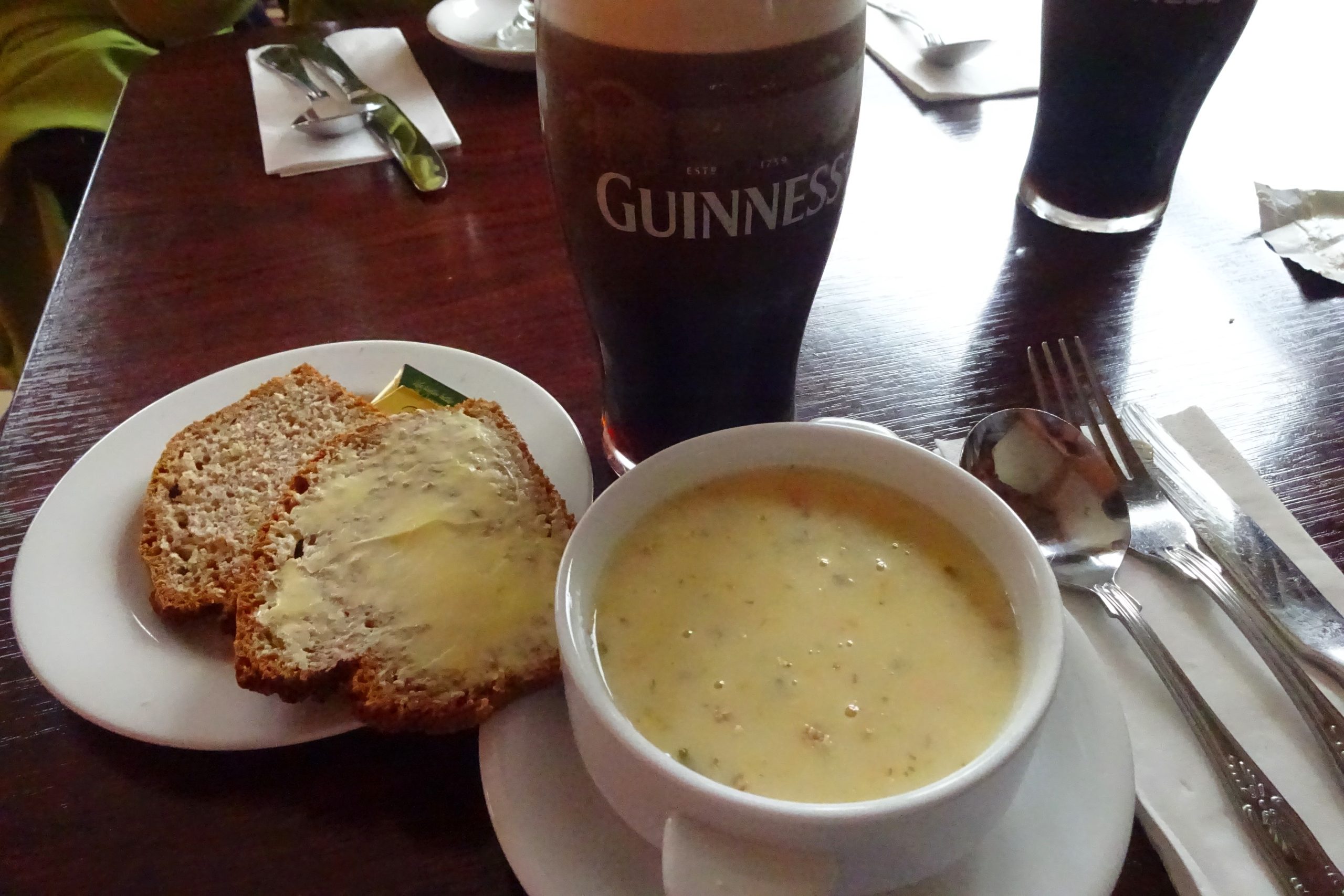
The chowder itself varies by county and by cook. Along the Wild Atlantic Way, you’ll find versions loaded with prawns, haddock, mussels, and clams — whatever came in that morning. The bread is typically a dense, wheaten loaf baked fresh on site. When the bowl is hollowed out and filled, the inner wall absorbs the broth and becomes part of the meal. You eat the bowl.
Places to try it: Garvey’s Inn in Dingle, the Harbour Bar in Howth, and the Pantry and Corkscrew in Westport are all known for their versions. Prices range from €10–€16 depending on location. It’s a working lunch dish, not a special-occasion one, which is part of why it works so well.
Seaweed on the Menu
Dillisk (also spelled dulse) is a dark red seaweed harvested from Irish coastal rocks. Bladderwrack, sea lettuce, and carrageen moss are also common along the Irish coastline. For centuries, coastal communities used seaweed as a food source, fertiliser, and medicine. Modern Irish chefs have brought it back into restaurants in ways that surprised even Irish diners.
At Aniar in Galway — a Michelin-starred restaurant committed to west of Ireland ingredients — seaweed appears in butter, in bread, and as a seasoning for meat and fish. JP McMahon, the chef and owner, has been central to the argument that Irish cooking should use what grows and swims in Ireland, not just what’s flown in from France or Spain.
You don’t need a Michelin-starred budget to try seaweed dishes. Coastal gastropubs and seafood bars in Connemara, Sligo, and Clare regularly incorporate local seaweed into their menus, often as a finishing salt or a garnish for oysters. Galway oysters with a dillisk dressing cost around €14–€18 for a half-dozen at most harbour-side spots.
Boxty: The Potato Dish You Haven’t Tried
Most visitors to Ireland know about colcannon (mashed potato with kale or cabbage) and champ (mashed potato with spring onions). Far fewer have heard of boxty, which is a Leitrim and Cavan speciality — a potato pancake made from a mix of raw and mashed potato.
The traditional version is a thick, flat pancake that’s fried in butter and served as a side. Modern versions are thinner, softer, and used as a wrap or base for fillings. In Dublin, the Boxty House on Temple Bar has been serving it since 1989. Their menu uses boxty as a wrapping for beef, chicken, bacon, and seafood — folded over and served with sides. It’s a different thing entirely from what you’d get in a Leitrim farmhouse kitchen, but both are worth trying.
Outside of the dedicated boxty restaurants, you’ll find it as a side or starter in traditional Irish pubs that still make their own bread and potato dishes. Ask specifically for it — it won’t always be on a printed menu.
Irish Butter, Served as a Course
Ireland produces some of the most consistently well-regarded butter in the world. Kerrygold is the most famous export, but within Ireland you’ll find farmhouse butters from small producers in Tipperary, Wexford, and Cork that don’t travel well enough to export.
In higher-end Dublin and Cork restaurants, butter has become a course in itself. House-churned cultured butter, served with a fermented crust or sprinkled with sea salt and herbs, arrives before the bread. It sounds like a minor thing. It isn’t. At Chapter One in Dublin (two Michelin stars), the bread and butter service is discussed in reviews alongside the main courses. At Dede restaurant in Baltimore, County Cork, the butter is made with the restaurant’s own cultured cream and has a tang that tastes nothing like anything you’d buy in a supermarket.
If you’re visiting creameries or farm shops — at Caulfield’s in Bandon or Sheridan’s Cheesemongers in Galway, for example — you can buy butter to take away. Keep it cold; it doesn’t last long once opened.
Planning an Ireland trip? Our free newsletter covers the restaurants, food festivals, and local markets worth building your itinerary around.
The Foraged Tasting Menu
A number of Irish restaurants now run tasting menus built around foraged ingredients — not as a gimmick, but because the Irish countryside, coastline, and hedgerows are genuinely abundant. Wild garlic in April and May, elderflower in June, blackberries and sloes in autumn, wood sorrel year-round in damp woodland.
The Wild Honey Inn in Lisdoonvarna, County Clare, is one of the most consistently talked-about spots for this kind of cooking. It holds a Michelin star and operates as a pub with rooms — which means the tasting menu sits alongside a pint of Guinness and a log fire. The menu changes with what’s available locally, so you cannot predict what you’ll eat until you sit down.
For something more accessible, the Saturday food market at Coal Quay in Cork or the English Market in Cork city has stalls run by small producers and foragers selling ingredients you can cook yourself, or simply eat on the spot.
Pig’s Head and Offal: The Old Menu Making a Return
Traditional Irish cooking used every part of the animal. Crubeens (pig’s trotters), pig’s head, blood pudding, lamb’s kidneys, and tripe all appear in old Irish cookbooks and farmhouse kitchens. Much of this disappeared from restaurant menus during the 20th century as food culture became more conservative. It’s coming back.
At Ox in Belfast — one Michelin star — offal and secondary cuts appear regularly on the menu, prepared with the same care as prime cuts. In Cork, Nash 19 serves black pudding from Clonakilty, one of the best-known Irish producers, as a breakfast and lunch staple. Clonakilty black pudding is made with oats and pork blood; it’s richer and more textured than most European versions.
If you want to try crubeens — the boiled, sometimes braised pig’s trotters that were once a staple of Cork night markets — they’re harder to find on restaurant menus now, but you can occasionally get them at food festivals like Cork on a Fork Fest in August or through butchers in the English Market who still prepare them to order.
Where to Eat: A Practical Starting Point
Ireland’s Michelin-starred restaurants offer the most technically creative food in the country, but the memorable eating isn’t limited to them — Kinsale makes its own case as Ireland’s food capital without a single star. Here’s a practical breakdown by region:
- Dublin: Chapter One (Parnell Square, fine dining), The Woollen Mills (Ormond Quay, casual modern Irish), The Fumbally (Fumbally Lane, daytime café with changing seasonal menu)
- Galway: Aniar (Dominick Street, tasting menu), Cava Bodega (Middle Street, JP McMahon’s Spanish tapas), Kai Café and Restaurant (South William Street, relaxed and seasonal)
- Cork: Nash 19 (Princes Street, daily specials board), Dede (Baltimore, southwest coastal ingredients), Farmgate Café (English Market, upstairs above the market stalls)
- Clare and the Wild Atlantic Way: Wild Honey Inn (Lisdoonvarna), Vaughan’s Anchor Inn (Liscannor, fish from the boats outside), Monks Pub (Ballyvaughan, mussels and oysters)
Booking is strongly recommended for dinner at any of the places above, particularly in summer (June–August) and around bank holiday weekends. Walk-ins at lunchtime are more likely to succeed. Most of the casual spots don’t take evening bookings and operate on a first-come, first-served basis.
Food Festivals Worth Planning Around
If you want to try a wide range of Irish food in one place, the major food festivals are worth building a trip around:
- Galway International Oyster and Seafood Festival — late September, one of the longest-running food festivals in Europe. The World Oyster Opening Championship takes place here.
- Taste of Dublin — June (Merrion Square in 2026). Chefs from top Dublin restaurants do short menus in a park setting.
- Dingle Food Festival — early October, in Dingle, County Kerry. Local producers, seafood, and live music.
- Cork on a Fork Fest — mid-August, centred on the English Market and surrounding venues.
Tickets for festival food events sell out early. Check each festival’s own website for exact dates and booking, as they vary by year.
Never miss an Irish food festival, market, or seasonal food guide. Subscribe free to our Ireland newsletter and we’ll keep you posted.
Irish food has been underrated for a long time. That’s changing. The creative dishes coming out of Irish kitchens — whether it’s a bowl of chowder you eat with a spoon and then with your hands, or a seaweed-cured piece of fish with foraged herbs — are the kind of meals that answer the question honestly: yes, this was the most interesting food I was served on this trip.
☘️ Join 64,000+ Ireland Lovers
Every weekday morning, get Ireland’s hidden gems, local secrets, and travel inspiration — the kind you won’t find in any guidebook.
Subscribe free — enter your email:
Already subscribed? Download your free Ireland guide (PDF)
📲 Know someone who’d love this? Share on WhatsApp →
Love more? Join 43,000 Scotland lovers → · Join 29,000 Italy lovers → · Join 7,000 France lovers →
Free forever · Unsubscribe anytime
Tours & experiences you might love


Powered by Viator. Some links are affiliate links — we may earn a small commission at no extra cost to you.
Secure Your Dream Irish Experience Before It’s Gone!
Planning a trip to Ireland? Don’t let sold-out tours or packed attractions spoil your journey. Iconic experiences like visiting the Cliffs of Moher, exploring the Rock of Cashel, or enjoying a guided walk through Ireland’s ancient past often sell out quickly—especially during peak travel seasons.

Booking in advance guarantees your place and ensures you can fully immerse yourself in the rich culture and breathtaking scenery without stress or disappointment. You’ll also free up time to explore Ireland’s hidden gems and savour those authentic moments that make your trip truly special.
Make the most of your journey—start planning today and secure those must-do experiences before they’re gone!