

On the afternoon of 18 May 1889, at the North of Ireland Cricket Club grounds in Belfast, a man named Willie Hume lined up for a race he had no real business winning. Hume was the captain of the Belfast Cruisers Cycling Club — a club, not a racing stable — and he was up against riders who were faster, stronger, and considerably more decorated than he was. Among them were two sons of Harvey du Cros, the president of the Irish Cyclists’ Association, who had organised his six boys into a competitive team he called The Invincibles.
Hume won all four events. The Invincibles came nowhere. And the man who noticed this most keenly — and understood exactly what it meant — was standing on the touchline watching his sons lose.
The Man with the Sporting Eye
Harvey du Cros had been born in Dublin in 1846 to a family of French Huguenot descent. He was educated at The King’s Hospital in the city, and he had gone on to become the kind of Victorian Irishman who resists easy categorisation. He had been Ireland’s boxing champion at two weights. He had been Ireland’s fencing champion. He had captained an Irish rugby team to the national championship. He understood competition from the inside, and he understood talent — and watching his boys lose that May afternoon, he saw something he couldn’t explain by talent alone.
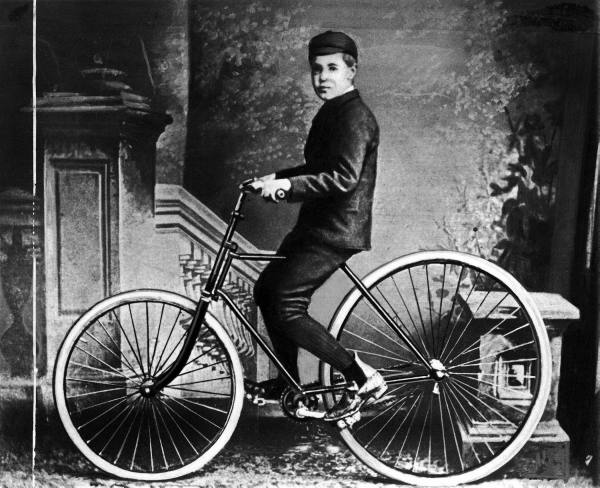
Hume, it emerged, was riding on something new. John Boyd Dunlop, a Scottish-born veterinary surgeon living in Belfast, had fitted Hume’s bicycle with inflated rubber tubes — pneumatic tyres — that Dunlop had developed in his own backyard just eighteen months earlier. To look at, they were almost comically simple. But on a cobbled Victorian street, or a racing circuit, they absorbed shock and reduced rolling resistance in ways that solid rubber wheels simply could not match. Hume rode on air, in the most literal sense, and the difference showed.
The Vet with the Garden Hose
Dunlop had come to Ireland in 1867, setting up a veterinary practise in Downpatrick before eventually relocating to Belfast. By the mid-1880s, his practise was among the largest in Ireland — he was not short of patients. He was also not an engineer, not a chemist, not a manufacturer. He was a vet who, in October 1887, watched his young son complain about the discomfort of riding his tricycle across Belfast’s hard cobbled streets.
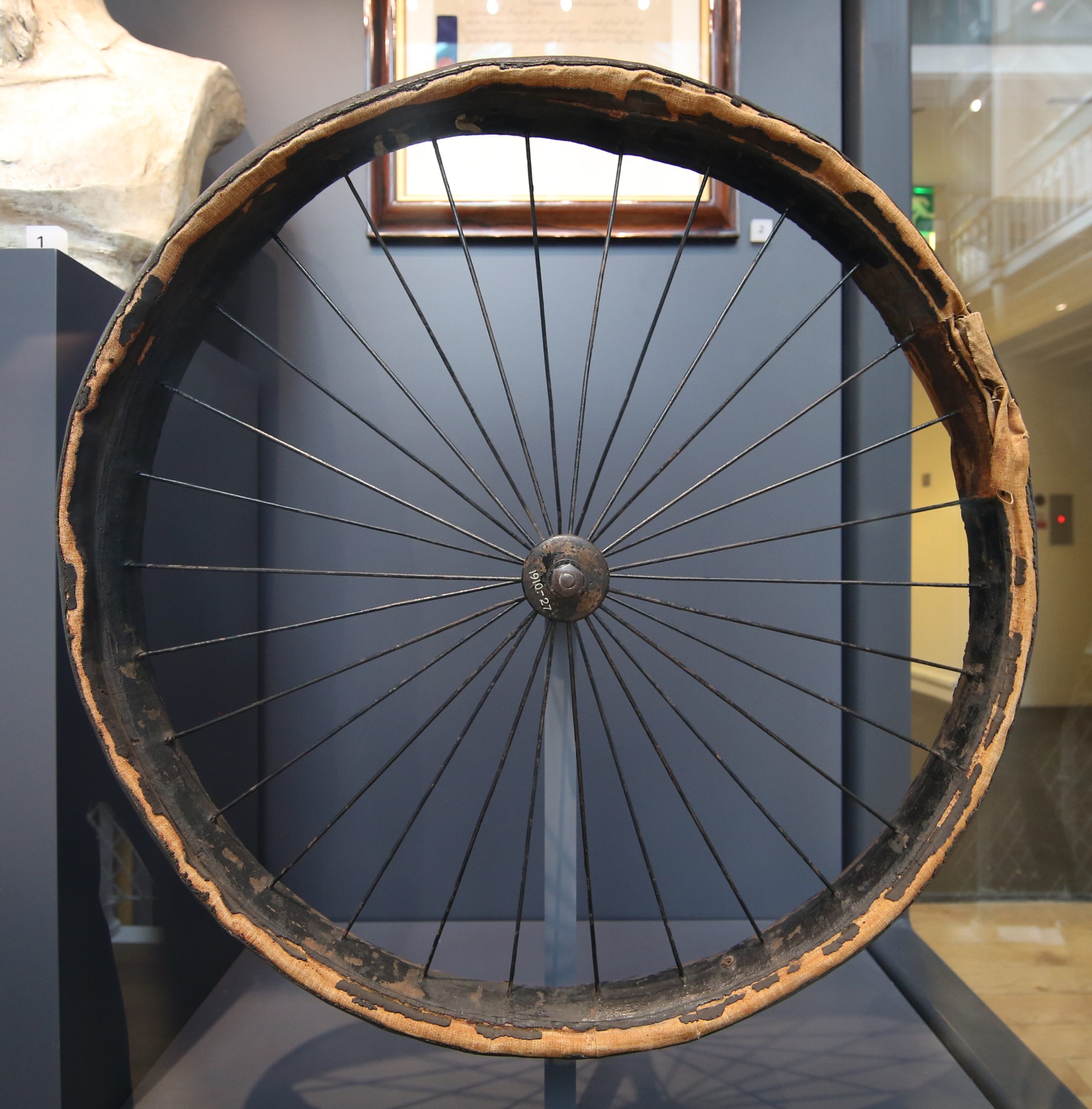
What Dunlop built in response was crude but effective: an inflated rubber tube, fastened to a wooden disc ninety-six centimetres across, with a strip of linen. He tested it at Cherryvale sports ground in south Belfast in February 1888. The result rode smoother and faster than anything he had seen. On 7 December 1888, the British patent was granted.
There was, however, a flaw in the patent that nobody would discover for another two years: it was invalid. A Scottish inventor named Robert William Thomson had patented the same concept in France in 1846 and in the United States in 1847. Thomson’s version had never caught on commercially — the vulcanised rubber it required was expensive and the manufacturing capacity simply wasn’t there — and his patents had long since lapsed. But the prior art was real, and when Dunlop was officially informed of it, the company he had helped found was already well underway. The legal question had become, by then, almost irrelevant. The commercial question had already been answered.
The Deal Made at the Racetrack
Harvey du Cros did not need an engineer’s assessment to understand what he had seen at the North of Ireland Cricket Club that May afternoon. He contacted Dunlop directly. He moved quickly to acquire the rights to Dunlop’s pneumatic tyre system, paying £3,000 for the patent. Then, on 18 November 1889, du Cros and Dunlop co-founded the Pneumatic Tyre and Booth’s Cycle Agency in Dublin — incorporating the Belfast firm Edlin and Co. and Dublin-based Booth Brothers into a single operation. Dunlop held a twenty per cent stake in the new venture. Du Cros, with his financial instincts and his connections in Irish business circles, floated the company’s shares and kept the arrangements firmly under his own control.
By late 1890, the firm had begun producing cycle tyres in Belfast. The following year, manufacturing shifted to Coventry — partly because Dublin Corporation had lodged complaints about the smell of rubber processing — but the company’s origins, its founders, its first registered address, remained thoroughly Irish.
Willie Hume, meanwhile, had already taken the technology to England. In 1889, riding at a meeting in Liverpool, he won three of four events — introducing pneumatic tyres to an English racing audience for the first time. By 1938, Cycling Weekly would award him his own page in the Golden Book of Cycling, recognising what his victories had set in motion.
The Boom That Built the Company
Du Cros’s timing was, to put it plainly, extraordinary. The bicycle industry of the late 1880s was already accelerating. In 1885, J. K. Starley had introduced the Rover safety bicycle — the chain-driven, two-equal-wheeled design we would recognise today — and it had democratised cycling for ordinary people in a way the old high-wheeled penny-farthing never could. What the pneumatic tyre did was make cycling genuinely comfortable. The two inventions together were like a locked door and a key finding each other at exactly the right moment.
Between 1889 and 1899, global bicycle production rose from an estimated two hundred thousand machines a year to over one million. By the mid-1890s, estimates of the number of cyclists in the United States alone ranged between two and four million. Britain, Ireland, France, Germany, and the Low Countries were all caught up in what contemporaries called the cycling craze. Clubs formed in every major city. Cycling schools opened to teach new riders. The bicycle was, for a brief and breathless decade, the defining technology of modern life — and almost every bicycle in the world rolled on an innovation developed in a Belfast backyard.
The Sons Go to Work
Du Cros, with six sons and a growing business, made a decision that would prove to be his masterstroke. He sent the boys abroad. Alfred, Frederick, Arthur, Harvey, William, and George du Cros became the company’s international scouts and representatives, dispatched to France, England, Belgium, Canada, North America, and South America to develop Dunlop’s presence in each new market. The company’s overseas expansion was, in a very real sense, a family operation — the du Cros sons as a distributed commercial network, their father’s reputation and relationships opening doors that advertising could not.
There was also a structural logic to this strategy that du Cros understood well. Foreign patents could only be maintained if the company was actively manufacturing in the countries where the tyres were sold. This compelled local production in each territory — and local production meant local presence, local supply chains, local expertise. A company founded in a Dublin office in November 1889 was driven, by the mechanics of international intellectual property law, to become a genuinely global manufacturer. What might have remained a British curiosity became, within a decade, a worldwide industrial concern.
Three Thousand Pounds to Three Million
In 1896, Harvey du Cros sold the company he had built — the Pneumatic Tyre concern, born of a £3,000 patent acquired at a Belfast racetrack — to a financier named Ernest Terah Hooley for £3 million. Hooley, who made a career of acquiring businesses and relaunching them on the public markets at a premium, immediately refloated the firm as the Dunlop Pneumatic Tyre Company and sold it again for £5 million. The profit to Hooley’s syndicate, including du Cros’s share, was £1.7 million.
To frame that: the original patent had cost three thousand pounds. The sale price was one thousand times that figure. Du Cros had taken a sporting instinct — the recognition, in a single afternoon at a Belfast cricket ground, that a new technology was about to change everything — and turned it into one of the largest commercial transactions in late Victorian Britain.
He stayed on as chairman of the newly refloated Dunlop Pneumatic Tyre Company. He went on to acquire distribution rights for Panhard and Levassor automobiles across Britain, Ireland, and the colonies, positioning himself — true to character — at the front edge of whatever came next. He died at his home in Dalkey, County Dublin, in December 1918, having moved from boxing rings to boardrooms to the House of Commons, where he briefly served as Member of Parliament for Hastings.
The Inventor’s Footnote
John Boyd Dunlop did not share in any of this. He resigned from the company in 1895, the year before the great sale, and sold most of his remaining stake. As his entry in the Dictionary of National Biography records with a certain quiet sadness, he “did not make any great fortune by his invention.” He went on living in Dublin, where he had spent the last decades of his life, and died there in 1921 at the age of eighty-one — his name on every tyre in Europe, his pockets comparatively light.
The company he had helped to launch was, by then, becoming something almost unrecognisably vast. By 1927, Dunlop controlled ninety per cent of British tyre production, with twelve thousand workers at the Castle Bromwich factory alone. By 1946, the company employed seventy thousand people worldwide, with a commercial presence in nearly every country on earth. The first rubber tube, fitted to a wooden disc on a Belfast street in the autumn of 1887, had become one of the great industrial empires of the twentieth century — manufacturing car tyres, aircraft tyres, and eventually golf balls, spreading from the company’s Dublin origins across six continents.
What is worth sitting with, looking back, is how much of this turns on a single afternoon in Belfast: a less-fancied rider winning four races, a father watching his sons lose, and a sporting instinct sharp enough to see in that defeat not a disappointment but an opportunity. The cycling revolution that transformed how people moved through the world — across Europe, across America, across routes that would later be paved for the cars du Cros would also help to bring — had its commercial birthplace not in Birmingham or London or Paris, but in a Dublin office in the last weeks of 1889, because a man who had won boxing championships and fencing titles understood, in his bones, what it looked like when a new technology simply outran everything that had come before it.
Ireland’s contribution to that revolution tends to be remembered, if at all, as a footnote about a Scottish vet and a rubber tube. The full story is considerably more interesting than that.
It sits alongside a handful of other quietly overlooked Irish exports — a baby wipe formulated in a Mayo garage that now ships to more than fifty countries, or the engineering problem Guinness spent thirty years solving inside a beer can — small, unglamorous breakthroughs that ended up changing how the rest of the world moved, drank, or raised its children.
☘️ Join 64,000+ Ireland Lovers
Every Friday, get Ireland’s hidden gems, local secrets, and travel inspiration — the kind you won’t find in any guidebook.
Already subscribed? Download your free Ireland guide (PDF)
Free forever · One email per week · Unsubscribe anytime
Tours & experiences you might love


Powered by Viator. Some links are affiliate links — we may earn a small commission at no extra cost to you.
Secure Your Dream Irish Experience Before It’s Gone!
Planning a trip to Ireland? Don’t let sold-out tours or packed attractions spoil your journey. Iconic experiences like visiting the Cliffs of Moher, exploring the Rock of Cashel, or enjoying a guided walk through Ireland’s ancient past often sell out quickly—especially during peak travel seasons.

Booking in advance guarantees your place and ensures you can fully immerse yourself in the rich culture and breathtaking scenery without stress or disappointment. You’ll also free up time to explore Ireland’s hidden gems and savour those authentic moments that make your trip truly special.
Make the most of your journey—start planning today and secure those must-do experiences before they’re gone!