

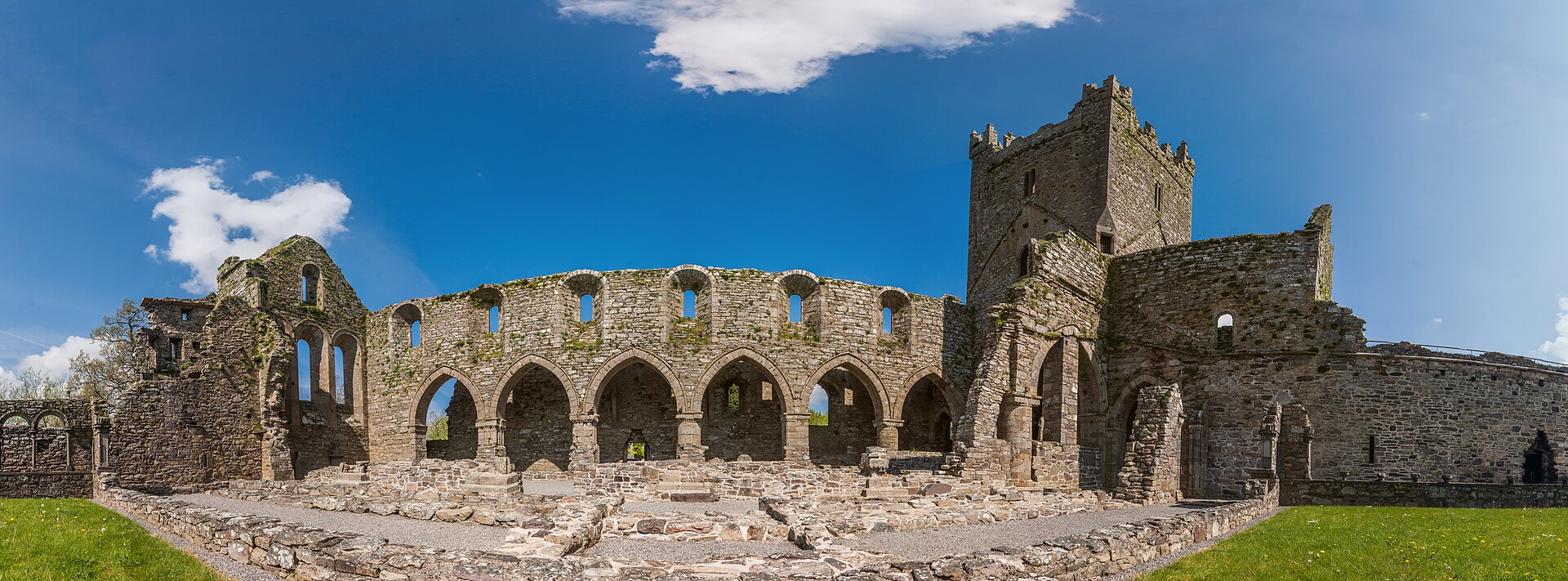
Jerpoint Abbey stands near Thomastown, County Kilkenny, as one of the finest examples of medieval monastic architecture in Ireland. Founded in the 12th century and once home to a community of Cistercian monks, the site has survived centuries of change and now draws thousands of visitors each year. Its combination of intact stonework, exceptional carvings, and a well-preserved crossing tower sets it apart from many other abbey ruins across the country.
If you are planning a trip to County Kilkenny, Jerpoint Abbey is worth making time for. This guide covers the history of the site, what you will see on a visit, practical visitor information, and what else to explore nearby.
Love Ireland’s hidden gems? Get weekly guides to the best places in Ireland — from medieval ruins to coastal drives — delivered straight to your inbox. Subscribe to our free newsletter.
The History of Jerpoint Abbey
Jerpoint Abbey was founded around 1160 by Domnall Mac Gilla Pátraic (also spelled MacGillapatrick), King of Osraige. The site was initially established as a Benedictine monastery before being transferred to the Cistercian order around 1180, when Donogh Mac Gilla Pátraic, King of Ossory, brought Cistercian monks to the site.
The abbey grew in influence during the medieval period, receiving grants of land from Anglo-Norman lords who had settled in Kilkenny after the 12th-century invasion. The church was built in stages between the late 12th and 15th centuries, which explains the mix of Romanesque and Gothic architectural styles visible in the ruins today.
Like many Irish monasteries, Jerpoint was dissolved during the Dissolution of the Monasteries under Henry VIII in 1540. The lands and buildings passed into private ownership. The structures were never entirely demolished, however, and enough has survived to give a clear picture of what a medieval Cistercian community looked like.
Today, the site is managed by the Office of Public Works (OPW) and is a national monument. Guided tours are available during the main visiting season and are recommended, as they bring the carvings and architectural details to life in a way that is difficult to appreciate on your own.
The Crossing Tower
One of the most striking features of Jerpoint is the crossing tower, which rises from the point where the nave and transepts of the church meet. This tower is largely intact, which is unusual for an Irish monastic ruin of this age. Most abbey towers were dismantled over the centuries for building material or simply fell due to neglect. At Jerpoint, the tower has survived with its crenellated battlements still in place, giving the ruin a dramatic silhouette against the Kilkenny sky.
The church itself dates primarily from the late 12th century. The nave is roofless, as is typical for ruins of this period, but the walls stand to full height in many sections. The Romanesque-style windows and doorways are well preserved and show the quality of craftsmanship that went into the original construction.
Standing inside the roofless nave and looking up through the arch at the crossing tower is one of those views that stays with you. It is the kind of place where it is easy to understand why so many people find Irish ruins compelling.
The Cloister and Its Carvings
The cloister at Jerpoint is the highlight of most visits. It dates from the late 15th century and is decorated with a remarkable series of carved figures. Knights, ladies, bishops, apostles, and mythical creatures are all represented in the stonework of the cloister arcade. The carvings are unusually detailed and expressive by medieval standards, and many of the figures retain clear features despite centuries of exposure to the elements.
The style of carving at Jerpoint is sometimes called the “Ossory School,” as it appears at several sites across the broader Kilkenny region from the same period. The figures represent a mix of religious subjects and secular characters, which gives some insight into the culture and concerns of medieval Irish society.
Some of the most frequently discussed figures in the cloister are the carved knights, depicted in full armour with swords and shields. These are thought to represent benefactors of the abbey rather than monks, which was a common way of honouring wealthy patrons in medieval times.
Want more like this? Our newsletter goes out weekly with Ireland travel guides, history articles, and local tips — all free. Join thousands of Ireland lovers here.
Tomb Effigies
Jerpoint contains an impressive collection of medieval tomb effigies — carved stone representations of the deceased, placed on or into tomb slabs. These include effigies of bishops, abbots, knights, and their consorts. Some of the finest examples are located inside the church, where the combination of shelter and the quality of the original stone has helped preserve the detail.
The effigies offer a direct connection to the people who lived and died in medieval Kilkenny. The bishops are shown in full vestments with mitres and crosiers; the knights in armour with crossed legs, a convention once thought to indicate a Crusader but now understood as simply a stylistic choice of the period.
One of the more unusual stories attached to Jerpoint is the local tradition that St Nicholas — the historical Bishop of Myra who inspired the legend of Santa Claus — is buried somewhere on the site. The story goes that Crusaders returning from the Holy Land brought his relics to Jerpoint in the 13th century. There is no firm historical evidence for this claim, but the tale is well-known locally and adds an unexpected dimension to a visit.
Practical Visitor Information
Jerpoint Abbey is located just outside Thomastown on the R448, approximately 2.5 kilometres south-west of the town centre. Thomastown is easily reached from Kilkenny city, which is about 18 kilometres to the north. The journey by car takes around 25 minutes. There is car parking at the abbey site.
The site is managed by the OPW and is open seasonally, generally from early March through early December (in 2026: 5 March – 2 December), though exact opening hours and dates vary by season and year. Check the OPW website (heritageireland.ie) before travelling, as hours can change. Admission is charged — around €5 for adults, with reduced rates for seniors, students, and children, and a family ticket available; holders of the OPW Heritage Card can enter free of charge. Guided tours are available during opening hours and add considerable value to a visit.
The site is not fully accessible for visitors with mobility difficulties, as parts of the ground are uneven and some areas involve steps. The main areas of the church and cloister can be reached without significant climbing, however.
Plan to spend at least an hour on site, and longer if you take a guided tour. There is a small interpretive display near the entrance that provides useful background on the history of the abbey before you explore the ruins.
What’s Nearby
Thomastown itself is a pleasant market town with a good selection of cafés and restaurants, making it an easy base for a half-day trip from Kilkenny city. The town also has its own medieval remains, including the ruins of Jerpoint Church and sections of the old town wall.
Kilkenny city is the obvious base for a longer stay in the area. The city has a wide range of accommodation and is home to Kilkenny Castle, the Black Abbey, St Canice’s Cathedral, and the Medieval Mile Museum. The Kilkenny countryside also contains several other significant medieval sites. Kells Priory, about 15 kilometres from Jerpoint, is another outstanding ruin — and has the advantage of being freely accessible at all times.
The Rock of Cashel in County Tipperary is about 60 kilometres to the south-west (roughly a 50-minute drive) and makes for a full-day pairing with Jerpoint if you are keen to cover a lot of medieval ground in one trip.
Tips Before You Go
- Book a guided tour if possible — the carvings in the cloister make far more sense with expert commentary.
- Wear sturdy footwear. The ground inside the ruins can be uneven, particularly after rain.
- Bring a camera. The crossing tower framed through the cloister arches is one of the most photographed views in Kilkenny.
- Check the OPW website for current opening times and ticket prices before you travel.
- Combine the visit with Kells Priory for a full day of medieval Kilkenny history.
- If travelling by public transport, Thomastown has a train connection from Kilkenny city and Waterford city. The abbey is roughly a 30-minute walk from the station, or a short taxi ride.
Planning a trip to Ireland? Our free weekly newsletter is full of practical guides, insider tips, and the kind of detail you won’t find in a generic travel site. Sign up here — it’s free.
Frequently Asked Questions About Jerpoint Abbey
When is Jerpoint Abbey open, and how much does admission cost?
Jerpoint Abbey is managed by the Office of Public Works (OPW) and is generally open from early March to early December each year. Adult admission is around €5, with reduced rates for seniors, students, and children; holders of the OPW Heritage Card enter free of charge.
What makes Jerpoint Abbey special compared to other Irish monastic ruins?
Jerpoint is distinguished by its near-intact medieval crossing tower — a rare survival among Irish ruins of this age — and by the outstanding quality of the carved figures in its 15th-century cloister arcade. The distinctive Ossory School style of carving, depicting knights, bishops, and mythical creatures in expressive detail, is found at only a handful of sites in the Kilkenny region.
How old is Jerpoint Abbey, and who founded it?
Jerpoint Abbey was founded around 1160 by Domnall Mac Gilla Pátraic, King of Osraige, initially as a Benedictine monastery before being transferred to the Cistercian order around 1180. The abbey flourished through the medieval period and was dissolved under Henry VIII in 1540, leaving behind more than 800 years of stonework that visitors can explore today.
Why Jerpoint Abbey Is Worth the Visit
Jerpoint Abbey does not have the same name recognition as Kilkenny Castle or the Rock of Cashel, but it arguably offers a richer experience for those with an interest in medieval history. The carvings are outstanding, the ruins are extensive, and the crossing tower gives the site a presence that many better-known ruins lack.
It is one of those places where the sheer survival of 800 years of stone carving makes the medieval world feel close. The monks who built this place, the lords who funded it, and the craftsmen who carved those figures in the cloister are long gone — but what they made has lasted, and it is very much worth seeing.
Featured image: Photo by Johannes Rössel / Wikimedia Commons (CC BY 4.0).
☘️ Join 64,000+ Ireland Lovers
Every weekday morning, get Ireland’s hidden gems, local secrets, and travel inspiration — the kind you won’t find in any guidebook.
Subscribe free — enter your email:
Already subscribed? Download your free Ireland guide (PDF)
📲 Know someone who’d love this? Share on WhatsApp →
Love more? Join 43,000 Scotland lovers → · Join 29,000 Italy lovers → · Join 7,000 France lovers →
Free forever · Unsubscribe anytime
Tours & experiences you might love


Powered by Viator. Some links are affiliate links — we may earn a small commission at no extra cost to you.
Secure Your Dream Irish Experience Before It’s Gone!
Planning a trip to Ireland? Don’t let sold-out tours or packed attractions spoil your journey. Iconic experiences like visiting the Cliffs of Moher, exploring the Rock of Cashel, or enjoying a guided walk through Ireland’s ancient past often sell out quickly—especially during peak travel seasons.

Booking in advance guarantees your place and ensures you can fully immerse yourself in the rich culture and breathtaking scenery without stress or disappointment. You’ll also free up time to explore Ireland’s hidden gems and savour those authentic moments that make your trip truly special.
Make the most of your journey—start planning today and secure those must-do experiences before they’re gone!