

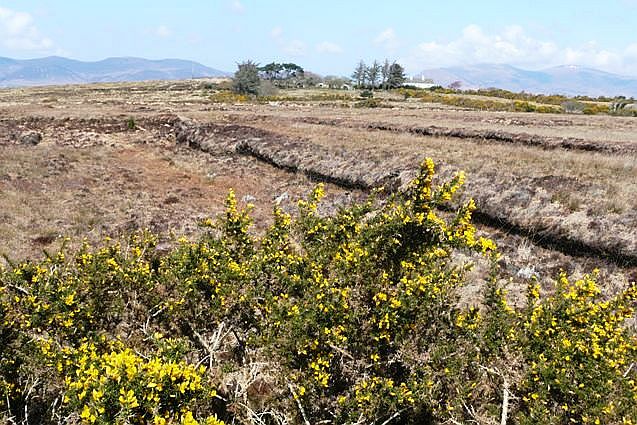
Katie Donnelly owed her life to a Christmas visit. Sometime in the final days of December 1896, she left the family home at Knocknageeha on the Cork-Kerry border to stay with her grandmother a few miles away. It was the kind of ordinary decision that gets made a thousand times over the Christmas period — a young teenager, a grandmother, a change of plans.
On the night of December 27th, while Katie slept safely elsewhere, the ground beneath her family’s cottage came alive.
By the time morning broke on December 28th, her father Cornelius, her mother Johanna, and all six of her brothers and sisters had been killed — swept away in their sleep by something that had no dramatic name in 1896, and that still barely registers in the national memory today. Not a flood. Not a landslide in any conventional sense. Something older, and weirder, and more particular to Ireland than almost anything else in the natural world.
A moving bog.
What the ground is doing underneath your feet
To understand what happened at Knocknageeha, you first have to understand what a bog actually is — not the romantic version, the haunt of poets and ancient bodies, but the hydraulic reality.
Irish blanket bog, the type that covers hundreds of thousands of acres across the west and southwest of the island, is not solid ground. It is a mass of partially decomposed plant material that has been building up, layer upon layer, for thousands of years in conditions too wet for the dead matter to fully rot away. At depth, the oldest, most humified layers — what scientists call the “catotelm” — are essentially liquid. Research on Irish blanket peat has measured water content at between 450 and 990 percent by mass. The volumetric water content, which measures how much of any given sample is water rather than solid material, runs between 0.88 and 0.97. Nearly all water. Almost no solid.
Sitting on top of those layers is the surface crust: the living or recently-dead sphagnum moss that looks and feels like solid ground. On a relatively flat, stable hillside, the surface crust holds everything together. The liquid basal layer stays put. But that arrangement is contingent — on slope angle, on drainage, on the weight of water above, on the integrity of the surface skin. Change enough of those variables at once, and the whole system can fail catastrophically.
What happens next is not a slow seeping of water. It is a rupture. The surface crust tears. The semi-liquid basal peat — which has been sitting under pressure, essentially waiting — evacuates through the breach and pours downhill. Researchers describe the failure as similar to the sudden collapse of a dam, except the dam is made of vegetation and the water behind it is black, viscous, and carries everything in its path.
This is what is called a bog burst. And Ireland, because of its climate, its topography, and its particular type of deep blanket peat, is one of the very few places on earth where they happen.
A summer too dry, an autumn too wet
The conditions that built toward the Knocknageeha disaster had been accumulating for months. The summer of 1896 had been unusually dry — which matters, because a dry bog contracts. The surface crust cracks, and those cracks become weak points. When the wet autumn arrived, rainfall began filling the sub-surface faster than it could drain away, raising the pressure in the basal layers. By late December, the bog was saturated, the surface was compromised, and the slope — shallow but real — was loaded with an enormous mass of liquid waiting for a trigger.
The trigger came on the evening of December 27th. A heavy downpour arrived from the south-east, accompanied by a gale. Sometime between two and four in the morning of December 28th, more than 200 acres of upland bog on the hillside at Knocknageeha — the name translates from Irish as “Hill of the Winds” — gave way.
Residents in nearby homes were woken by what contemporary accounts described as a sound like distant thunder that seemed to shake the earth beneath them. But there was no thunder that night. What they heard was the bog.
The Donnelly family
Cornelius Donnelly — known locally as Con — worked as a quarry-man and bog ranger for the Earl of Kenmare, one of the great Kerry landowners of the era. He and his wife Johanna had built their lives in the shadow of Knocknageeha, raising their family in the townland of Gneeveguilla, on the border where Kerry meets Cork.
That night, eight of them were home: Con, Johanna, and six children including a baby of about eighteen months. When the bog burst above them and began moving in a southerly direction down the valley of the Owencree River, their cottage was directly in its path. The structure — and everyone inside it — was overwhelmed and carried away by the moving peat mass.
Only Katie survived. She was not there.
Recovery of the bodies was painstaking and grim work. Five were found by January 3rd, 1897, as the main mass of moving peat slowed and came to a standstill. The rest — including children named Daniel, Hannah, Humphrey, Lizzie, and James — were recovered over the following months, the last not until July 1897, half a year after the night itself.
Katie’s portrait was later published in the Australian Town and Country Journal in May 1897. The image of the young girl who had simply gone to visit her grandmother became one of the disaster’s few surviving human faces.
What 200 acres of bog does when it moves
For those not in the direct path of the Donnelly cottage, survival came down to geography and luck. The bog flowed south, cutting through the valley like something with purpose. At the cottage of Jeremiah Lyne, the peat mass rose five feet against the outside walls before stopping short of demolishing it. Two pits of potatoes belonging to a widow named Brown at Mausrower were taken away entirely. Two local men — a Kelliher of Lacka and a Cronin of Reboy — nearly became lost that night bringing cattle to a fair, finding the roads around them transformed by the moving peat. At the house of a Mr. Morgan McSweeney near the Quarry Lodge, roughly twenty acres of his land was buried before the bog came to rest.
Downstream, the material entered the Owencree River, then flowed into the River Flesk, a tributary of the lower lake of Killarney, ten miles away. A limestone quarry along the route was filled completely. Forty-five families in the area suffered losses of one kind or another; twelve tenant farmers collectively estimated their losses at around £400, and eight of those were reportedly ruined.
The bog, it turned out, had been giving warnings for years. Locals had noticed that the ground “trembled” when walked upon — a sign that the surface crust was floating, essentially, on the liquid mass beneath. Extensive turf cutting had weakened the bog’s structural integrity, and there was no drainage system in place to relieve the pressure building below. The disaster had not been unforeseeable. It had simply not been foreseen.
The scientists show up
Within weeks of the disaster, the scientific community had taken notice. Nature magazine published a detailed account of the “Bog-Slide of Knocknageeha, in the County of Kerry” in early 1897, making it one of the first bog burst events to receive serious scientific documentation. Contemporary investigators described the tear in the surface crust, the evacuated peat mass, the path of destruction down the valley, and the pattern of concentric disruption in the bog above the breach point — a pattern that modern researchers now recognise as diagnostic of a bog burst rather than a conventional landslide.
The Kerry News covered the disaster from January 1st, 1897 onwards. The Boston Pilot, serving the large Irish-American community that had a keen and often painful interest in news from Kerry and Cork, ran the story in its January 16th issue under the headline “The Land Slide in Kerry, Ire.” — using the term “land slide” because English had not yet developed a better vocabulary for what a bog burst actually was.
The event entered scientific literature, and stayed there. Not since Knocknageeha, wrote researchers studying a subsequent Irish bog event more than a century later, had so much attention been paid to a bog burst. The phrase is telling. It acknowledges the 1896 disaster as the benchmark — the event against which all subsequent Irish bog failures are still measured.
They haven’t stopped
Here is what makes the Knocknageeha story something other than a historical curiosity: bog bursts in Ireland have not stopped happening.
In August 2008, a bog at Maghanknockane in the Lyrecrompane area of Kerry gave way, destroying approximately ten hectares and cutting off water supply to tens of thousands of residents in the Tralee-Castleisland area. Thousands of fish died in the Smearlagh River after peat travelled more than two miles downstream. A second slide followed just two weeks later.
In June and November of 2020, three significant peat failures occurred across Ireland. Scientific analysis of those events identified the same conditions that brought down the Knocknageeha bog in 1896: deep peat, low shear strength in the basal layers, saturated conditions following a dry period, and a trigger rainfall event. The science has only gotten more precise. The underlying geology has not changed.
A new complicating factor has emerged in recent decades: wind farm construction. Access roads cut across blanket bog remove the lateral support that holds saturated peat in place. Several recent failures have been traced, at least in part, to infrastructure development in upland bog areas — a new version of the same basic problem that turf cutting created at Knocknageeha in the 1890s. Destabilise the surface, raise the pressure, provide a wet trigger, and the bog will move.
Research published in the scientific literature has estimated roughly three significant peat failure events per decade as a long-term average across Ireland. That number is considered likely to be an undercount, both because historical events were poorly documented and because more recent failures may go unreported in remote areas. Researchers working on 2020 events noted that pandemic travel restrictions made field investigation difficult — suggesting that the monitoring of a genuinely ongoing hazard remains patchy.
The hill of the winds, now
A memorial marker stands near the site where the Donnelly cottage once was, at the point where over 200 acres of Kerry hillside came unstuck from itself on a December night and swept eight people from their lives. The name Knocknageeha is still on the map, the River Flesk still runs to the lakes of Killarney, and the upland bogs of southwest Kerry still hold the same extraordinary volumes of water in their basal layers that they always have.
Katie Donnelly went on to live her life. What became of her after the Australian newspaper published her portrait, after the Recovery teams finished their work in July 1897, the records do not clearly say. She was a young girl who went to visit her grandmother at Christmas and came back to find the world entirely changed.
The bog burst that took her family is generally absent from the way Ireland tells the story of its disasters — understandable, given everything else the country went through in the nineteenth century, but also a loss. It is not a story about human cruelty or historical injustice. It is a story about the ground itself, about an island built on a substance that is barely solid, and about what happens when the physics finally wins.
That story is still unfolding. It is, in the most literal sense, part of the landscape.
Join 169,000+ Ireland lovers
Every week, stories like this one — plus hidden gems, heritage deep-dives, and the Ireland most visitors never find.
Already subscribed? Download your free Ireland guide (PDF)
Free forever · One email per week · Unsubscribe anytime
☘️ Join 168,000+ Ireland Lovers
Every week, get Ireland’s hidden stories, heritage, and travel inspiration — delivered free to your inbox.
Subscribe free:
Tours & experiences you might love


Powered by Viator. Some links are affiliate links — we may earn a small commission at no extra cost to you.
Secure Your Dream Irish Experience Before It’s Gone!
Planning a trip to Ireland? Don’t let sold-out tours or packed attractions spoil your journey. Iconic experiences like visiting the Cliffs of Moher, exploring the Rock of Cashel, or enjoying a guided walk through Ireland’s ancient past often sell out quickly—especially during peak travel seasons.

Booking in advance guarantees your place and ensures you can fully immerse yourself in the rich culture and breathtaking scenery without stress or disappointment. You’ll also free up time to explore Ireland’s hidden gems and savour those authentic moments that make your trip truly special.
Make the most of your journey—start planning today and secure those must-do experiences before they’re gone!