

County Galway is one of Ireland’s most liveable places. It has a proper city with pubs, restaurants, and a thriving arts scene. Wild Atlantic coastline sits just 40 minutes away. And the pace of life here makes most people wonder why they waited so long to come. If you have been thinking about moving to Ireland, County Galway deserves serious consideration.
Why Galway Attracts So Many Americans
Galway is Ireland’s fifth-largest city, with around 85,000 people in the city itself and roughly 270,000 across the wider county. It sits on the west coast where the River Corrib meets Galway Bay. On a clear day you can see the Aran Islands from the Salthill promenade. Travel writers and visitors consistently name Galway one of Europe’s friendliest cities, and that reputation is earned.
Americans tend to come here for a few reasons. The city feels genuinely vibrant. There is no sense that culture and nightlife are happening somewhere else while Galway settles for second best. The Galway International Arts Festival draws performers from across the world every July — it has run since 1978. The Galway Film Fleadh is one of Ireland’s most respected film festivals. The food scene has improved dramatically over the past decade, with proper restaurants alongside the traditional chippers and pub lunches.
But the real draw is the west. Connemara starts just beyond the city limits. Kylemore Abbey is 80 km away. The Twelve Bens mountain range, the Killary Harbour fjord, and the bog roads of south Connemara all sit within easy reach for a weekend. People who move to Galway talk about the landscape as something that changes them over time. Once you have driven through Connemara in autumn fog, with turf smoke drifting across the road, it becomes very difficult to go back to anywhere flat.
🇮🇪 Discover Your Irish Heritage
Join 64,000 people staying connected to their Irish roots. Get our free Irish Ancestry Guide — surnames, counties, parish records and emigration history — when you subscribe free.
Life in Galway City
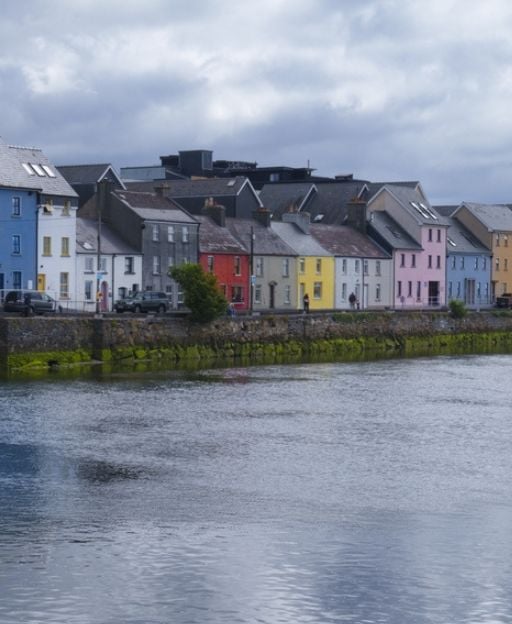
Galway city is compact and walkable. The Latin Quarter, centred on Shop Street and Quay Street, holds most of the pubs and restaurants. Colourful terraced houses line the canals. A covered market runs on Saturdays. The Spanish Arch, which dates from 1584 and once served as a loading bay for merchant ships trading with Spain, is a five-minute walk from the main shopping street.
The city has a strong university presence. University of Galway — founded in 1845 as Queen’s College Galway — enrolls around 19,000 students and runs a growing research campus. This keeps the city young and energetic in a way that smaller Irish towns are not. You will find bookshops, independent coffee shops, record shops, and a lively live music scene running through the week, not just on weekends.
The Claddagh neighbourhood, just across the Corrib from the city centre, once governed itself as an independent fishing village. The Claddagh ring — the hands holding a crowned heart — originated here. Today it offers a pleasant residential area with views across the bay and a quiet atmosphere that contrasts with the bustle of the city centre five minutes away.
Salthill, technically a suburb but very much its own place, sits 3 km from the city centre along Galway Bay. There is a long promenade, a traditional diving tower at Blackrock, and a string of restaurants and hotels facing the sea. Many American arrivals choose Salthill for its seaside character while staying close to city amenities.
The Food and Drink Scene
People take food seriously in Galway. The county sits between the Atlantic and some of Ireland’s best farmland, so the raw ingredients are exceptional. Fishermen harvest Galway Bay oysters from wild beds off Clarinbridge, around 20 km south of the city. The Clarinbridge Oyster Festival has run every September since 1954 and draws thousands of visitors each year.
The Saturday market beside St Nicholas’ Collegiate Church is one of the best food markets in the country. The church dates from 1320 and is one of the largest medieval churches still in active use in Ireland. At the market you will find Aran Island seaweed, local cheeses, freshly baked sourdough, and street food from a dozen different cuisines, all within a few hundred metres of the city centre.
Restaurants worth knowing include Ard Bia at Nimmos, which occupies a converted 18th-century customs warehouse and serves food that reflects the local landscape. Aniar holds a Michelin star and sources its produce entirely from Connacht. Neither is cheap, but both justify the price.
☘️ Enjoying this? 64,000+ Ireland lovers get stories like this every week. Subscribe free →
Beyond the City: Connemara and the Islands
Connemara is the part of County Galway that people fall hardest for. It covers roughly 2,000 square kilometres of bog, mountain, lake, and coastline west of Lough Corrib. The population density is so low that entire stretches feel genuinely remote, even though they are under an hour from the city.
The Twelve Bens are a quartzite mountain range rising sharply from the bog near Clifden. The highest, Benbaun, reaches 729 metres. Walkers have come here for generations. The light changes constantly, bog cotton blooms across the hillsides each summer, and the lakes between the mountains carry a particular shade of dark blue-grey you do not see elsewhere in Ireland.
Clifden, the main town of Connemara, has around 1,600 people. It has several good hotels, a handful of restaurants, and a weekly market. The Connemara Pony Show runs on the third Thursday of August — a tradition since 1924. The Connemara pony is a native Irish breed known for its hardiness and temperament, developed over centuries to survive on rocky upland terrain.
The Aran Islands — Inis Mór, Inis Meáin, and Inis Oírr — sit at the mouth of Galway Bay about 48 km from the city. The largest, Inis Mór, has around 850 permanent residents. It is home to Dún Aonghasa, a prehistoric clifftop fort standing over a 90-metre drop into the Atlantic. Ancient peoples erected the fort sometime between 1100 BCE and 800 BCE. Ferries run from Rossaveel, about 40 km from Galway city, and from the city docks in summer.
The Irish Language in County Galway
Galway has one of Ireland’s largest Gaeltacht areas — the Irish-speaking region running through Connemara and onto the Aran Islands. In these communities, Irish is the everyday language of home, school, and commerce. Around 20,000 people in County Galway speak Irish regularly, and the language has a real presence here that most of Ireland lacks.
If you have Irish ancestry and feel any connection to the language, Galway is the place to explore it. Irish-language courses run throughout the year. Raidió na Gaeltachta, the Irish-language radio station, operates from Casla in Connemara and broadcasts across the country. There are Irish-language theatre companies, publishers, and film productions in the county. For many in the diaspora, hearing Irish spoken naturally in the streets of Connemara is something that stays with them long after they leave.
Galway’s Location and Transport Links
Galway city is 217 km from Dublin by road, which takes around 2 hours 15 minutes on the M6 motorway. Trains from Galway Ceannt Station run to Dublin Heuston several times daily, with the journey taking approximately 2 hours 30 minutes on average (the fastest services do it in around 2 hours 20 minutes). Bus Éireann and the private operator GoBus also run regular coaches on the route.
Ireland West Airport Knock sits about 90 km north of Galway city and serves a number of European routes. Shannon Airport is about 100 km to the south and connects to more destinations, including transatlantic routes to the United States and Canada. Dublin Airport, with the M6 motorway, is manageable from Galway on an occasional basis.
Neighbourhoods and Where People Settle
The areas that tend to attract newcomers include:
- Salthill: Seaside suburb with a promenade that locals walk year-round. A mix of houses, apartments, and hotels. Three kilometres from the city centre, walkable or a short bus ride.
- Claddagh: Historic fishing village turned residential neighbourhood. Views across the bay, close to the city centre, quieter than Shop Street but only minutes away on foot.
- Newcastle: Residential area next to the university campus. Popular with academics and professionals who want a quieter setting close to the city.
- Renmore: Suburban area east of the city centre, family-oriented with good schools and lower-density housing than the inner city.
- Moycullen: Village 12 km from the city on the N59 towards Connemara. Rural character with access to the city for work. Popular with people who want space but do not want to be fully remote.
What Daily Life Looks Like
Life in Galway moves at a pace that most arrivals from American cities find genuinely surprising. This is not a place where people eat at their desks. Lunches run long. Pubs on a Tuesday evening fill up with people talking, not staring at phones. Sessions — informal gatherings of musicians playing traditional Irish music — happen in dozens of pubs throughout the week, not just on weekends.
The weather comes up in almost every conversation. Galway sits on the Atlantic coast, which means it gets a lot of wind and a fair amount of rain — around 1,200 mm per year across more than 225 wet days. The county rarely gets frost or snow. Winters are mild. Summer evenings can run long and warm enough for sitting outside. The light on the bay in late evening is something residents comment on for decades after they arrive.
The people are easy to talk to. Galwegians have a reputation for sociability even by Irish standards. The city’s history as a medieval trading port means it has always had an international mix. Americans who arrived knowing nobody have typically built their social circle within a few months rather than years.
Is County Galway Right for You?
Galway suits people who want a proper city feel — arts, food, pubs, people — combined with access to one of Europe’s most dramatic landscapes. It is a good choice if you enjoy the outdoors, if the Irish language and heritage matter to you, or if you want to live somewhere with a genuine sense of community that most large cities have lost.
It is probably not the right choice if you need to be close to Dublin regularly for work, or if you want the anonymity of a large urban centre. Galway is small enough that you will bump into neighbours. Most people who choose to come here see that as a feature. For some, it takes adjustment.
Many Americans who move to Galway say the same thing after their first year: they cannot imagine going back. The city gets under your skin. You spend a winter watching the storms come in off the bay. Then you see the same bay on a June evening when the light turns everything gold. After that, most other places feel like they are missing something.
Thinking seriously about the move? Our full Move to Ireland guide walks through the practical steps and lifestyle realities of starting over on Ireland’s west coast.
What is Galway like to live in compared to Dublin?
Galway offers a slower pace and a stronger sense of community than Dublin, with a vibrant city centre in a much smaller and more navigable package. Dublin has more job opportunities and better international transport connections, but Galway consistently attracts people who prioritise quality of life over career speed.
Is Galway a good place for Americans to move to?
Galway is consistently popular with Americans who move to Ireland, particularly those with Irish heritage connections or an interest in traditional culture, music, and the Irish language. The city’s friendliness, its arts scene, and its proximity to Connemara make it one of Ireland’s most sought-after destinations for relocation.
How far is Galway from the rest of Ireland?
Galway is 217 km from Dublin — around 2 hours 15 minutes by car or approximately 2 hours 30 minutes by train. Shannon Airport is approximately 100 km to the south, Ireland West Airport Knock is 90 km to the north, and the Wild Atlantic Way runs directly through the county from north to south.
What is the weather like in County Galway?
Galway receives around 1,200 mm of rainfall annually across more than 225 wet days per year. Winters are mild with very little frost or snow. Summers can be warm, and the long Atlantic evenings from May through August are a major draw for residents and visitors alike. Wind and rain are part of life on the west coast, but the landscape they create is central to what makes the county worth living in.
☘️ Join 64,000+ Ireland Lovers
Every weekday morning, get Ireland’s hidden gems, local secrets, and travel inspiration — the kind you won’t find in any guidebook.
Subscribe free — enter your email:
📲 Know someone who’d love this? Share on WhatsApp →
Love more? Join 43,000 Scotland lovers → · Join 29,000 Italy lovers → · Join 7,000 France lovers →
Free forever · Unsubscribe anytime
Tours & experiences you might love


Powered by Viator. Some links are affiliate links — we may earn a small commission at no extra cost to you.
Secure Your Dream Irish Experience Before It’s Gone!
Planning a trip to Ireland? Don’t let sold-out tours or packed attractions spoil your journey. Iconic experiences like visiting the Cliffs of Moher, exploring the Rock of Cashel, or enjoying a guided walk through Ireland’s ancient past often sell out quickly—especially during peak travel seasons.

Booking in advance guarantees your place and ensures you can fully immerse yourself in the rich culture and breathtaking scenery without stress or disappointment. You’ll also free up time to explore Ireland’s hidden gems and savour those authentic moments that make your trip truly special.
Make the most of your journey—start planning today and secure those must-do experiences before they’re gone!