

Somewhere along the M18 motorway in County Clare, tucked between the northbound carriageway and a slip road at Junction 11, there stands a small, unremarkable hawthorn shrub. From a car window at motorway speed you would clock it as a scrubby green bush and move on. It is not tall. It does not announce itself. But that bush has been standing in roughly the same spot longer than anyone can document, and in 1999 it became the centre of an international news story, a serious argument about folklore, and a genuine question about where to put a major piece of Irish infrastructure.
The local name for it is the Latoon fairy bush. The reason it still stands there today — fenced in by the county council, still green, still uncut — tells you something unusual about the relationship between the modern Irish state and a very old set of beliefs that has shaped this landscape for over a thousand years.
The Folklorist, the Letter, and the Evening Drive
In the spring of 1999, a man named Eddie Lenihan was driving home from Limerick when he noticed construction machinery near a whitethorn tree he had known for years. Work was underway on the Newmarket-on-Fergus bypass — what would become part of the M18 motorway — and the tree stood in the path of the planned route.
Lenihan, then 49, was a secondary school teacher by day and one of Ireland’s few remaining practising seanchaí by vocation — a traditional Irish lore-keeper and oral storyteller. He had spent decades driving rural roads and sitting with elderly Irish speakers, collecting stories passed down through oral tradition. He maintained what is widely described as the largest private collection of folklore in Ireland. He knew exactly what the tree was, and what cutting it would mean.
He wrote letters. To the Clare Champion, to Clare FM, to The Irish Times. The warning was specific: the Latoon bush, he said, was “an important meeting place for supernatural forces of the region” — specifically the traditional gathering point where the fairies of Munster mustered before riding against the fairies of Connacht. The consequences of felling it would be severe. “Death and great misfortune” for motorists on the new road. “Never shift a fairy bush.”
A New York Times correspondent picked up the Irish Times letter. By June 1999, the story had run on BBC and CNN and been reported in France and Sweden. A road project in County Clare had become a global curiosity.
On 28 May 1999, the county engineer for County Clare confirmed that the Latoon fairy bush would be spared and incorporated into the bypass design. Protective fencing was installed. The county engineer, Tom Carey, later clarified that the road had not technically been rerouted for the tree — when precise coordinates were finally determined, engineers found the bush occupied a strip of ground between the main carriageway and the northbound slip road, meaning it had never been directly in the construction path. The government never faced a formal binary choice between tarmac and superstition. But the international media campaign had made the outcome feel inevitable regardless, and the preservation of the tree was announced as a victory for all sides.
In 2002, someone came at it with a chainsaw. The attempt failed. The tree still stands.
What Makes a Tree a Fairy Tree
To understand why Lenihan’s letters landed with such force — why thousands of Irish readers recognised immediately what he was describing — you have to go back roughly a thousand years, and possibly further.
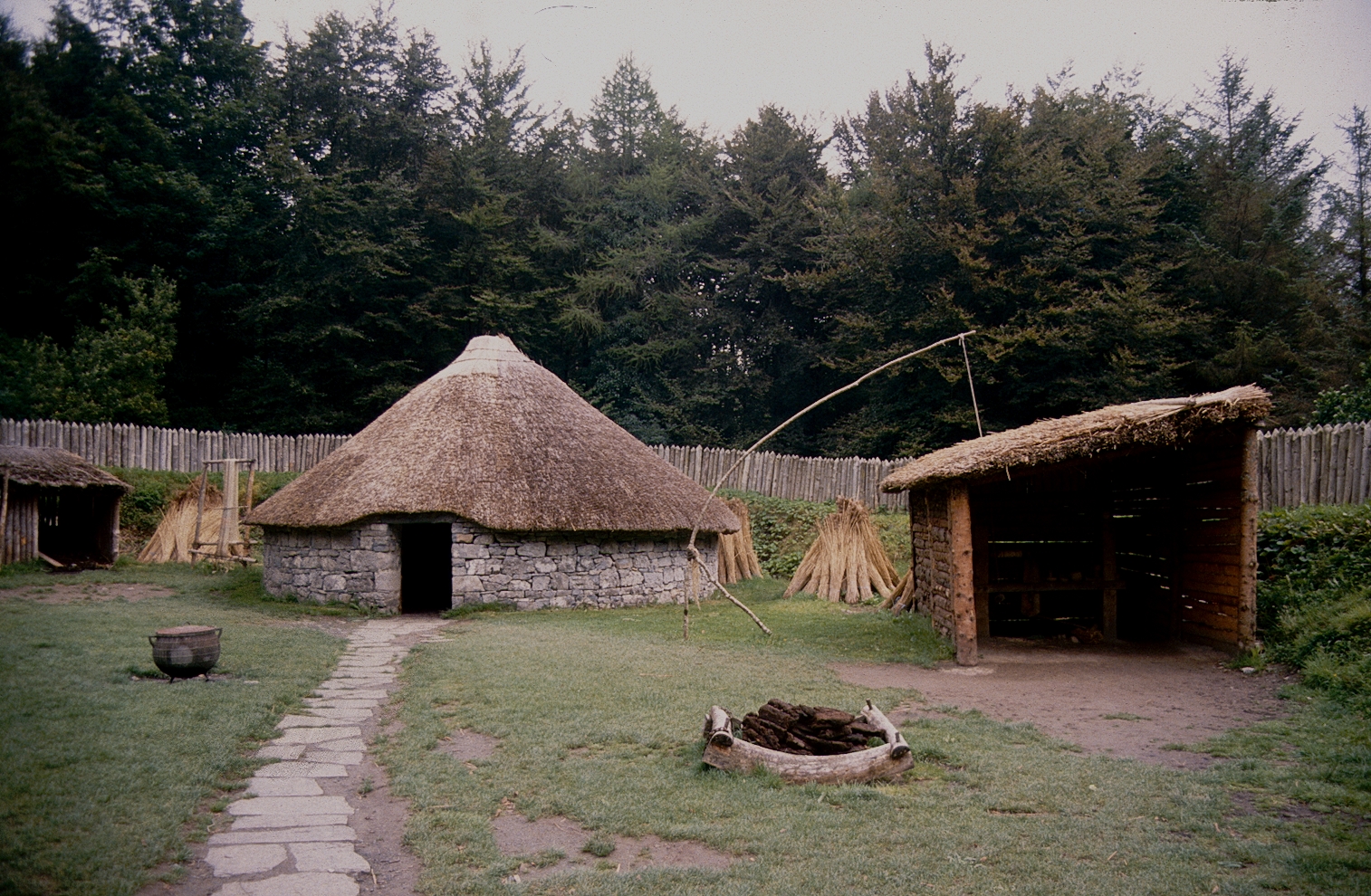
Ireland is covered in circular earthwork enclosures. They sit in fields across every county: low grass-covered banks, sometimes with a ditch on the inner or outer edge, sometimes so worn by time and weather that they barely register from the road, until you see the aerial photograph and the pattern becomes unmistakable. They are known by various names depending on region — raths, lisses, dúns in their earthen form; cashels when built from stone. Most archaeologists date the bulk of them to the Early Christian period, roughly 500 to 1100 AD, when they functioned as the defended enclosures of individual farmsteads: the private property of a single family, separated from the wider landscape by a bank of earth and a ditch.
The total number still surviving across Ireland runs to somewhere between 30,000 and 45,000, depending on the survey methodology. The National Monuments Service database holds confirmed records for around 30,000 sites with accurate coordinates. Broader research estimates place the figure above 40,000. Some archaeologists working from historical evidence put the original number at 50,000 or more — at one point in Irish history, roughly one ringfort for every two square kilometres of the island.
Somewhere through the medieval period, these old farmsteads were reinterpreted. They became “fairy forts”: the underground dwellings and meeting grounds of the sídhe, the fairy people. No one can fix an exact date for when this transformation in belief occurred, but the logic was straightforward enough — the earthworks were there. They had always been there. They would still be there after you were gone. And lone hawthorn trees — the whitethorn, sceach in Irish — grew at or beside them, or along the invisible paths between them, in a way that seemed deliberate. Which, given that hawthorn was planted as a boundary marker and hedge plant throughout the early medieval period, it often was.
The hawthorn has a particular quality that does not make it easy to dismiss. Its blossoms produce trimethylamine — the same compound, noted botanist Richard Mabey observed in Flora Britannica, that is released by decomposing flesh. It flowers on what old Irish seasonal calendars marked as the beginning of summer. It forms impenetrable thorned boundaries. It keeps its own counsel in the middle of a ploughed field where everything else has been cleared, because nobody has come near it. In the Ogham alphabet, the letter associated with the hawthorn — hUath — carried associations, some scholars have argued, with the concept of fear.
A tree that grows alone in a field, that has been there longer than anyone’s grandfather, that marks a spot where something old and circular rises from the earth — this is the anatomy of a fairy tree. What makes it one is not the species alone but where it stands, and the fact that it has been left alone while everything around it has changed.
The Cost of Cutting One
The consequences of disturbing a fairy fort, and especially of cutting the hawthorn growing within or beside it, were understood in traditional belief to be extremely specific. A farmer who broke the bank or cleared the whitethorn could expect illness for the household, dead livestock, fire, ruin. “Even cutting brush, especially the sceach or whitethorn, on fairy forts was reputed to be the death of those who performed the act.”
The most striking modern parallel to this belief involves a car factory. In 1978, work began on a new manufacturing plant in Dunmurry on the outskirts of Belfast, where American auto executive John DeLorean planned to build his gull-winged stainless steel sports car. Site preparation involved clearing land, and a single hawthorn tree survived the initial bulldozing. Local construction workers refused to remove it. According to accounts from the period, management tried various methods to encourage the tree’s removal, including spreading a rumour that money was buried beneath its roots. The tree disappeared overnight regardless, with no one admitting responsibility; local accounts suggested a senior manager had removed it quietly and without attribution.
DeLorean Motor Company went on to produce around 9,000 cars between 1981 and October 1982, when the factory closed. Hours after the closure announcement, John DeLorean was arrested in connection with a drug trafficking operation he had agreed to finance in an attempt to save the business. The company went into permanent receivership.
Those inclined toward the connection note the sequence carefully. Those without such inclinations point out that building a luxury sports car during a recession in a region already experiencing severe economic pressures was probably a sufficient explanation on its own. The tree remains the kind of detail that gets passed on.
The Accidental Archaeological Record
Here is the thing that most accounts of fairy forts tend to understate, because it disrupts the shape of a folklore story: the superstition actually worked.
An estimated 37 per cent of Ireland’s ringforts have disappeared since the first Ordnance Survey mapping in 1837 — ploughed under for modern agriculture, built over, quarried for stone, lost to development. That figure sounds significant. But consider what it implies in reverse: roughly two-thirds of a prehistoric and early medieval monument record survived into the twenty-first century on an agricultural island with one of the densest settlement histories in Europe. That survival did not happen primarily because of formal legal protections, which only arrived with the National Monuments Acts of the twentieth century. It happened because generations of farmers would not touch the bank in the corner of the field.
The reluctance was not heritage consciousness in any modern sense. It was the inherited understanding that the sídhe lived there and that disturbing them was an invitation to disaster. The outcome, from an archaeological perspective, was extraordinary: thousands of Iron Age and early Christian farmsteads, with their associated field systems, boundary evidence, and material culture, preserved intact through centuries when almost any other rationale would have seen them cleared. The fear was wrong, in the sense of being factually incorrect about the nature of reality. The outcome was, from the perspective of the archaeological record, right.
Legal protection came later and has sat uneasily alongside economic development. The National Monuments (Amendment) Act 2004, passed partly to enable motorway construction during the Celtic Tiger building boom, gave the Irish state the power to demolish national monuments in the path of road schemes without the standard environmental impact assessment. Archaeological surveys ahead of the Dublin-Cork motorway corridor, from County Laois to Dunkettle near Cork city, identified well over a hundred ringfort and other early-medieval sites along the route. The M3 motorway through the Tara-Skryne Valley in Meath — its contested route approved in 2003, built between 2007 and 2010 — became a particular point of conflict between archaeologists and road planners. Since 2007, a small number of prosecutions have been brought under the National Monuments Acts for unauthorised interference with recorded monuments — including ringforts — typically for failing to notify authorities rather than outright deliberate destruction, though successful convictions remain rare relative to the scale of reported damage.
The ancient folk prohibition and the modern legal framework have not always been pointing in the same direction.
The Seanchaí and His Archive
Eddie Lenihan went on working after the Latoon episode. His 2003 book, Meeting the Other Crowd: The Fairy Stories of Hidden Ireland, co-written with Carolyn Eve Green, collected oral accounts of fairy encounters taken directly from elderly Irish speakers — stories documented before the last generation of fluent traditional storytellers was gone. His private archive, the largest such collection in Ireland, represents decades of fieldwork conducted with urgency and precision.
He has been careful, over the years, not to frame his position as personal belief in the literal existence of fairies. What he has consistently argued — and what his career demonstrates — is that the stories are real, that the functions they served are real, and that the landscape they encoded tells you something true about the past that no other record preserves in quite the same way. The Latoon tree, fenced neatly into the verge of a motorway junction, is a fairly good illustration of how that argument plays out in practice.
Road schemes in Limerick, Mayo, and Cork have each, at various points, been adjusted to avoid a fairy fort or a lone thorn. The number of places in Ireland where a lane curves unexpectedly, a field boundary takes an odd angle, or a construction crew revised its approach because of an old and specific belief is not possible to count precisely. But it is not small. There are, after all, between 30,000 and 40,000 earthwork enclosures still sitting in Irish fields, each with its own local history, its own oral tradition, and in many cases its own lone hawthorn still growing at the bank. (For a field guide to spotting and visiting one yourself, see our guide to Ireland’s fairy forts.)
The hawthorn blooms white in May, briefly and intensely, and then the blossom is gone. The tree remains. It has been there longer than the road, and longer than the records that explain why nobody cut it.
Ireland preserves its oldest things by attaching stories to them that made generations of people reluctant to look too closely. As strategies for keeping a civilisation’s material past intact across a thousand years of agriculture and development, it has turned out to be one of the more effective approaches anyone has ever tried.
Tours & experiences you might love


Powered by Viator. Some links are affiliate links — we may earn a small commission at no extra cost to you.
Secure Your Dream Irish Experience Before It’s Gone!
Planning a trip to Ireland? Don’t let sold-out tours or packed attractions spoil your journey. Iconic experiences like visiting the Cliffs of Moher, exploring the Rock of Cashel, or enjoying a guided walk through Ireland’s ancient past often sell out quickly—especially during peak travel seasons.

Booking in advance guarantees your place and ensures you can fully immerse yourself in the rich culture and breathtaking scenery without stress or disappointment. You’ll also free up time to explore Ireland’s hidden gems and savour those authentic moments that make your trip truly special.
Make the most of your journey—start planning today and secure those must-do experiences before they’re gone!