

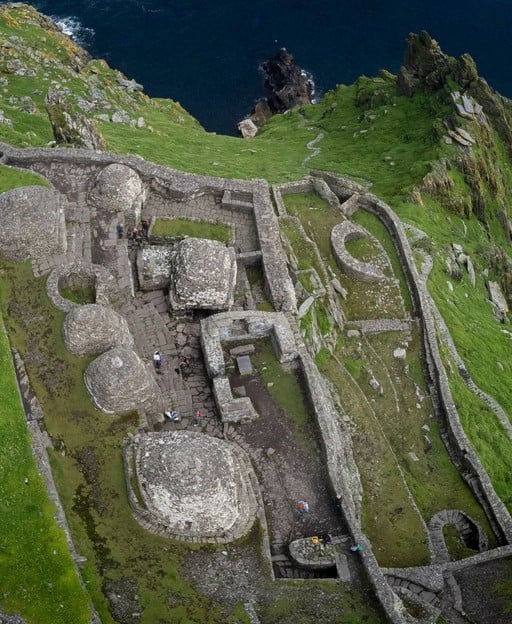
Skellig Michael rises 218 metres from the Atlantic Ocean, 12 kilometres off the Kerry coast. At its summit stands one of the best-preserved early Christian monasteries in Europe — a cluster of stone beehive huts where monks lived, prayed, and survived in near-total isolation from around the 6th century AD. Today it ranks as a UNESCO World Heritage Site and one of the most dramatic visitor experiences in Ireland.
This guide covers everything you need to know before you go: how to get there, when to visit, what to expect on the climb, and why this extraordinary place has drawn pilgrims and travellers for more than 1,400 years.
What Is Skellig Michael?
The name comes from the Irish An Sceilg Mhichíl — “the Rock of Michael,” honouring St. Michael the Archangel. The island forms part of a pair: Little Skellig sits nearby and hosts the second-largest northern gannet colony in the world, with around 30,000 breeding pairs nesting on its near-vertical cliffs. You can see both islands clearly from the boat crossing.
Skellig Michael belongs to a chain of early Christian hermitage sites along Ireland’s western seaboard, but none of them match its remoteness or state of preservation. The monks who settled here did not escape the world by accident — they sought one of the harshest environments they could find, believing that physical hardship brought them closer to God. For a broader look at what makes it, in our view, one of Ireland’s most extraordinary places, see our overview guide.
How old is the monastery?
The monastery dates from around the 6th century AD, making it at least 1,400 years old. Monks arrived during the early period of Irish Christianity, when remote island hermitages represented the pinnacle of ascetic devotion. The community remained until approximately 1100 AD, then relocated to the mainland — increasingly severe winter storms likely drove them off, not invasion or plague.
The Monastery at the Top
Reaching the monastery means climbing 618 stone steps, most carved directly into the rock face by the monks themselves. The steps are uneven, steep, and exposed to Atlantic wind — handrails cover only part of the route. Bring walking shoes with good grip, and allow 30 to 45 minutes for the climb each way.
The summit enclosure contains six intact clocháin — stone beehive huts that the monks built using a corbelling technique requiring no mortar. Each stone layer projects slightly inward above the one below, forming a dry-stone dome that has kept out Atlantic rain for over a millennium. The largest hut measures roughly 4.5 metres across internally and would have housed two or three monks. An oratory, a graveyard, and a later medieval church also occupy the terrace.
The OPW (Office of Public Works) manages the site strictly — it permits roughly 180 visitors per day, spread across morning and afternoon landing slots. Calm conditions are essential for landing, and many boat trips cancel at short notice when the sea turns rough.
- Height: 218 metres (714 feet) above sea level
- Stone steps to the monastery: approximately 618
- Beehive huts: 6 intact clocháin
- Period of occupation: approximately 6th century to 1100 AD
- Daily visitor limit: approximately 180 people, strictly enforced
What was life like for the monks?
Remarkably difficult. Winter storms on Skellig Michael routinely send waves crashing over the lower terraces, cutting the island off from the mainland for weeks. The thin soil and salt air prevented any farming. The monks fished instead, collected seabird eggs, and received occasional supplies from mainland communities.
They followed the same rigid cycle of prayer that governed Irish monasticism elsewhere: seven prayer offices through the day and night, manual labour, fasting, and scholarship. Archaeologists have found a quern stone for grinding grain, fragments of worked bone, and evidence of an iron-working hearth — signs of a small but determined community that stayed active for at least five centuries.
☘ Planning a trip to Ireland?
Our free 7-day road trip itinerary covers the Wild Atlantic Way from Dublin to the west — day-by-day driving guide with hidden gems, practical tips, and local secrets.
Get the Free 7-Day ItineraryHow to Get to Skellig Michael
A boat is the only way to reach Skellig Michael. Licensed operators run trips from three departure points along the Kerry coast — Portmagee, Ballinskelligs, and Cahersiveen. Most visitors depart from Portmagee, which sits roughly 12 kilometres from the island.
The crossing takes between 45 minutes and 1 hour 30 minutes depending on sea conditions and departure harbour. Most operators use open boats — sea spray is unavoidable, and there is no shelter during the crossing. Pack waterproof outer layers even on sunny days.
You must book boat trips in advance — see our 2026 Skellig Michael tours and booking guide for operator-by-operator detail. Peak-season slots sell out weeks or months ahead. Operators include the OPW landing fee in most landing-tour prices. Expect to pay roughly €130 to €145 per adult for the return crossing and island landing permit; non-landing eco boat tours, which don’t put you ashore, cost less — around €55 to €70 per adult.
- Departure points: Portmagee (most common), Ballinskelligs, Cahersiveen
- Crossing time: 45 minutes to 1 hour 30 minutes
- Typical cost: approximately €130 to €145 per adult including island landing (non-landing eco tours run €55 to €70)
- Booking: Pre-booking essential; summer trips often sell out weeks ahead
- Weather cancellations: Common — choose refundable or flexible bookings where possible
How far in advance should I book?
Book four to six weeks ahead for July and August. For June and September — the best shoulder months — two to three weeks usually works, but popular operators fill their slots quickly. Do not assume you can secure a last-minute place by turning up at the harbour on a fine day. It rarely works.
When Is the Best Time to Visit?
Operators run boat landing trips within the OPW’s official season, 9 May to 30 September, depending on weather. The sweet spot is June and September.
June gives you the best combination of reliable weather, puffin sightings (puffins nest on the island from April to August and appear most frequently in June), and lighter crowds than mid-summer. Long daylight hours mean more time on the island before the return crossing.
July and August offer the most reliable crossing conditions but fill up fastest and attract the largest crowds. Mid-summer visibility is often excellent.
September sees the puffins begin to leave, but the weather often stays fine and the island quietens considerably. Autumn light turns the old stone huts a rich gold in photographs.
Avoid May if you want reliable conditions — it is the most unpredictable month, and operators cancel trips more frequently than in June onward.
☘ Enjoying this? 64,000+ Ireland lovers get stories like this every week. Subscribe free
The Puffins of Skellig Michael
Atlantic puffins nest on Skellig Michael from April to August each year. At peak season, several thousand puffins inhabit the island — they burrow into the grassy slopes above the monastery and often land within a few metres of the stone paths. Unlike puffins at many coastal sites, the Skellig birds show little fear of people, making this one of the most intimate wildlife encounters in Ireland.
June is the ideal month if puffins are a priority. By late August, chicks have fledged and adults begin dispersing to sea for the winter.
Skellig Michael and Star Wars
Skellig Michael appeared as the planet Ahch-To in Star Wars: The Force Awakens (2015) and Star Wars: The Last Jedi (2017). The island’s isolation, dramatic cliffs, and ancient stone structures made it a natural stand-in for the last Jedi temple — both films used the beehive huts almost unchanged from their ancient form.
The productions brought a significant and lasting increase in visitor interest. The OPW carefully restricted film crew numbers to protect the fabric of the site. Visitors familiar with the films will recognise the monastery terrace and several paths from Luke Skywalker’s island retreat sequences.
What to Bring and What to Expect
Skellig Michael does not operate as a conventional managed tourist attraction. No cafés, no upper-terrace toilets, no summit guides, and no shelter from wind or rain on the exposed climbing route. Operators cancel boat trips regularly due to sea conditions, especially early and late in the season.
- Footwear: Sturdy hiking boots or trail shoes with non-slip soles — no sandals or smooth-soled shoes
- Clothing: Waterproof jacket even on sunny days; layers for the crossing and the summit
- Food and water: Pack your own — operators sell nothing on the island
- Physical fitness: The 618-step climb is steep and demanding; not suitable for those with significant mobility difficulties
- Time on the island: Typically 2 to 2.5 hours before the return crossing
- Children: Older, agile children can manage the climb; pushchairs and very young children are not practical on the steep terrain
Is the climb difficult?
The 618 stone steps are steep and uneven, with some sections requiring careful foot placement. Most reasonably fit adults manage the climb without trouble, though the pace stays slow throughout. The descent requires equal care — rain or sea mist makes wet stone steps slippery. Allow 30 to 45 minutes each way and take your time. The monastery stands at the top of a 218-metre rock island in the Atlantic — the effort matches the setting.
Getting to the Departure Points
Portmagee, the most popular departure village, sits on the Ring of Kerry approximately 3 hours by car from Cork and 3.5 hours from Dublin. Killarney is the nearest large town with accommodation and rail connections, about 50 minutes drive from Portmagee.
No public transport runs to Portmagee. Visitors without a car can hire one from Killarney or Cahersiveen. Many visitors combine a Skellig Michael crossing with a Ring of Kerry drive, staying in Portmagee the night before departure — early-morning crossings are standard, and staying close removes the stress of a long pre-dawn drive.
The Skellig Experience Visitor Centre on Valentia Island, just across the bridge from Portmagee, offers an excellent exhibition about the monastery, the monks, and the wildlife. Visit it before a cancelled crossing, or use it as orientation for the day of your trip.
Frequently Asked Questions
When is the best time to visit Skellig Michael?
June gives you the best balance of calm weather, puffin sightings, and availability of boat trips. September offers a quieter alternative with still-reasonable conditions. Avoid May if possible — operators cancel crossings more frequently that month than at any other point in the season.
How do I book a boat trip to Skellig Michael?
Book directly with one of the OPW-licensed operators based in Portmagee, Ballinskelligs, or Cahersiveen. The OPW lists all licensed operators on its heritage.gov.ie website. Book four to six weeks ahead for July and August, and two to three weeks ahead for June and September. Most operators allow free rebooking if weather cancels your trip.
Is Skellig Michael suitable for children?
The climb suits confident children who cope well with uneven terrain and heights. The 618 stone steps are steep and exposed, with limited handrail sections. The OPW advises parents to judge each child’s fitness and agility individually before booking. Very young children should not attempt the crossing or the climb.
Is there an entrance fee for Skellig Michael?
Operators include the OPW landing fee in the boat trip price. As of 2026, a landing tour runs roughly €130 to €145 per adult depending on operator. Non-landing eco boat tours, which don’t put you ashore, cost less — around €55 to €70 per adult. You do not buy a separate entry ticket on the island itself.
What should I wear to visit Skellig Michael?
Wear sturdy walking shoes or hiking boots with non-slip soles — smooth-soled shoes are dangerous on wet stone steps. Bring a waterproof jacket regardless of the forecast; sea spray on the crossing and exposed conditions at the summit guarantee you get wet without one. Layer up, and pack food and water since nothing is available for purchase on the island.
☘ Join 64,000+ Ireland Lovers
Every weekday morning, get Ireland’s hidden gems, local secrets, and travel inspiration — the kind you won’t find in any guidebook.
Subscribe free — enter your email:
📲 Know someone who’d love this? Share on WhatsApp
Free forever · Unsubscribe anytime
Tours & experiences you might love


Powered by Viator. Some links are affiliate links — we may earn a small commission at no extra cost to you.
Secure Your Dream Irish Experience Before It’s Gone!
Planning a trip to Ireland? Don’t let sold-out tours or packed attractions spoil your journey. Iconic experiences like visiting the Cliffs of Moher, exploring the Rock of Cashel, or enjoying a guided walk through Ireland’s ancient past often sell out quickly—especially during peak travel seasons.

Booking in advance guarantees your place and ensures you can fully immerse yourself in the rich culture and breathtaking scenery without stress or disappointment. You’ll also free up time to explore Ireland’s hidden gems and savour those authentic moments that make your trip truly special.
Make the most of your journey—start planning today and secure those must-do experiences before they’re gone!