

Most visitors to the Cliffs of Moher come for the view. The 214-metre drop to the Atlantic, the sound of guillemots and razorbills wheeling below the cliff edge, the way weather rolls in from the west with no warning — these are the things people remember. But the rock itself has a story that is just as remarkable. The Cliffs of Moher geology begins not in Ireland but near the equator, roughly 315 million years ago.
Enjoy reading about Ireland? Our free weekly newsletter covers history, travel, and the places worth knowing — straight to your inbox. Subscribe here.
What the Rock Is Actually Made Of
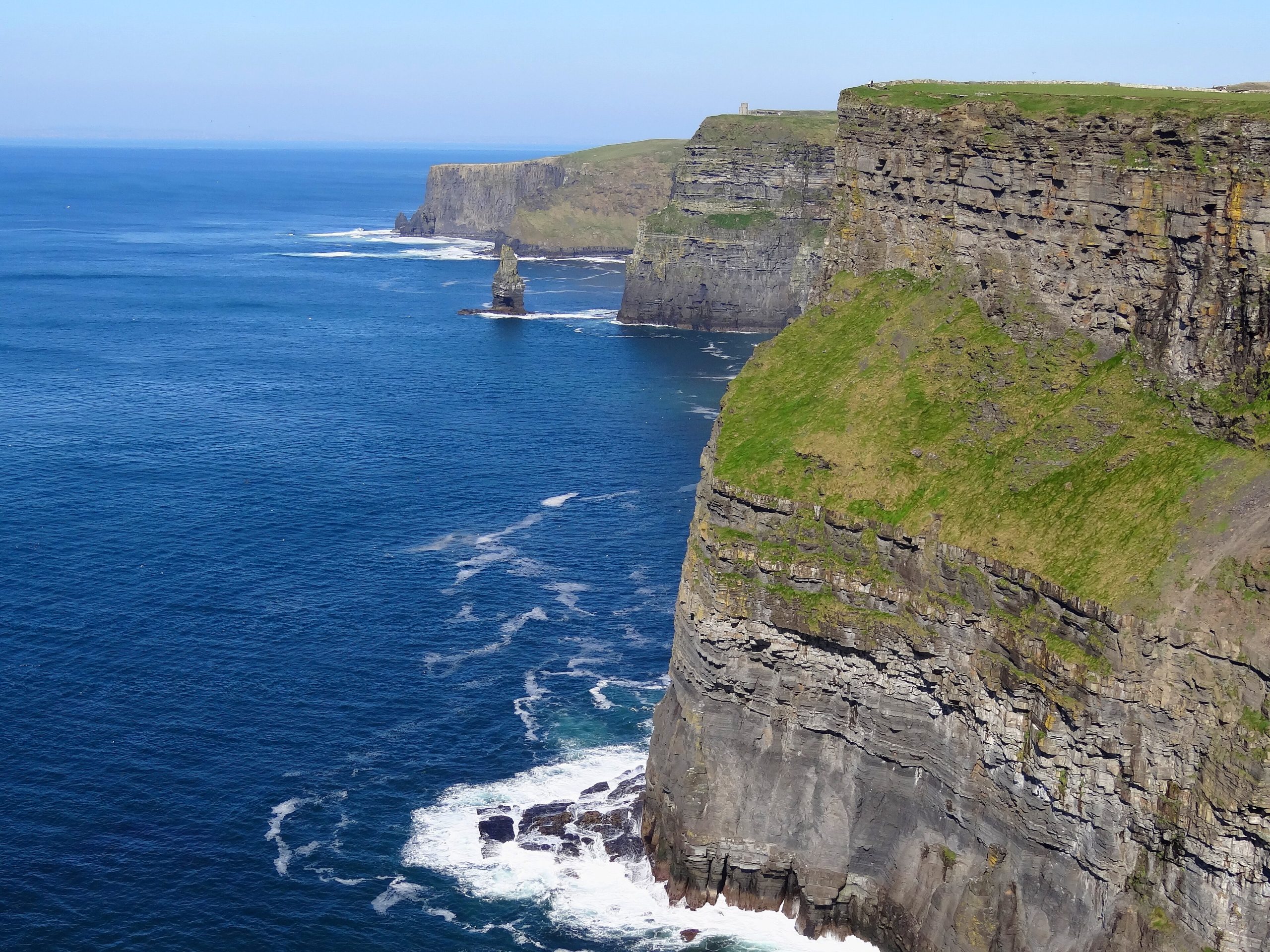
The cliffs are composed mainly of shale and flagstone, laid down in horizontal layers that are clearly visible along the cliff face. These sedimentary rocks formed from silt, mud, and organic material that settled on the floor of a deep marine basin during the Carboniferous Period, with much of the sand and silt carried out to sea by rivers building deltas.
At that time — roughly 313 to 326 million years ago, in the Namurian stage of the Carboniferous — Ireland sat in a very different position on the planet. The tectonic plates that carry the continents were arranged quite differently, and the landmass that would eventually become Ireland lay close to the equator. The seas were warm and the climate was humid, and the area that is now County Clare lay beneath that sea.
Over millions of years, layer upon layer of sediment built up. Organic material from dead sea creatures mixed with fine silt and clay. Pressure compressed it all into the rock that now rises up to 214 metres above the Atlantic. The dark grey colour comes largely from carbon-rich organic material locked into the stone.
The 2024 Fossil Discovery
☘️ Join 64,000+ Ireland Lovers
Every weekday morning, get Ireland’s hidden gems, local secrets, and travel inspiration — the kind you won’t find in any guidebook.
Subscribe free — enter your email:
Already subscribed? Download your free Ireland guide (PDF)
📲 Know someone who’d love this? Share on WhatsApp →
Free forever · Unsubscribe anytime
In 2024, Dr Eamon Doyle, geologist for the Burren and Cliffs of Moher UNESCO Global Geopark, announced a new species of fossil sponge found in the cliff rocks. It was named Cyathophycus balori after Balor, the mythological giant whose eye destroyed his enemies. At about 315 million years old, the specimen stands up to 50 cm tall and is the largest known example of its kind, and it is the first record of this type of sponge from Ireland.
The find added weight to the scientific picture of what this coastline looked like before it was a coastline at all. The sponge would have lived on the sea floor, filtering food from the water. Its body eventually became part of the sediment, compressed over hundreds of millions of years into the same grey stone you can press your hand against at the cliff edge today.
Other marine fossils, including corals, brachiopods and crinoids, have been recorded in the limestone of the wider Burren. The shale and sandstone of the cliffs sit to the south-west of that limestone landscape, one of the most unusual in Europe.
How the Cliffs Took Their Current Shape
The rock was laid down horizontally on the sea floor. The cliffs stand nearly vertical today. The difference between those two states is explained by hundreds of millions of years of tectonic movement, glaciation, and coastal erosion.
Around 300 million years ago, the Variscan Orogeny — a major mountain-building event caused by continental collision — compressed and tilted much of the rock in southern Ireland. The rock layers at the Cliffs of Moher remain relatively flat compared to the dramatically folded geology found further south, but the region was uplifted well above sea level.
The Ice Ages then played their part. Glaciers moving across County Clare scoured the landscape repeatedly, depositing till and reshaping the terrain. As the last ice sheets retreated — roughly 12,000 to 15,000 years ago — sea levels rose and the Atlantic began to eat into the western edge of the shale and sandstone.
That process continues today. The Cliffs of Moher are actively eroding. Rock falls happen periodically, and the cliff line moves slowly eastward over geological time. The roughly 14 kilometres of cliff along this coast will look different in a thousand years.
What to Look For When You Visit
The geology is readable if you know where to look. From the main viewing platforms — particularly around O’Brien’s Tower in the centre of the cliff walk — you can see the horizontal banding in the rock face clearly. Darker bands are shale-rich, lighter ones are flagstone. Each layer represents a different period of deposition, the record of a season, a decade, or a century on an ancient sea floor.
At low tide, the wave-cut platform at the base of the cliffs is occasionally visible from certain angles. This flat shelf of rock is where the waves are doing their most active erosive work, undercutting the cliff face above.
If you have binoculars, the cliff face itself rewards close attention. The cliffs host major guillemot and razorbill colonies. Guillemots and razorbills return from their winter at sea from late February, and puffins are around from late April to early August. All of them nest in cracks in the rock. Those cracks often follow natural fault lines in the stone, structural weaknesses that have been there since the Carboniferous.
Planning Your Visit
The Cliffs of Moher are in County Clare on the Wild Atlantic Way, about an hour’s drive south of Galway and 1.5 hours from Limerick. The main car park and visitor centre are signed from the R478 road near the village of Liscannor. For the wider landscape, see our guide to the Burren, Ireland’s strangest landscape.
Entry: The admission ticket covers parking in the main car park, which is across the road from the visitor centre. It also gives entry to the visitor centre, exhibition and, when open, O’Brien’s Tower. Adult tickets are €8 when booked online off-peak, with higher prices at peak times and at the gate. Children aged 12 and under enter free. Booking online is the cheapest option and lets you choose a time slot. Audio guides and a geology exhibit are available inside.
Hours: The site is open from 08:00 to 21:00 in May to August, 08:00 to 19:00 in March, April, September and October, and 09:00 to 17:00 in January, February, November and December. It is closed on 24, 25 and 26 December. Check the official Cliffs of Moher website before travelling, as hours can change.
Best time to visit: Early morning in spring or autumn gives the best chance of clear air and smaller crowds. Midday in July and August is when the site is at its busiest. The coastal walk has been closed for safety reasons, including the southern section towards Hag’s Head, and the Doolin end only reopens as far as Surfers Path. Check current trail status before you go (see our Cliffs of Moher Trail 2026 guide).
Weather: Come prepared for anything. Wind at the cliff edge can be strong even on a fine day, and conditions change quickly. Wear layers and bring waterproofs regardless of the forecast.
One More Reason to Look Down
Most people at the Cliffs of Moher look out — at the Aran Islands on a clear day, at the Atlantic horizon, at the light on the water. That view is genuinely worth the journey.
But the rock beneath your feet is carrying something equally extraordinary: the compressed remains of an ancient sea that existed before the dinosaurs, before flowering plants, before the continents took their current shape. The grey stone is not just scenery. It is a 315-million-year archive of what this part of the world once was.
That changes the view somewhat, once you know it.
Tours & experiences you might love


Powered by Viator. Some links are affiliate links — we may earn a small commission at no extra cost to you.
Secure Your Dream Irish Experience Before It’s Gone!
Planning a trip to Ireland? Don’t let sold-out tours or packed attractions spoil your journey. Iconic experiences like visiting the Cliffs of Moher, exploring the Rock of Cashel, or enjoying a guided walk through Ireland’s ancient past often sell out quickly—especially during peak travel seasons.

Booking in advance guarantees your place and ensures you can fully immerse yourself in the rich culture and breathtaking scenery without stress or disappointment. You’ll also free up time to explore Ireland’s hidden gems and savour those authentic moments that make your trip truly special.
Make the most of your journey—start planning today and secure those must-do experiences before they’re gone!