

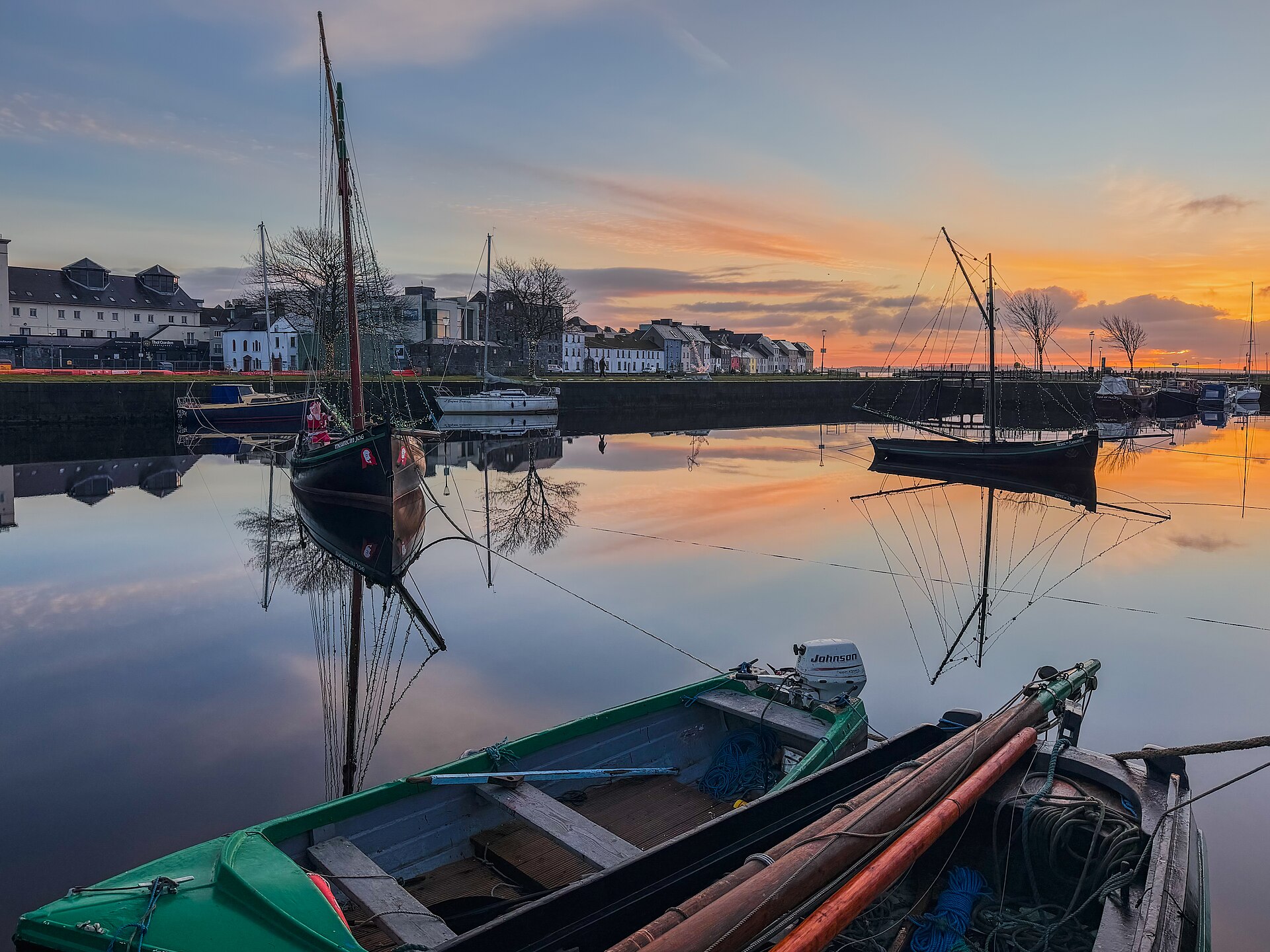
By 1970, Only Two Galway Hookers Were Still Sailing. This Is How They Came Back.
On an August morning in 1979, a man named Tony Moylan stood on the pier at Kinvara, a small village on the southern edge of Galway Bay (home to Dunguaire Castle), watching three old turfboats sail in from Connemara. The boats — An Capall, An Tonaí, and An Maighdean Mhara — were wooden, black-hulled, their sails the same deep rust-red they’d always been. They had last made this crossing commercially in 1957. Twenty-two years later, Moylan had persuaded their owners to do it one more time, and he’d organised a three-day gathering around their arrival.
That event — Cruinniú na mBád, the Gathering of the Boats — is now in its fifth decade. At the time, it was a last roll of the dice for a vessel that had run the economy of western Connacht for 150 years, and which, by the early 1970s, had nearly ceased to exist.
The Cargo Economy That Ran on Wind
Start with the geography, because the geography is the whole explanation.
The Aran Islands sit in the mouth of Galway Bay — bare limestone platforms rising out of the Atlantic, remarkable for almost everything except what they lack: there is no bogland on the Aran Islands, and there is no peat. For heating, cooking, and survival through an Irish winter, the islands depended entirely on fuel brought in by sea. The Burren of County Clare, across the water on the southern shore, was in a similar position. Meanwhile, Connemara and County Mayo had more turf than they could ever use, and soil so acidic from the peat that crops barely grew — soil that needed lime, specifically the kind of limestone that could be quarried from the Aran Islands and the Burren and shipped back in the returning boats.
This is the trade the Galway hooker was built for. Turf west-to-east, limestone east-to-west, and everything else the coastal economy needed in between: livestock, fish, seaweed, building materials, general supplies, and — where the occasion required — consignments of poitín that never quite appeared on any manifest.
The boats that ran this trade were precisely engineered for Galway Bay’s conditions. Built from oak frames with thick beech keels, they carried a sharp entry at the bow, a bluff and robust hull, and a particular inward curve in the upper sides — called tumblehome — that shed breaking waves without swamping. The mast sat well forward, carrying a three-sail rig: mainsail, foresail, and jib. The hulls were black from regular tarring. The sails were made from calico treated once a year with a solution of tree bark — sometimes mixed with tar and butter — that turned them the distinctive dark red that made a hooker recognisable from the far end of the bay.
There were four distinct classes. The bád mór (big boat), at 35 to 44 feet, was the cargo workhorse, capable of carrying up to fifteen tons per run. The leathbhád (half-boat) ran slightly smaller, at 28 to 35 feet. The gleoiteog, between 20 and 28 feet, was the preferred fishing vessel. The púcán, the smallest class, was used for seaweed harvesting and could be rowed when the wind died. Each had its place in the coastal system, and skilled builders in Mweenish Island and Kinvara could read what a captain needed and build to it.
At their peak, in 1836, 105 sailing boats and 80 rowing boats were operating out of the Claddagh — the old fishing village at the mouth of the River Corrib in Galway — crewed by roughly 820 fishermen. Eyewitnesses described 20 boats moored at one time in the harbour of Inis Mór and 35 sailing out of Connemara on any given working day. The hooker was not a feature of the economy of western Connacht. It was the economy.
The Slow Erasure
No single disaster killed the Galway hooker as a working vessel. That, counterintuitively, is part of what made the decline so thorough and so easy to miss.
Larger trawlers entered Galway Bay in the late 19th century and began outcompeting the smaller-crewed hookers on open water. The fishing trade from the Claddagh went into steep decline. By the time the Second World War ended, new roads had been pushed far enough west to make overland haulage viable on the mainland. And then, in 1957, bottled gas reached the Aran Islands and the offshore communities that had previously depended on regular turf deliveries by sea. The commercial trade between the parishes of Carraroe in County Galway and Kinvara — which had run without interruption for over 150 years — simply stopped.
There was nothing left to carry that a lorry couldn’t carry more cheaply.
The boats that remained were moored. Then they started rotting. The families that had crewed them moved to other work; the builders who had made them were aging, and their apprentices had left for construction work or emigration. By the mid-1960s, only six báid mhóra — the largest class — still floated. By 1970, across the whole Galway Bay coast, the number was two.
The boat that outlasted almost all of them was the True Light, built in 1922 by boatbuilder John Reney — the last craftsman to supply the Claddagh fleet — for the Oliver fishing family of Galway. The True Light survived the Cleggan Disaster of October 1927, when a sudden Atlantic gale caught the Connemara fishing fleet in the open water and killed more than forty fishermen in a single afternoon. It survived Hurricane Debbie in 1961. It kept moving because a sequence of owners kept caring enough to keep it afloat — eventually purchased in the early 1960s by the Irish poet Richard Murphy, who sailed it in the earliest regattas of the boat revival and used it as a charter vessel for about a decade before it passed on.
By the time the True Light eventually deteriorated into near-ruin in the 1990s, the boat-building tradition had already been interrupted for decades. The first new hooker in approximately forty years — a 23-foot gleoiteog — wasn’t built until the late 1970s. The knowledge of how to build these hulls was as endangered as the hulls themselves.
The Man Who Called a Gathering
The first real act of revival was not an institution or a government programme. It was one man in Kinvara deciding that the boats were worth saving, and persuading enough people to agree.
In 1976, a bád mór called The Morning Star — built around 1890 in Kinvara — was restored by a man named John Healion and sailed back to Connemara for the summer festival of Saint MacDara on the island of Oileán Mhic Dara off the Cárna coast. The boat had been sold to Dublin years earlier; bringing it back was a small act of retrieval. For people along the Galway Bay coast who had been watching the fleet disappear, the sight of a fully rigged hooker on the water again stirred something that hadn’t been stirred in a long time.
The Galway Hooker Association was formally established in 1978, tasked with promoting restoration and preservation of all four boat classes and with organising regattas that might draw surviving boats together and give people a reason to keep them. It was the kind of association that needs to exist before a revival can be called a revival.
Then came Tony Moylan.
Moylan was from Kinvara. He tracked down three of the oldest surviving turfboats, persuaded their owners to make one more Connemara crossing, and organised the first Cruinniú na mBád around their arrival in August 1979. The name translates simply as Gathering of the Boats. The event lasted three days. It worked.
By 1982, when photographer Joe St Leger first began documenting the regatta, the revival was still only three years underway and the people involved were still slightly astonished it had taken hold. The Galway Hooker Association was commissioning new boats alongside restorations of old ones. Builders were taking on apprentices. The regattas multiplied — from Kinvara in the south-east to Roundstone in the north-west, running through the Galway summer.
Why It Almost Died Twice
In 1980, the year after Moylan’s first gathering, the Dominican priest in Galway found himself unable to find a Claddagh hooker to take him out to bless Galway Bay. The annual ceremony had been a fixture of the Claddagh’s life for as long as anyone could remember. It was the first time in living memory it had happened without a hooker on the water. The revival was real; the near-extinction was simultaneously real. Both things were true at the same time.
The problem was never just the boats. It was the knowledge. Building a Galway hooker properly requires the kind of spatial understanding that comes from years of watching and doing, not from reading a manual. The tumblehome, the entry, the raked transom — these are proportional judgements that experienced builders hold in their hands and eyes, not in diagrams. The builders who’d spent their lives in the tradition were aging. The Galway Hooker Association was working against a clock that ran on human lifespans as much as on boat rot.
What saved the craft was the same thing that had made it seem, for a moment, redundant. Once the hookers were no longer economically necessary, they became something arguably more durable: beloved. The regattas drew crowds. Cruinniú na mBád became a fixed point in the west of Ireland summer, pulling in spectators who had never seen a traditional hooker and owners who needed the community of other boat people to stay motivated through costly restorations. The boats became worth preserving for their own sake, which turned out to be a more stable foundation than pure economic necessity.
Where We Are Now
The current fleet of báid mhóra — the largest class of Galway hooker — stands at around 25 boats. New ones continue to be built; some are restorations of surviving hulls, others entirely new construction following traditional lines. The Cruinniú na mBád has run every summer since 1979, and the gathering of black hulls and rust-red sails on Kinvara Bay in August has become one of the more arresting sights the west of Ireland offers.
Tony Moylan, who started all of this in 1979 with three old turfboats and an idea about a gathering, was still involved twenty years after that first event. He was one of four people who acquired the deteriorated remains of the True Light in 1999 — the last surviving vessel of the original Claddagh fleet — and began the work of restoring it. At the 40th anniversary Cruinniú na mBád in August 2019, a plaque was unveiled at the Kinvara pier head in his honour.
In September 2026, with the festival now in its 47th year, the association Cumann Húicéirí na Gaillimhe (the Galway Hookers Association) is backing calls for the traditions of the Galway hooker to be added to Ireland’s National Inventory of Intangible Cultural Heritage — the first step towards any later nomination for UNESCO’s Representative List. Ireland ratified the UNESCO convention in 2015, and the case is built around something the association’s leadership has been direct about: recognition is needed not just for the boats themselves but for the building knowledge, which remains vulnerable. There are very few full-time hooker builders working today, and without new builders trained in the tradition, the revival of the 1970s could eventually be followed by a second extinction.
What the Galway hooker represents, in the end, is an entire logistical system — one that ran on wind and tide and the knowledge of how to work both — that connected communities across a bay for a century and a half. It moved the fuel that kept the Aran Islands warm through winter. It returned with the stone that made Connemara’s fields workable. It was practical, unglamorous, essential. And then it was nearly gone — down to two boats, no new builders, a 23-year gap in the cargo run — before enough people decided they couldn’t let it vanish entirely.
The sails are still dark red. The hulls are still black. On the right August afternoon in Kinvara, with the bay running before a westerly and a fleet of báid mhóra running with it, it is genuinely difficult to believe those two remaining boats were ever all that was left.
Join 169,000+ Ireland lovers
Every week, stories like this one — plus hidden gems, heritage deep-dives, and the Ireland most visitors never find.
Already subscribed? Download your free Ireland guide (PDF)
Free forever · One email per week · Unsubscribe anytime
☘️ Join 168,000+ Ireland Lovers
Every week, get Ireland’s hidden stories, heritage, and travel inspiration — delivered free to your inbox.
Subscribe free:
Tours & experiences you might love


Powered by Viator. Some links are affiliate links — we may earn a small commission at no extra cost to you.
Secure Your Dream Irish Experience Before It’s Gone!
Planning a trip to Ireland? Don’t let sold-out tours or packed attractions spoil your journey. Iconic experiences like visiting the Cliffs of Moher, exploring the Rock of Cashel, or enjoying a guided walk through Ireland’s ancient past often sell out quickly—especially during peak travel seasons.

Booking in advance guarantees your place and ensures you can fully immerse yourself in the rich culture and breathtaking scenery without stress or disappointment. You’ll also free up time to explore Ireland’s hidden gems and savour those authentic moments that make your trip truly special.
Make the most of your journey—start planning today and secure those must-do experiences before they’re gone!