
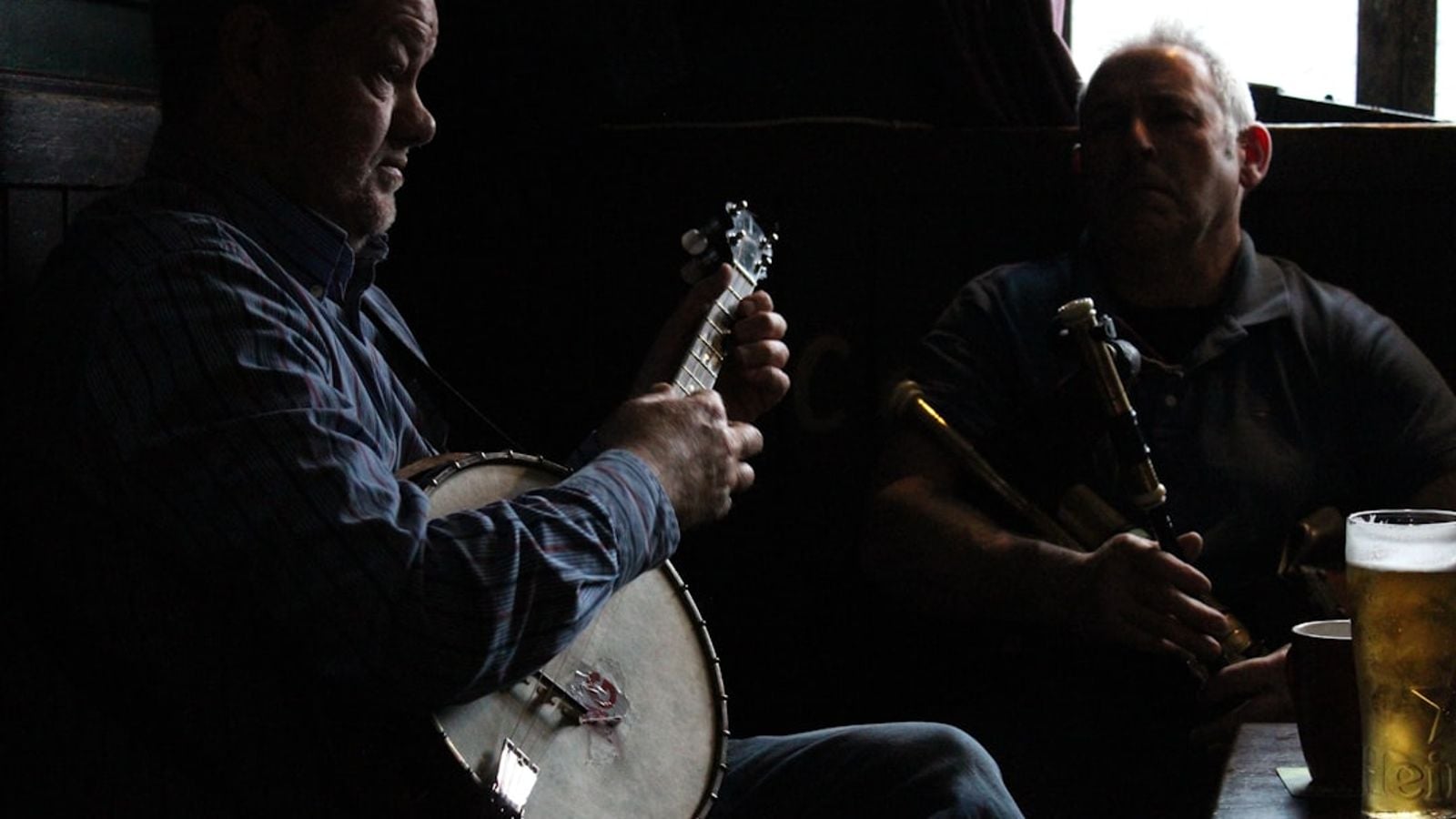
There is no bandleader at a proper Irish trad session, no set list, and often no fee. Musicians gather around a table, usually in a pub, and play tunes from a shared repertoire that runs into the thousands — jigs, reels, hornpipes and slow airs passed largely by ear rather than from sheet music. A newcomer might notice that the whole thing seems to run on unspoken rules, and it does. This is Guide № 009 in The Love Ireland Guide series.
Get the Full Collectible Guide (Free PDF)
The Irish Trad Session — in a beautifully designed, printable booklet. The Love Ireland Guide № 009.
What a Session Actually Is
The word “session” — seisiún in Irish — refers to an informal gathering where musicians play traditional tunes together, typically in a pub, typically without payment. The music is largely instrumental dance music, and the core structure is the “set”: two or three tunes of the same type strung together, with the group changing to the next tune on a shared, silent cue. One player starts a tune, others join once they recognise it, and the set repeats a few times before rolling into the next.
Crucially, a session is not a concert or a gig. The musicians are usually playing for each other and for their own enjoyment as much as for any audience. There is no stage, the players face inward toward one another, and whether anyone is listening is beside the point.
A Tradition Younger Than It Feels
While the tunes themselves are old, the pub session as we know it is a relatively recent format. It is commonly traced to the Irish emigrant communities of London and other cities in the mid-twentieth century, where displaced musicians gathered in pubs to play together — the pub being one of the few social spaces available to them. The practice then travelled back to Ireland and spread widely. The folk and traditional music revival of the 1960s, along with groups like The Chieftains and Ceoltóirí Chualann, helped cement the session as a central pillar of Irish musical life.
The Instruments You’ll Hear
The classic session line-up includes the fiddle, the tin whistle, the flute, the button accordion, the concertina, and the tenor banjo. Rhythm and drone come from the bodhrán, a frame drum played with a double-ended beater called a tipper, and increasingly the guitar or bouzouki for backing chords. Pride of place often goes to the uilleann pipes — the Irish bellows-blown bagpipes, pumped by the elbow rather than the mouth, and considered one of the most complex woodwind instruments in the world to play well.
Melody instruments generally play the same tune in unison rather than harmonising, which is why a room of fiddles, whistles and flutes can lock together into a single driving line. The bodhrán and guitar sit underneath, keeping time and texture.
The Unwritten Etiquette
Sessions run on convention rather than rules posted on a wall, but the conventions are real. It is normal to listen for a while before joining, to play quietly until you know a tune, and to sit out any tune you don’t know rather than guess loudly over it. Starting a tune that others can’t follow, playing too loud, or treating the session as your personal performance are all quick ways to lose the room.
When a slow air or a song begins, the room typically falls quiet to let a single voice or instrument carry it — this hush is one of the most respected customs of all. There is usually a musician or two who anchor the session and set its tone; following their lead is the safest course for anyone new to the table.
For a deeper dive into the customs tourists get wrong most often, see our full guide to the unwritten rules of an Irish trad session.
Finding a Real One
Sessions happen all over Ireland and range from tourist-facing sets in city-centre pubs to fiercely local gatherings in small towns. Areas with deep traditional roots — County Clare, particularly around Doolin and Ennis, along with parts of Galway, Kerry and Donegal — are strongly associated with the music. The annual Fleadh Cheoil na hÉireann, run by the organisation Comhaltas Ceoltóirí Éireann, is the largest traditional music festival and gathers thousands of musicians for competitions and spontaneous street sessions.
A useful tell for a genuine session: the musicians are facing each other, not the room, and the music simply continues whether the pub is packed or half-empty. If there’s a poster, a cover charge and a microphone, you may be at an enjoyable show — but it isn’t quite the same thing.
Myths Worth Retiring
Myth: Sessions are performances staged for tourists. Many pubs do host music aimed at visitors, and that’s fine — but the traditional session is fundamentally musicians playing for one another. The audience is welcome, not the point.
Myth: Everyone is improvising freely. The tunes are drawn from a large but shared repertoire and are played more or less as learned. Individual expression comes through ornamentation and phrasing, not through making the melody up on the spot.
Myth: You need to be a virtuoso to take part. Sessions include players of very mixed ability. What matters far more than flash is knowing the tunes, keeping time, and respecting the unwritten etiquette of the table.
Frequently Asked Questions
Can I join in if I play an instrument?
Often, yes — but read the room first. Listen for a while, ask the anchoring musicians if it’s an open session, play quietly, and only lead a tune once you’re confident the others will know it. Some sessions are open to all comers; others are effectively private among regulars.
Do I have to be quiet as a listener?
Normal chat is fine during the lively dance tunes — sessions are social by nature. But when a slow air or a song starts and the room hushes, join the hush. Talking over a solo air is the one thing almost guaranteed to draw disapproval.
Is it rude to request a song or tip the musicians?
Since most session players aren’t performing for pay, shouting out requests can miss the spirit of the thing. If you’ve enjoyed it, buying the musicians a drink is the traditional and warmly received gesture — far more so than treating them as a jukebox.
More The Love Ireland Guides
The Love Ireland Guide is a numbered series — one tightly focused subject at a time, each with its own downloadable collectible edition. Guide № 001 is Irish Soda Bread, Guide № 002 is St. Patrick’s Day, Guide № 003 is The Claddagh Ring, Guide № 004 is Guinness — The Pour, The Pint, The Ritual, Guide № 005 is Irish Pub Etiquette, Guide № 006 is Irish Slang & Hiberno-English, Guide № 007 is The Irish Wake, Guide № 008 is Irish Whiskey, This is Guide № 009. More editions are on the way.
☘️ Join 64,000+ Ireland Lovers
Every week, get hidden stories, local secrets, and travel inspiration from people who live and love it.
Subscribe free — enter your email:
Secure Your Dream Irish Experience Before It’s Gone!
Planning a trip to Ireland? Don’t let sold-out tours or packed attractions spoil your journey. Iconic experiences like visiting the Cliffs of Moher, exploring the Rock of Cashel, or enjoying a guided walk through Ireland’s ancient past often sell out quickly—especially during peak travel seasons.

Booking in advance guarantees your place and ensures you can fully immerse yourself in the rich culture and breathtaking scenery without stress or disappointment. You’ll also free up time to explore Ireland’s hidden gems and savour those authentic moments that make your trip truly special.
Make the most of your journey—start planning today and secure those must-do experiences before they’re gone!


