

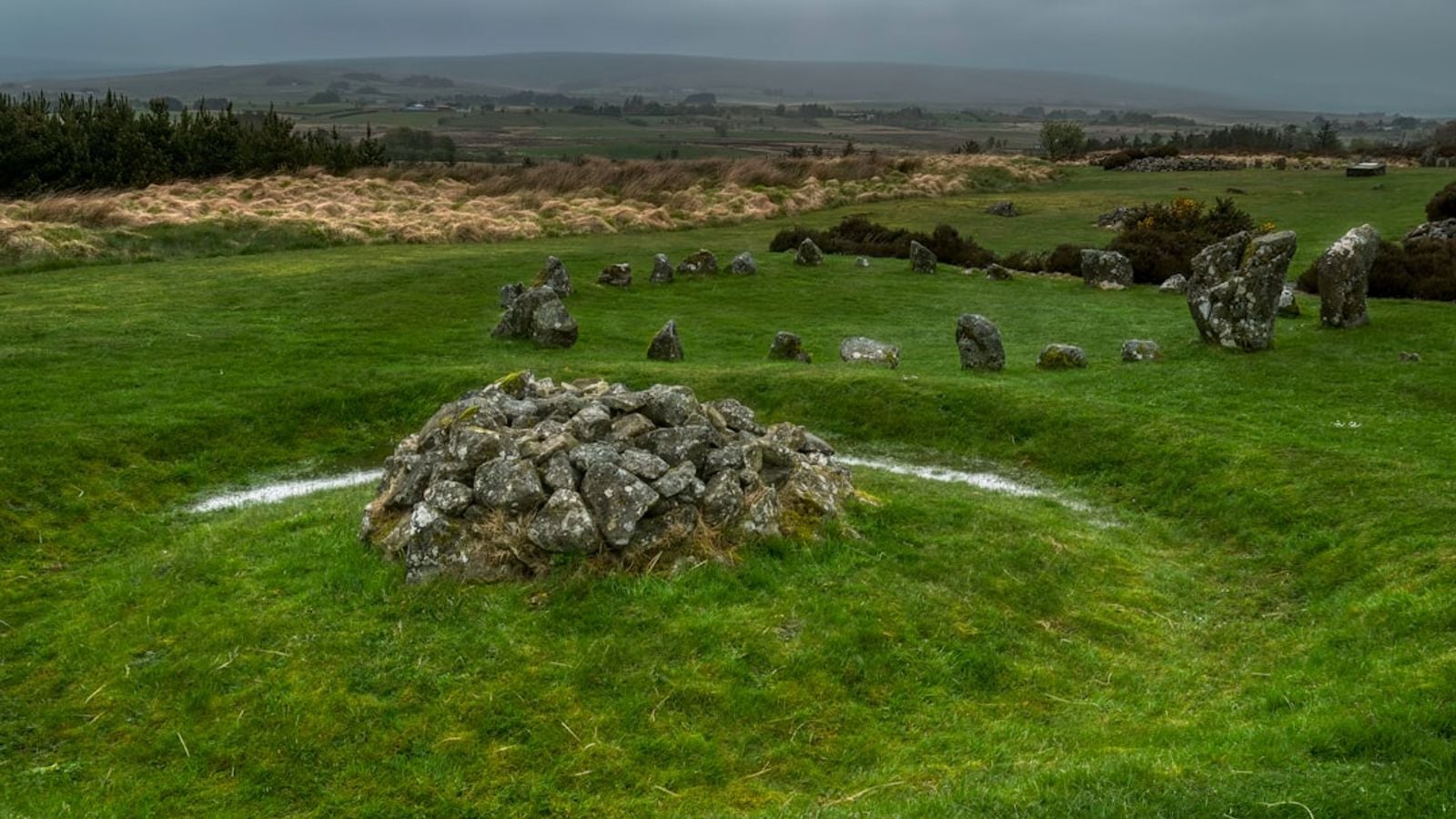
Five thousand five hundred years ago, a farming community in the west of Ireland built something remarkable. They laid out field systems, raised stone walls, and worked the land with a precision that still astonishes archaeologists today. Then the bog swallowed it all. For millennia, it sat beneath the peat — perfectly preserved, utterly forgotten. Then a schoolteacher digging for turf stumbled across something strange.
A Teacher, a Spade, and an Accidental Discovery
In the 1930s, Patrick Caulfield was cutting peat on the slopes above the north Mayo coast when his spade kept striking old stones. Not just one or two — hundreds of them, buried at the same depth across a wide stretch of bogland. He noted it and moved on. But he told his son.
That son, Seamus Caulfield, grew up to become an archaeologist. He spent the better part of thirty years investigating what his father had found beneath the bog. What emerged was extraordinary: the largest and oldest known enclosed landscape in the world. The Céide Fields cover an estimated ten square miles of north County Mayo, all of it buried under up to four metres of peat bog.
The walls themselves are still perfectly intact. The bog preserved them exactly as they were left. You can trace the field boundaries, identify the individual farms, and follow the path of a road that was already ancient when the Pyramids were being built.
Who Built Them — and What Did They Know?
The people who created the Céide Fields were Neolithic farmers. They arrived in Ireland around 6,000 years ago, bringing cattle, sheep, and knowledge of how to work the land. They chose this north Mayo coast for a reason: the climate was warmer then, the land fertile, and the Atlantic horizon stretched out before them in every direction.
They built with intention. The field systems show a level of planning and coordination that suggests a well-organised community — not a scattered collection of individual farms, but a managed landscape shared across a wider group. The fields are laid out in long parallel strips running from the sea inland, divided by cross walls at regular intervals.
Nobody instructed them from a book. Nobody handed them a blueprint. They figured it out through generations of observation, negotiation, and hard work. The result is the oldest proof we have that people in Ireland were farming, building, and thinking communally before any monument in the world most of us have heard of.
If you’re planning a journey through Ireland’s ancient west, the County Mayo guide covers everything worth knowing about this remarkable county.
☘️ Enjoying this? 64,000+ Ireland lovers get stories like this every week. Subscribe free →
Why Did the Bog Take It?
Around 3,000 BC, the climate shifted. Rainfall increased, temperatures dropped, and the land that had supported this farming community for centuries became waterlogged. The bog began to creep across the fields.
Some archaeologists believe the farmers themselves may have contributed to the problem. Clearing trees to create farmland removes the natural drainage a landscape relies on. Without the root systems, the soil holds water. The bog begins.
Whatever the cause, the community eventually left. The walls were not demolished. The farms were not burned. Everything was simply abandoned in place, and the creeping bog did the rest. Over three thousand years, it buried the fields under a thick, waterlogged blanket of peat — and in doing so, preserved them in remarkable condition.
Peat is extraordinary for preservation. It is cold, acidic, and lacks the oxygen that causes organic matter to decay. The walls the Neolithic farmers built are as solid today as the day they were abandoned. Even wooden artefacts have been found in the bog nearby — tools and timbers that would have rotted away entirely under normal conditions.
Reading the Landscape
Seamus Caulfield developed a simple but ingenious method to map the hidden walls. He used a long iron rod to probe the bog, pushing it down until it struck stone, then moving along in a line, probing every metre. Over years of patient work, he mapped thousands of metres of buried wall — tracing the outline of an entire farming landscape that no one had seen for three millennia.
The patterns that emerged are striking. The field systems are regular and methodical. The walls run roughly parallel, between 50 and 150 metres apart, with cross walls creating individual plots. Some areas show evidence of what may have been houses. There are traces of what appear to be a communal space — a gathering point for a community that managed this landscape collectively.
None of this was visible from the surface. It all had to be found by feel, one probe at a time, across miles of featureless bog.
What You Can See Today
The Céide Fields Visitor Centre sits on a clifftop above the Atlantic in north Mayo, near the village of Ballycastle. It is shaped like a pyramid — a deliberate echo of an ancient form — and the experience inside is genuinely arresting. Full-scale reconstructions, original artefacts, and clear explanations take you through how the landscape was built and how it was discovered.
Outside, a guided walkway leads across the exposed section of the fields where archaeologists have carefully removed the peat to reveal the original stone walls below. Seeing them in person — those ancient, weathered stones, laid by hands five thousand years ago — is a different experience to reading about them. The scale of what these people built is only clear when you stand beside it.
The views from the site are extraordinary too. The north Mayo coast is wild and elemental — cliffs, sea, and sky in every direction, with very little between you and the horizon. It is not hard to see why the Neolithic farmers chose this place.
The Ireland planning hub has everything you need to build a trip that takes in north Mayo alongside the rest of this remarkable island.
The Oldest Enclosed Landscape in the World
That phrase carries real weight. Not the oldest farmland we suspect — the oldest we can prove, with physical evidence still in place. Older than the Egyptian Pyramids. Older than Stonehenge. Older than almost every structure that most people in the world think of when they think of antiquity.
And it was found not by a government expedition or a university research programme. It was found by a man digging for fuel, who told his son, who gave his working life to understanding what his father had felt under his spade.
There is something deeply Irish about that. The discovery hiding in the ordinary. The past insisting on itself through the work of patient hands. The bog keeping its secrets for thousands of years, and then letting them go when the right person came along to listen.
The Céide Fields are not on every tourist itinerary. They are not as famous as Newgrange or the Rock of Cashel. But they should be — because what they represent is something that no other place on earth can offer. A complete Neolithic world, frozen in time, waiting beneath the peat of north County Mayo for someone to find it again.
☘️ You Might Also Love
☘️ Want More Hidden Ireland?
Join 64,000+ subscribers who discover Ireland’s best-kept secrets every week.
Subscribe Free — Join the Community →
Free forever · Unsubscribe anytime · No spam
📥 Free Download: Ireland Travel Planning Guide
Our most popular resource — itineraries, insider tips, and the 50 places you must not miss.
Tours & experiences you might love


Powered by Viator. Some links are affiliate links — we may earn a small commission at no extra cost to you.
Secure Your Dream Irish Experience Before It’s Gone!
Planning a trip to Ireland? Don’t let sold-out tours or packed attractions spoil your journey. Iconic experiences like visiting the Cliffs of Moher, exploring the Rock of Cashel, or enjoying a guided walk through Ireland’s ancient past often sell out quickly—especially during peak travel seasons.

Booking in advance guarantees your place and ensures you can fully immerse yourself in the rich culture and breathtaking scenery without stress or disappointment. You’ll also free up time to explore Ireland’s hidden gems and savour those authentic moments that make your trip truly special.
Make the most of your journey—start planning today and secure those must-do experiences before they’re gone!