

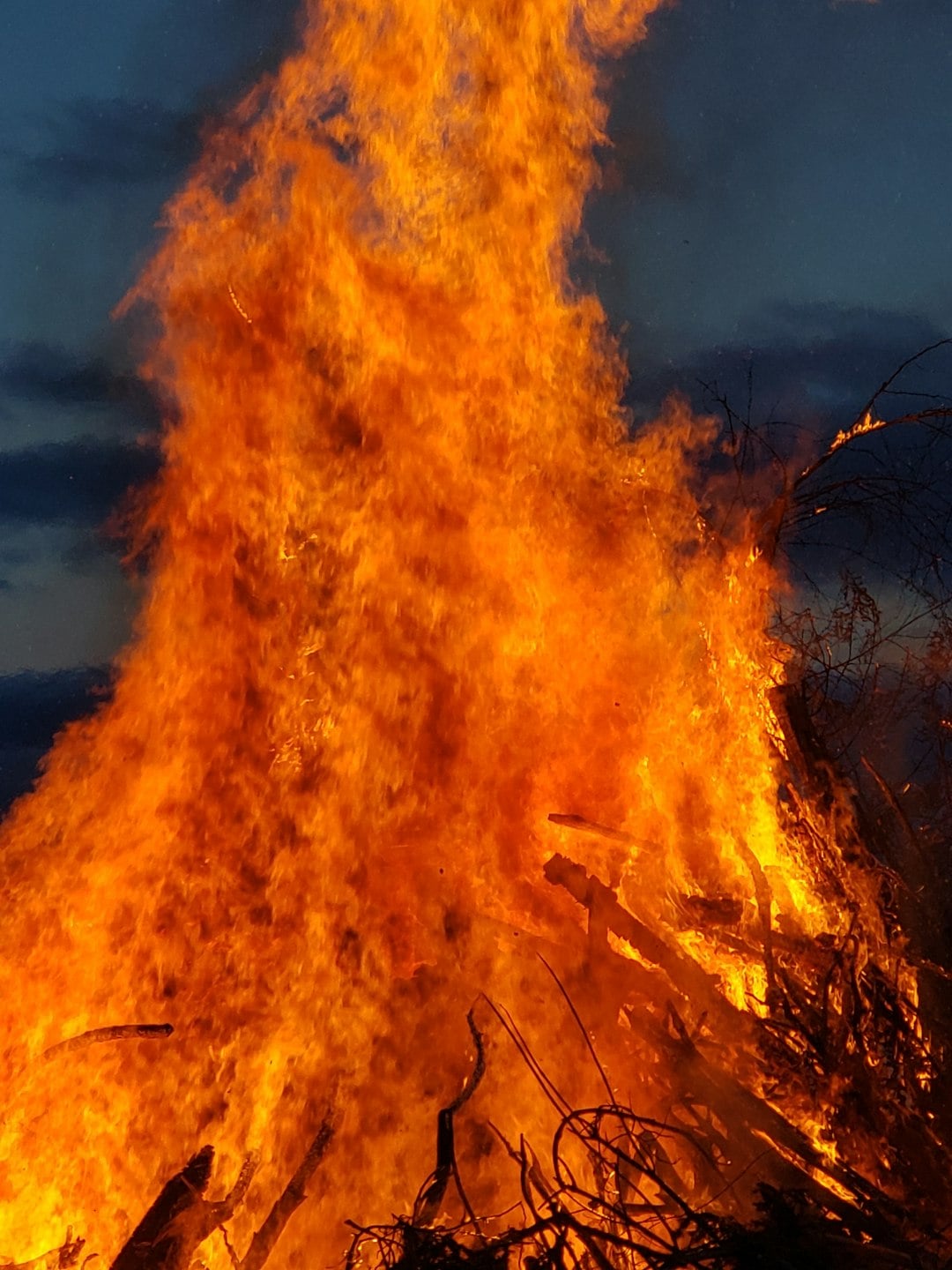
Every year, as darkness fell on the last evening of April, Ireland went quiet. Then, one by one, fires appeared on the hilltops. First one, then ten, then hundreds — blazing beacons stretching across the country from Donegal to Cork. It was Bealtaine. And for thousands of years, this was how Ireland welcomed summer back.
What Was Bealtaine?
Bealtaine (pronounced byal-tin-uh) is one of the four great seasonal festivals of ancient Ireland. It falls on the first of May, exactly halfway between the spring equinox and the summer solstice. The name likely comes from the Old Irish bel taine, meaning “bright fire” — a clue to what made this night different from every other night of the year.
For the ancient Irish, the year was divided into two halves: the dark half, which began at Samhain in November, and the light half, which began at Bealtaine. This was the moment when the world crossed a threshold. Summer was arriving. The cattle were moving to their summer pastures. And fire was the key that opened the gate.
The Druids played a central role in the ritual. In the days before May Eve, all fires in Ireland were extinguished. Every hearth went cold. Then, at Bealtaine, the Druids lit the first sacred fire of the new season. One by one, households would rekindle their own fires from a brand carried from the great bonfire. The whole country was reignited.
The Sacred Fire on the Hilltop
The most important Bealtaine fire in all of Ireland was lit on the Hill of Uisneach in County Westmeath — the mythological centre of Ireland. According to the old stories, the Druids lit the first great fire of summer here, visible across the whole country. Every other Bealtaine fire in Ireland had to be lit from a spark that came, ultimately, from Uisneach.
The significance of hilltops mattered deeply. Fire on high ground could be seen for miles. It was a signal and a summons. When one fire appeared, others followed. By midnight, the whole country glimmered with light.
Just as important was the Hill of Slane in County Meath, where St Patrick once lit his own sacred fire in direct challenge to the king’s Bealtaine fire burning at Tara — a moment that changed Ireland for ever. Old world and new, clashing on a hilltop in the spring dark. The ruins of the church and round tower built on Slane still stand today, silent watchers over the Boyne Valley below.
The May Bush and the Hawthorn Tree
The hawthorn — the whitethorn — was the sacred tree of Bealtaine. When it burst into blossom in late April and early May, it was known as the May bush, and its white flowers were the symbol of the season. Families would decorate a live hawthorn bush outside their door with ribbons, shells, and lit candles as an offering to the summer.
This is why the hawthorn became so respected in Irish folk tradition. Even today, you’ll find lone hawthorn trees standing untouched in the middle of Irish fields. Nobody moves them. Nobody cuts them. The old reverence for Bealtaine’s sacred tree never entirely faded.
The flowers of the hawthorn were also used to decorate wells, doorsteps, and byres. The scent of hawthorn blossom in the Irish countryside is still, for many Irish people, the smell of late spring itself — sweet and sharp, ancient and deeply familiar.
Driving Cattle Through the Flames
One of the most striking Bealtaine customs was the driving of cattle between two fires. Before the herds were led to their summer pastures, they were walked — sometimes run — through a narrow gap between two blazing bonfires. It sounds alarming. But it was, above all, an act of love.
The fire was believed to ward off disease, bad spirits, and the piseogs — the malicious charms that envious neighbours might cast on your livestock. A herd that passed safely through the Bealtaine fire was a herd that would thrive all summer long.
The same belief applied to people. Young men jumped the flames. Courting couples leaped across the embers together — a fire-blessing on a new relationship. Ashes from the Bealtaine bonfire were carefully gathered and scattered on the fields to encourage a good harvest.
☘️ Enjoying this? 64,000+ Ireland lovers get stories like this every week. Subscribe free →
Bealtaine at the Centre of the World — Uisneach
The Hill of Uisneach, in County Westmeath, holds a place of extraordinary importance in Irish mythology (read more in our full guide to the ancient fire festival of Bealtaine). It was said to be the true centre of Ireland — the point where the five ancient provinces met. A massive boulder called the Cat Stone (Aill na Míreann) marks the spot. It still stands there today, in a quiet field that looks no different from any other.
Every year in May, the modern Bealtaine festival at Uisneach draws thousands of visitors to watch the great fire lit once again on the ancient hill. Druids process, musicians play, and for a few hours the hilltop feels exactly as it must have felt two thousand years ago.
It is one of Ireland’s most extraordinary experiences — and one of its least known.
The Dew of May Morning
Not all Bealtaine magic involved fire. On the morning of the first of May, the dew on the ground was believed to have extraordinary power. Women would rise before dawn and wash their faces in the May morning dew to preserve their beauty and health through the year.
In some parts of Ireland, women would travel miles to gather dew from a particular hilltop or fairy mound. The dew of Bealtaine morning was said to be a gift from the Tuatha Dé Danann — the ancient supernatural race who, according to Irish myth, retreated underground at Bealtaine to make way for the new world.
This is a telling detail. Bealtaine was not only a celebration of summer. It was also the moment the invisible world drew very close. The boundary between the living and the otherworld thinned. Strange things were said to happen on Bealtaine night. Fairy forts glowed from within. The rules of the ordinary world were briefly suspended.
Why Bealtaine Still Echoes in Ireland Today
Bealtaine never fully disappeared. The fires went quiet for centuries, but the instinct behind them never died. The love of the hawthorn in bloom, the sense that early May is charged with something older and bigger — these persisted in Irish households long after anyone could explain why.
Today, Bealtaine festivals are held across Ireland every May. The largest is at Uisneach in Westmeath. Others take place in Dublin, Galway, and Wicklow. They are not recreations of something dead. They are continuations of something very old — a thread running unbroken from the ancient Irish hilltops to the present day.
If you’re planning a trip to Ireland, try to time it for early May. Walk the fields when the hawthorn is in bloom. Find a hilltop at dusk. And if you notice a faint sense of something older than memory on the air, you’ll know exactly what it is.
☘️ You Might Also Love
☘️ Want More Hidden Ireland?
Join 64,000+ subscribers who discover Ireland’s best-kept secrets every week.
Subscribe Free — Join the Community →
Free forever · Unsubscribe anytime · No spam
📥 Free Download: Ireland Travel Planning Guide
Our most popular resource — itineraries, insider tips, and the 50 places you must not miss.
Tours & experiences you might love


Powered by Viator. Some links are affiliate links — we may earn a small commission at no extra cost to you.
Secure Your Dream Irish Experience Before It’s Gone!
Planning a trip to Ireland? Don’t let sold-out tours or packed attractions spoil your journey. Iconic experiences like visiting the Cliffs of Moher, exploring the Rock of Cashel, or enjoying a guided walk through Ireland’s ancient past often sell out quickly—especially during peak travel seasons.

Booking in advance guarantees your place and ensures you can fully immerse yourself in the rich culture and breathtaking scenery without stress or disappointment. You’ll also free up time to explore Ireland’s hidden gems and savour those authentic moments that make your trip truly special.
Make the most of your journey—start planning today and secure those must-do experiences before they’re gone!