

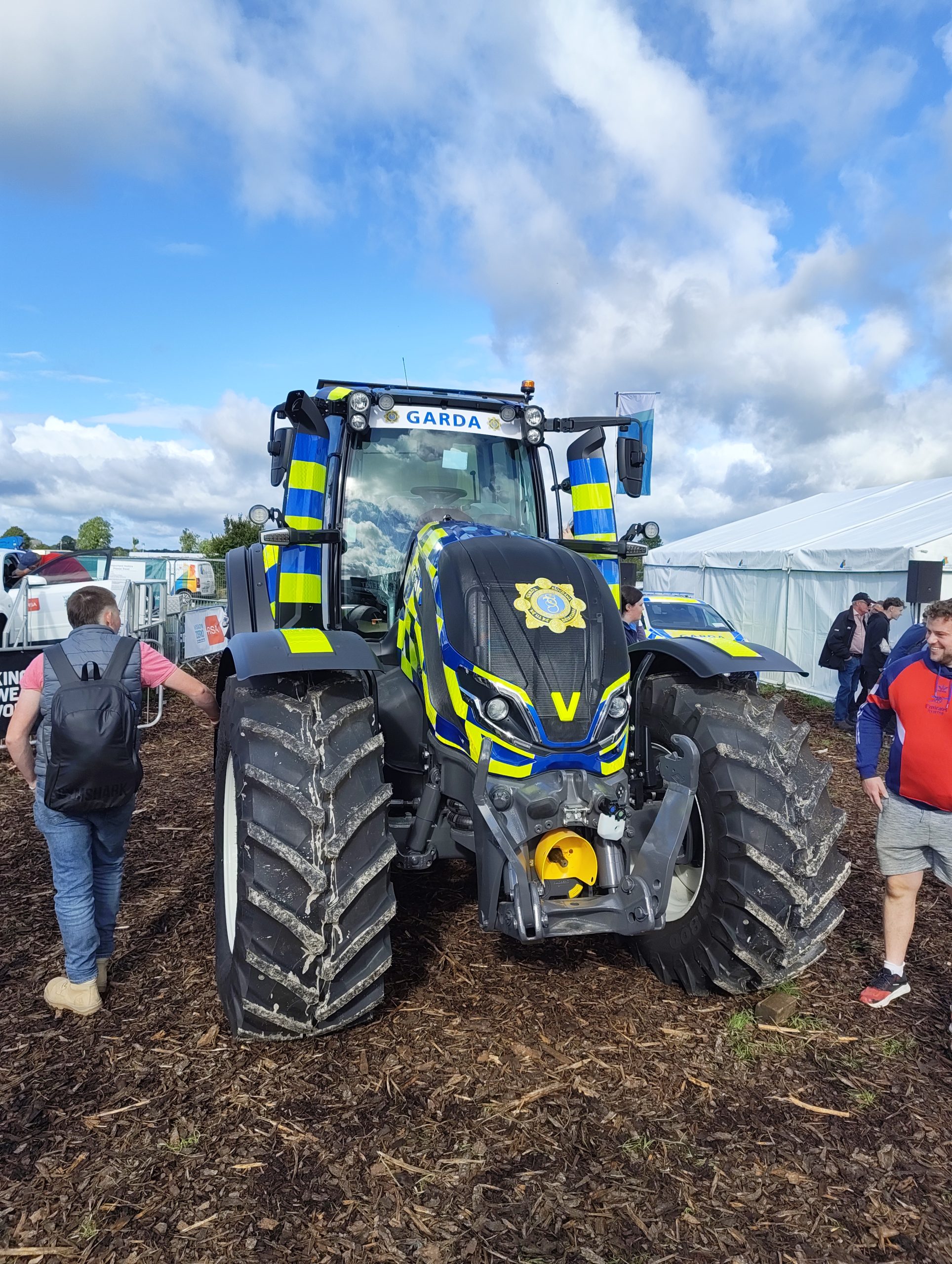
What Actually Happens at the National Ploughing Championships — and Why 300,000 People Show Up
Every September, on several hundred acres of Irish farmland, something happens that is genuinely difficult to explain to someone who did not grow up here. A private organisation with nineteen employees lays 51 kilometres of electrical cable, pipes in 20.5 kilometres of water mains, and installs 31 kilometres of trackway. It runs a fashion show every day, a matchmaking service, a working brewery, a government policy village, sheep dog trials, a funfair, live cooking demonstrations, and — yes — a ploughing competition. Nearly a quarter of a million people come. The Taoiseach comes. The Tánaiste comes. Every party leader comes. And when it is all over, the organisers pack up, find a different field, and prepare to do it again twelve months later.
This is the National Ploughing Championships. And the story of how a nine-county match held on a February morning in 1931 became a major annual outdoor agricultural event involves a budget of just over nine pounds, a woman who started work at seventeen, and enough institutional stubbornness to make the whole thing look effortless from the outside.
It Started With an Argument
The first National Ploughing Championships cost its organisers £9, three shillings, and five pence. The date was February 16, 1931. The location was a field belonging to a farmer named W.K. Hosie, near Coursetown in Athy, County Kildare. Nine counties sent competitors. The stated mission of the event, written down by its founders, was “to bring the message of good ploughing to all parts of the country.”
The event came about because two men could not settle a question by talking. J.J. Bergin of County Kildare and Denis Allen of County Wexford had each formed the view that their county produced superior ploughmen. Rather than continuing to argue, they organised a competition. That is, in broad terms, still what happens: people line up, pick up their equipment, and see who can do it best. Everything else — the fashion shows, the food stalls, the government ministers pressing the flesh at party headquarters marquees the size of aircraft hangars — came later.
By 1932, the second championships drew 3,000 people to Wexford. By 1934, seventeen counties were sending competitors. By 1942, tractors had earned their own class. By 1955, the event had stretched to two days. By 1988, to three. In 2001, it was cancelled for the only time in its history before COVID-19, because of the foot-and-mouth outbreak. In 2019, a record 297,000 people attended over three days in County Carlow. In 2026, the championships, held at Screggan outside Tullamore in County Offaly, drew 243,000.
What 730 Acres Actually Looks Like
☘️ Join 64,000+ Ireland Lovers
Every weekday morning, get Ireland’s hidden gems, local secrets, and travel inspiration — the kind you won’t find in any guidebook.
Subscribe free — enter your email:
Already subscribed? Download your free Ireland guide (PDF)
📲 Know someone who’d love this? Share on WhatsApp →
Free forever · Unsubscribe anytime
The site is not a venue in any permanent sense. It is farmland, reconfigured from scratch each year. Of the 730 acres required for the 2026 event, 180 were given over to ploughing competition, 150 to trade stands, and 400 — more than half the total site — to parking. The 80,000 vehicles expected daily had to go somewhere.
The infrastructure that goes into a site like this is staggering when you lay it out. Fifty-one kilometres of electric cable. Twenty kilometres of broadband cable. Twenty point five kilometres of water pipe. Fifteen generators. Thirty-one kilometres of internal trackway so that the site, which is farmland, does not turn into a swamp when 80,000 vehicles and 80,000 people arrive on the same morning. The event costs approximately €7 million to stage. It generates, by official estimates, over €50 million in economic activity — in a single county, over three days.
That local impact is not abstract. When the championships come to a county, every hotel within 30 to 40 miles runs at full capacity for four days. Accommodation demand starts building eight to ten weeks before the event, as workers arrive to prepare the site. In Tullamore for 2026, over 2,000 temporary staff, volunteers, and stewards were employed. The local Enterprise Office used it as a platform for more than twenty Offaly-based businesses. Soap-makers, bakers, foragers, artists, and food producers all had stands. The economic case for hosting it is straightforward. The case against is mainly about what 80,000 cars a day does to your county roads.
A Trade Fair With Ploughing Attached
People who have never attended sometimes imagine it as a farming competition surrounded by related stalls — seed merchants, machinery dealers, that sort of thing. The reality has been, for several decades, something considerably stranger and more exhilarating than that. For other events to plan around, see our guide to autumn festivals in Ireland.
The 2026 championships featured, among other things: a fashion show every day; a government policy village where ministers and civil servants presented housing policy, climate action plans, and road safety initiatives to passing farmers; an EU headquarters pavilion that was described by one journalist as resembling “a sauna” due to its wood-clad walls; a matchmaking service run from inside the Whistlin’ Donkey bar by a woman from Mullingar, which apparently achieved results; a booth where Keogh’s Crisps printed visitors’ faces onto unpeeled potatoes (“Innovation and tradition all in one”); Enterprise Ireland’s Innovation Arena, which is one of the most visited exhibits; university recruitment stands; craft demonstrations including Irish lacemaking and soda bread baking; a working funfair; and 2,000-plus trade stands spanning an area that, without the trackway, would be impassable.
Competing in the ploughing itself, there were more than 320 competitors across nineteen separate classes, including horse-drawn ploughing — a discipline that requires not only technical skill but a relationship with an animal that fewer Irish farmers now maintain. Sheep shearing, tug-of-war, sheepdog trials, and pony games round out a competitive programme that runs alongside the exhibition in parallel all day.
Adult entry in 2026 was €30 when bought in advance online and €35 at the gate. Children under twelve go free when accompanied by an adult.
The Woman Who Made It This Way
The National Ploughing Association, which organises all of this, is a private company incorporated in 1956. It has nineteen employees. Its managing director is Anna May McHugh, who is ninety-two years old and has held the role since 1973.
She was born the fifth of eight children on a farm in Ballylinan, County Laois. In 1951, aged seventeen, she took a job as secretary to J.J. Bergin — the same Bergin who had co-founded the championships twenty years earlier. She became company secretary in 1955. When she was appointed managing director in 1973, it was, as one account put it, “an unprecedented move” for a woman in that role at that time. In 1997, she became the first woman to sit on the board of the World Ploughing Organisation. Her daughter, Anna Marie McHugh, now serves as assistant managing director alongside her.
The expansion of the championships beyond a ploughing competition is largely her doing. The fashion shows, introduced in 1981, came after male colleagues questioned what fashion had to do with a ploughing match. “I’m having a fashion show,” was the response McHugh recalled giving. It stayed. The livestock section arrived in 1987. Shopping arcades in 1985. Celebrity chef cookery demonstrations followed. The entertainment venues, the play areas, the teenage competitions — all of it was layered on, year by year, over seventy-plus years of the same person running the same organisation in an ever-expanding field.
In 2013, she won the Veuve Clicquot Business Woman of the Year Award. The following year, the National University of Ireland awarded her an honorary doctorate. France’s government gave her the Ordre du Mérite Agricole in 2015. Harper Adams University in England gave her an honorary degree in 2019. She has received these recognitions for building, from scratch and without public funding, a major outdoor commercial event in Ireland, which began with a budget of barely £9.
Why the Politicians Come
The National Ploughing Championships takes place in mid-September. Ireland’s Budget is announced in October. This is not a coincidence in terms of the political calculus involved.
All the main parties maintain stands at the championships, staffed by party workers and visited by senior figures. In 2026, attendees included Taoiseach Micheál Martin and Tánaiste Simon Harris. The event is, as one political correspondent has put it, suffused with an air of electioneering — an annual opportunity to stand in a field with 243,000 members of rural Ireland at a moment when what the government is about to do to farm incomes and rural budgets is directly relevant to their livelihoods.
The NPA has never formally positioned the event as a political forum. It does not need to. When you draw a quarter of a million people to a county in a country of five million, politics comes to you. A man in his 60s was arrested after an alleged attempt to assault the Taoiseach at the 2026 event and has since been charged. The event is, by this point, somewhere between a trade fair and a national assembly — and it happens on private farmland, moved each year to a new county, organised by nineteen people and a ninety-two-year-old woman who has been doing this longer than most of the politicians attending were alive.
The Annual Hunt for 730 Acres
The championships’ defining logistical quirk is that they move. Every year, the NPA must find and secure a new site — or return to a familiar one — that can accommodate 730 acres of flat, workable agricultural land within range of major motorways, with soil good enough for competitive ploughing and ground firm enough to hold 80,000 vehicles a day. Counties that get picked tend to campaign for the honour; the €50 million economic impact makes it worth their while. Some locations have hosted multiple times — County Wexford has appeared in the list going back to 1932, County Tipperary many times, County Offaly repeatedly.
The venue list over ninety-five years reads like a roll-call of Irish agricultural heartland: Athy, Gorey, Athenry, Mallow, Killarney, Thurles, New Ross, Tullow, Carlow, Laois, Offaly, returning and returning. There is no permanent home, no fixed infrastructure, no stadium that sits waiting. Every September, someone has to lay 51 kilometres of cable again.
This is, in a real sense, what makes the event so improbable as an ongoing commercial proposition: the scale it operates at, and the logistics it demands, would justify permanent infrastructure many times over. The NPA does it anyway, without it, every year, on a different patch of Irish soil. The championships have been cancelled twice in their history — once for foot-and-mouth, once for a pandemic. Every other year, since 1931, someone has found a field.
There is something in that persistence that is genuinely worth understanding. The event is not a government project. It is not backed by a large corporation. It runs on ticket sales, exhibitor fees, and the kind of institutional momentum that only comes from seven decades of being the same person doing the same job, adding one thing at a time — a fashion show here, a shopping arcade there, a matchmaker in a bar, a boot of politics — until the thing you are running is somehow too large and too important to fail. September in Ireland has the ploughing in it the way October has the Budget. Both, in their way, are about what the land is worth and who gets to decide.
The championships will take place again next year. Another field. Another 50 kilometres of cable. Same organisation, same mission, different county. We will almost certainly be there.
Tours & experiences you might love


Powered by Viator. Some links are affiliate links — we may earn a small commission at no extra cost to you.
Secure Your Dream Irish Experience Before It’s Gone!
Planning a trip to Ireland? Don’t let sold-out tours or packed attractions spoil your journey. Iconic experiences like visiting the Cliffs of Moher, exploring the Rock of Cashel, or enjoying a guided walk through Ireland’s ancient past often sell out quickly—especially during peak travel seasons.

Booking in advance guarantees your place and ensures you can fully immerse yourself in the rich culture and breathtaking scenery without stress or disappointment. You’ll also free up time to explore Ireland’s hidden gems and savour those authentic moments that make your trip truly special.
Make the most of your journey—start planning today and secure those must-do experiences before they’re gone!