

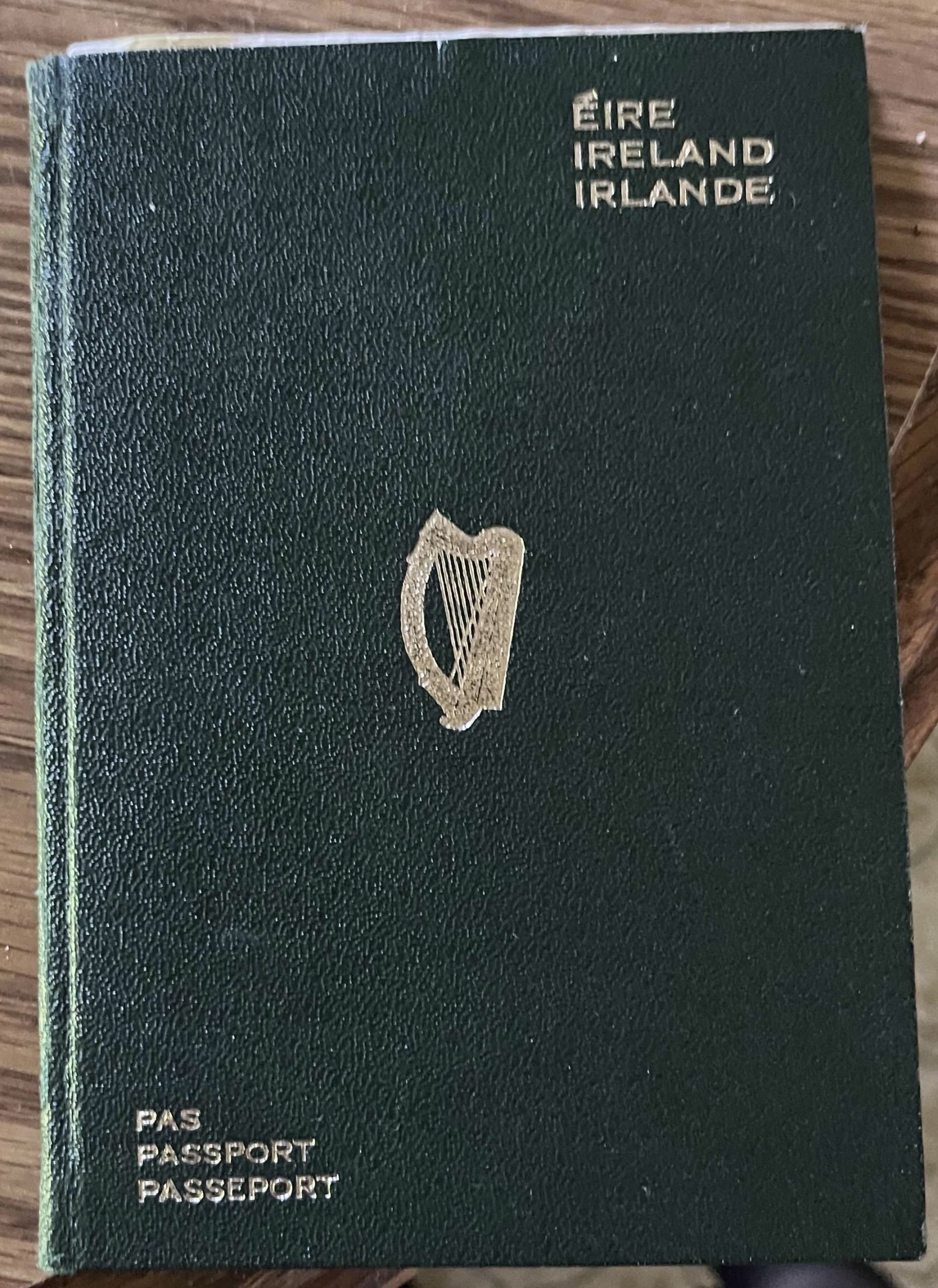
How a 70-Year-Old Irish Law Turned Brexit Into the Biggest Passport Rush in Living Memory
The Brexit result came through in the early hours of June 24, 2016. Within weeks, applications for Irish passports from Great Britain had nearly doubled.
Between July and September of 2015, the Irish Passport Service received 10,959 applications from England, Scotland, and Wales. In the same three months of 2016 — the quarter immediately following the referendum — it received 21,549. Not a gradual drift upward. A doubling, in a single quarter, with no change in eligibility rules. Just a vote, and then a sudden, widespread realisation among hundreds of thousands of British people that they had a claim they had never particularly needed to use.
What they had remembered — or in many cases, discovered for the first time — was a provision in Irish citizenship law that few people in Britain had ever considered. And what followed was a sharp administrative surge.
The Law That Made It Possible
Irish citizenship law has always been shaped by emigration. For most of the nineteenth and twentieth centuries, Ireland was a country people left — and, unlike most nations that watched their populations scatter across the world, Ireland chose to keep the door open across generations.
Under the Irish Nationality and Citizenship Act, anyone born on the island of Ireland before 1 January 2005, when changes approved by a 2004 referendum took effect, has an automatic entitlement to citizenship. Children of Irish citizens, wherever they were born, can claim citizenship by descent. And so can grandchildren: if you have an Irish-born grandparent, you can register your birth in the Foreign Births Register — maintained by the Irish Department of Foreign Affairs — and from there apply for a passport. For a full overview of Irish citizenship routes, see How Americans Can Get Irish Citizenship in 2026. The Department of Foreign Affairs, which runs the register, is at dfa.ie.
Claims that run through a grandparent are unusual, and Ireland’s willingness to extend eligibility this far back reflects the demographic reality it was legislating for. The Irish who left for Britain, the United States, and Australia during the great waves of twentieth-century emigration mostly did not come back. Their children grew up British, American, Australian. Drawing citizenship eligibility at the first generation would have cut off exactly the people the law was written to reach.
For decades, this provision sat quietly in the statute books. Then Britain voted to leave the European Union, and it became very relevant indeed.
The Numbers Build
☘️ Join 64,000+ Ireland Lovers
Every weekday morning, get Ireland’s hidden gems, local secrets, and travel inspiration — the kind you won’t find in any guidebook.
Subscribe free — enter your email:
Already subscribed? Download your free Ireland guide (PDF)
📲 Know someone who’d love this? Share on WhatsApp →
Free forever · Unsubscribe anytime
The Q3 2016 doubling was not a spike that settled down. It was the opening move in a sustained surge.
Full-year applications from Great Britain reached 81,287 in 2017. In 2018, they climbed to 98,544 — a 22% year-on-year increase that represented 12% of all Irish passport applications worldwide that year.
Northern Ireland was moving simultaneously on its own trajectory. Applications from Northern Ireland also rose, reaching 84,855 in 2018, a 2% increase on the year before.
Fine Gael Senator Neale Richmond was among those pressing for detail on the scale of the demand from Britain and Northern Ireland, and the figures that emerged were consistent with a sustained rise.
Reported refusal figures showed that the number of UK-based applications turned down by the Irish Passport Service remained in double digits — meaning the overwhelming majority of people applying had the legal entitlement they were claiming. This was not wishful thinking at scale. It was a large diaspora population formalising a right that was genuinely, legally theirs.
A Record-Breaking Machine
By 2018, the Irish Passport Service was processing applications at a rate it had never experienced. That year, it issued 822,581 passports — 529,673 to adults and 292,908 to children — from a total of 855,283 applications received. Both were records.
And then came the winter of 2018 and 2019, when the prospect of a no-deal Brexit — the UK leaving the EU without any withdrawal agreement, with immediate effect — began to look genuinely possible. Contingency planning allowed for as many as 300,000 additional applications in the event of a no-deal outcome.
Demand stayed high regardless. Close to one million Irish passports were issued in 2019. The no-deal Brexit never materialised; the UK formally departed the EU in January 2020 under a negotiated withdrawal agreement. But applications remained considerably elevated above any pre-referendum baseline, and the logistical exercise the Passport Service had been planning for was the shape of the new normal regardless.
Northern Ireland: A Different Calculation
Northern Ireland deserves its own accounting, because the story there is not simply a subset of the broader UK picture. It is more complicated, and in some ways more interesting.
Under the terms of the Good Friday Agreement — the 1998 peace settlement that ended the Troubles — people born in Northern Ireland have always been entitled to hold Irish citizenship, British citizenship, or both. The right was not contingent on Brexit. For many Northern Irish people, particularly those from unionist or broadly British-identifying backgrounds, the Irish citizenship entitlement had simply never seemed relevant. There had been no particular practical benefit to claiming it. Then, in June 2016, holding an Irish passport became the only way for a Northern Irish resident to remain a European Union citizen.
The population-level response, captured in the 2021 Northern Ireland Census conducted by the Northern Ireland Statistics and Research Agency, is striking in its scale. In 2011, 375,800 people in Northern Ireland held an Irish passport, solely or alongside a UK passport. By 2021, that figure was 614,300 — a 63.5% increase in a decade.
By 2021, those 614,300 people represented 32.3% of Northern Ireland’s usual resident population. In the same census, 1,000,200 people (52.6% of the population) held a UK passport, solely or jointly.
Nearly one in three people in Northern Ireland held an Irish passport by the time the census was taken.
What the Grandparent Rule Was Actually For
An Irish passport is, practically speaking, an EU passport. It grants the holder the right to live and work in any of the European Union’s 27 member states — a right that British citizens without Irish descent or another EU-citizen ancestry lost when the UK’s Brexit transition period ended on December 31, 2020.
For those in Great Britain who had the legal entitlement, claiming Irish citizenship was a way of preserving something concrete: the freedom of movement that had, for 47 years, been simply part of what it meant to hold a British passport. For many of them, the discovery that they qualified came through family conversations, ancestry websites, or the kind of accelerated genealogy that tends to follow moments of political uncertainty. An Irish-born grandmother. A grandfather who came over from Cork or Mayo or Donegal in the 1950s and never quite entirely stopped being Irish. The legal provision existed. The family history existed. It was a matter of documentation.
The Foreign Births Register process requires applicants to provide a chain of evidence: a grandparent’s birth certificate from the island of Ireland, proof that the intervening generation registered their foreign birth before the applicant was born, and supporting identity documents. It is not automatic. The inter-generational registration requirement means a parent must have formally registered their own foreign birth before you were born for the claim to pass cleanly to your generation. For help documenting an Irish-born ancestor, see How to Trace Your Irish Ancestry: A Complete Step-by-Step Guide. And yet the refusal data tells its own story: with UK refusals in double digits while applications ran into six figures, the documentary chains existed at significant scale in British families that had largely stopped thinking of themselves as Irish in any formal sense.
The drafters of the 1956 Irish Nationality and Citizenship Act were writing law for a country whose citizens had scattered across the world. They probably did not spend much time considering what would happen if a grandchild of a 1950s Cork emigrant found themselves, seven decades later, in urgent need of an EU passport because their country had voted to leave a political union. But they wrote legislation capacious enough to cover exactly that situation — and the Irish Passport Service processed the applications. The numbers show the rest.
What makes this story worth sitting with is not the bureaucratic achievement, though handling a near-doubling of UK applications while simultaneously setting records in total passport volumes is no small thing. It is what the numbers reveal about legal entitlement and identity. For the 614,300 people in Northern Ireland who held an Irish passport by 2021, and for the hundreds of thousands in Great Britain who applied after June 2016, the act of claiming that passport was a piece of formal documentation — an acknowledgement of a connection that already existed, written into law more than sixty years ago, and still waiting when it was needed most.
Tours & experiences you might love


Powered by Viator. Some links are affiliate links — we may earn a small commission at no extra cost to you.
Secure Your Dream Irish Experience Before It’s Gone!
Planning a trip to Ireland? Don’t let sold-out tours or packed attractions spoil your journey. Iconic experiences like visiting the Cliffs of Moher, exploring the Rock of Cashel, or enjoying a guided walk through Ireland’s ancient past often sell out quickly—especially during peak travel seasons.

Booking in advance guarantees your place and ensures you can fully immerse yourself in the rich culture and breathtaking scenery without stress or disappointment. You’ll also free up time to explore Ireland’s hidden gems and savour those authentic moments that make your trip truly special.
Make the most of your journey—start planning today and secure those must-do experiences before they’re gone!