

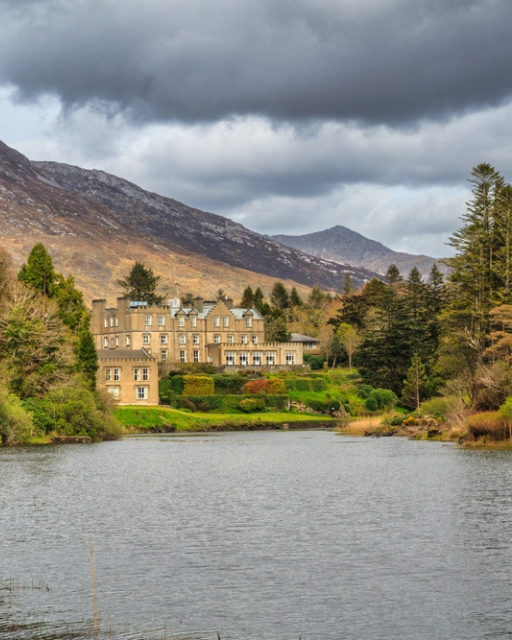
There are places in Ireland that ask you to slow down. Ballynahinch Castle in Connemara is one of them. Set on a 700-acre estate in County Galway, it sits beside a salmon river with the Twelve Bens mountains rising behind it. The landscape is big, open and quiet in a way that is hard to find elsewhere. If you are looking for somewhere that genuinely offers a break from the noise of daily life, this is worth serious consideration.
This article covers what makes Ballynahinch worth visiting, how to get there, what to do on the grounds and nearby, and what to expect if you are planning a stay.
Love discovering Ireland’s hidden gems? Get weekly stories, travel tips and local secrets delivered to your inbox. Subscribe to the Love Ireland newsletter →
A Brief History of Ballynahinch Castle
The castle has a long and layered past. The estate traces its roots back over 300 years, though the current building dates largely from the 18th and early 19th centuries. It was once home to the Martin family, whose most famous member was Richard Martin — known as “Humanity Martin” — who was one of the founding members of what became the Royal Society for the Prevention of Cruelty to Animals (RSPCA). That gives you some sense of the values the place has long been associated with.
Before the Martins, the land was connected to the O’Flaherty clan and later to the wider history of Connemara’s chieftains. Grace O’Malley, the 16th-century pirate queen and one of Ireland’s most compelling historical figures, has a long association with this stretch of the west coast, though the castle as it stands today came later.
In the 20th century, Ballynahinch was owned for a time by His Highness the Maharaja Jam Saheb of Nawanagar — better known as Ranjitsinhji, the famous cricketer who played for Sussex and England. He used the estate as a fishing retreat during the 1920s and 1930s. The cricket-to-salmon-fishing connection might seem unusual, but it speaks to the kind of place Ballynahinch has always been: somewhere that attracts people who want to step away from their usual world for a while.
The castle has operated as a hotel since 1946 and is now one of the better-regarded country house hotels on the west coast of Ireland.
What the Estate Looks Like Today
The grounds cover 700 acres of Connemara bogland, woodland and riverbank. The Ballynahinch River runs through the estate and is one of the better salmon rivers in Ireland. Fishing rights on the river are available to guests, which draws serious anglers from across Europe and further afield each season.
The castle building itself is solid and handsome rather than dramatic. It is the landscape around it that does the heavy lifting. The Twelve Bens — a compact range of quartzite mountains — are visible from much of the estate. On a clear day the light on those peaks changes constantly, which is something you notice if you spend any time sitting still and looking.
The grounds include formal gardens, woodland paths and river walks. You do not need to be a guest at the hotel to explore the area around Ballynahinch — much of Connemara is accessible to walkers — but staying on the estate gives you access to the river walks and the quieter corners of the grounds.
Want more like this? Join thousands of Ireland lovers who get our free weekly newsletter — packed with places to visit, things to do, and stories from across the island. Sign up free here →
Getting to Ballynahinch Castle
The castle is located near Recess (Sraith Salach) in County Galway, roughly 65 kilometres west of Galway city. By car from Galway, the drive takes around an hour along the N59, which is one of the more scenic main roads in Ireland as it passes through Oughterard and into the heart of Connemara.
There is no direct public transport to the castle. Bus Éireann runs services from Galway to Clifden, which passes through the general area, but you would need a car or taxi for the last stretch. If you are flying in, Shannon Airport is around two hours away. Dublin Airport is roughly three hours by car via Galway.
The nearest town of any size is Clifden, about 20 kilometres to the west, which has a good range of restaurants, pubs and shops. Roundstone, a small fishing village, is closer and worth a stop for lunch if you are passing through.
Walking and the Outdoors
The area around Ballynahinch offers some of the best walking in Connacht. The Twelve Bens provide challenging hill walks for those who want them — Benbaun is the highest at 729 metres — while the valleys and bogs around the range are accessible to walkers of all fitness levels.
The Connemara National Park, centred on the Diamond Hill loop walk near Letterfrack, is about 30 minutes from the castle by car. The Diamond Hill walk is well-marked, takes two to three hours and gives excellent views across Connemara and out towards the Atlantic. It is one of the most popular short walks in the west of Ireland, and for good reason.
On the estate itself, the river walk along the Ballynahinch is particularly good in the morning when the light is low and the water is clear. You are likely to see herons, kingfishers and, during the fishing season, the jumping of salmon in the pools below the weir.
Cycling is another option. The area has some good quiet roads, though you need to be comfortable with hills and the occasional loose gravel surface. A mountain bike is more practical than a road bike in this terrain.
The Best Time to Visit Connemara
The honest answer is that Connemara is worth visiting in any season, but each brings different conditions. Summer (June to August) is the busiest period and the most reliable for weather, though “reliable” in the Irish west means you should still carry a waterproof at all times. The long evenings are genuinely beautiful — it stays light until after 10pm in June.
Spring and autumn are quieter and often have their own appeal. April and May bring new growth to the bogs and the mountains and the roads are far less busy. September and October can have long stretches of calm weather and the light has a different quality to it — lower, warmer, more dramatic at sunrise and sunset.
Winter is quiet. Many visitor attractions in the area reduce their hours or close. But if you want Connemara to yourself and are prepared for short days and cold temperatures, there is something remarkable about the landscape when the rest of Ireland has forgotten it exists. The castle hotel stays open year-round.
Salmon Fishing on the Ballynahinch River
Ballynahinch is one of Ireland’s most respected salmon fisheries. The river system drains several lakes — Ballynahinch Lake being the main one — and the salmon run from spring through to autumn. Spring salmon — larger, multi-sea-winter fish — begin arriving from late winter and early spring. Grilse, the smaller single-sea-winter fish, follow from May or June, with the main run continuing through July depending on water levels and temperature.
Guests at the castle can book fishing beats on the river through the hotel. It is not cheap — this is a premium fishery with a long waiting list for popular dates — but for serious anglers it is considered one of the best experiences available on the west coast. The ghillies (fishing guides) who work the river have deep knowledge of the system and are worth listening to.
Even if you have no interest in fishing, watching someone working a salmon pool on the Ballynahinch on a still morning is something worth seeing. The skill involved is considerable.
Never miss an Irish adventure. Our newsletter goes out every week with the best of Ireland — from wild coastlines to cosy country houses. Subscribe for free →
Practical Information for Visitors
Ballynahinch Castle Hotel is a four-star property with 48 rooms, a restaurant and a bar. It is not budget accommodation — room rates in summer typically start from around €300 per night and go up from there. The restaurant sources locally where possible and is well regarded for its seafood. The bar is comfortable and unpretentious, the kind of place you might spend a long evening without particularly noticing.
If staying at the castle is outside your budget, there are self-catering cottages and B&Bs in the wider Connemara area that give you access to the same landscape for considerably less. Recess, Clifden and Roundstone all have options.
The area around Ballynahinch has limited mobile signal in some spots — this is not a complaint but a feature. If you are planning activities that require navigation, download your maps offline before you leave. Petrol stations are sparse in Connemara, so fill up in Galway or Clifden rather than assuming you will find one when you need it.
Dogs are welcome at the castle and on most of the surrounding walking routes. Ballynahinch is the kind of place that suits dogs well.
Why Connemara Stays With You
Most people who visit Connemara come back. There is something about the scale of the landscape — the way the bog stretches out, the mountains hold their shape against changing skies, and the Atlantic light makes everything look slightly unreal — that is difficult to shake off once you have seen it.
Ballynahinch Castle is not the only place worth visiting in Connemara, but it is one of those locations that concentrates what the region does well: wildness, quiet, history and the slow pleasure of being somewhere that has not been over-managed. You do not need to stay at the hotel to appreciate any of that. You just need to get there.
Image credit: Love Ireland Archive
Thinking about it for retirement?
If you’ve started thinking seriously about retiring there, our complete our full Retire in Ireland guide covers the visa, healthcare, cost-of-living, and the regions worth shortlisting.
Tours & experiences you might love


Powered by Viator. Some links are affiliate links — we may earn a small commission at no extra cost to you.
Secure Your Dream Irish Experience Before It’s Gone!
Planning a trip to Ireland? Don’t let sold-out tours or packed attractions spoil your journey. Iconic experiences like visiting the Cliffs of Moher, exploring the Rock of Cashel, or enjoying a guided walk through Ireland’s ancient past often sell out quickly—especially during peak travel seasons.

Booking in advance guarantees your place and ensures you can fully immerse yourself in the rich culture and breathtaking scenery without stress or disappointment. You’ll also free up time to explore Ireland’s hidden gems and savour those authentic moments that make your trip truly special.
Make the most of your journey—start planning today and secure those must-do experiences before they’re gone!