

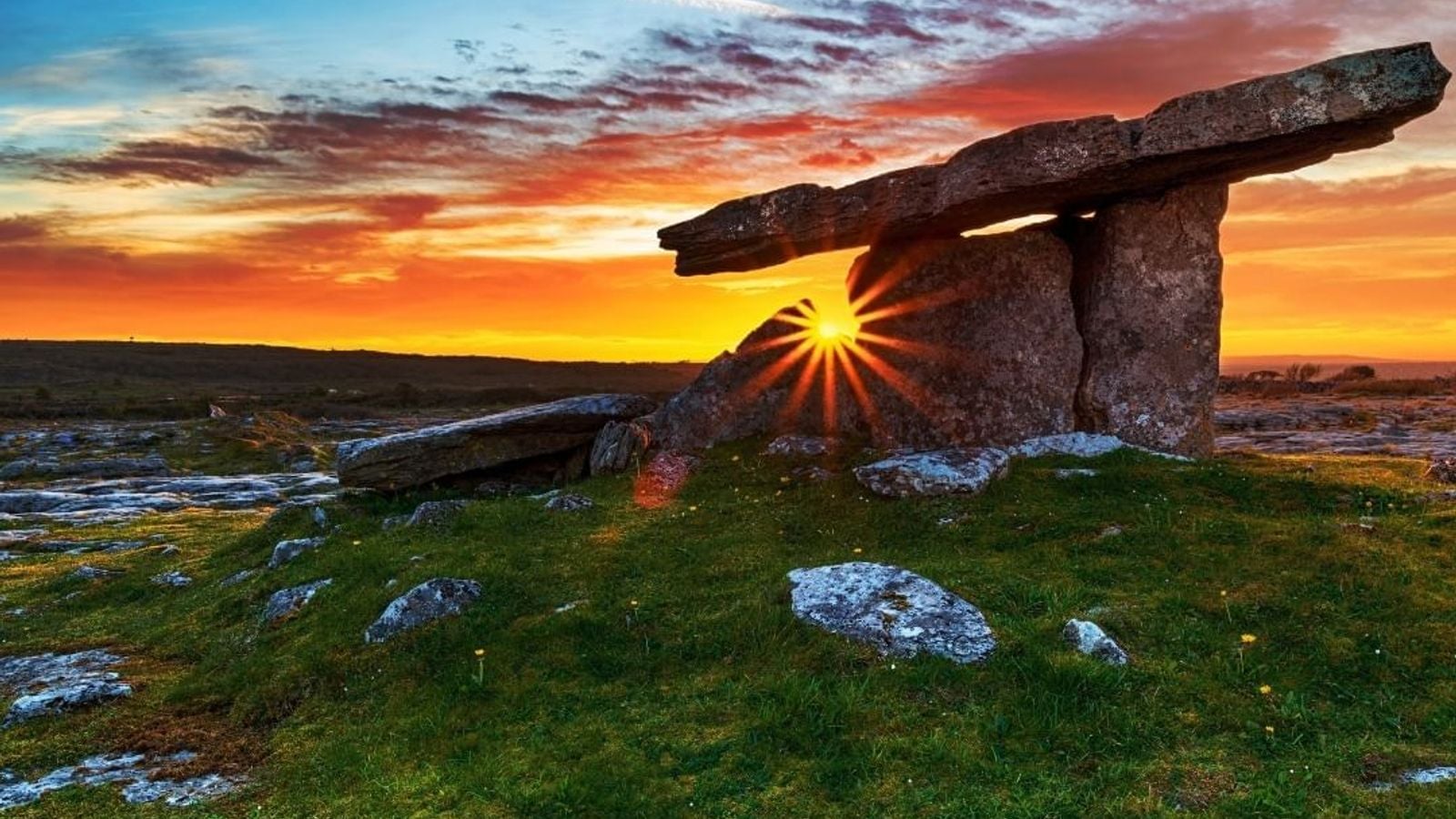
In a field in County Clare, four ancient stones support the capstone of a portal tomb so large that no machinery alive today could have shifted it. This is Poulnabrone, one of Ireland’s oldest portal tombs, and it has stood for nearly 6,000 years. No one knows who built it, why they chose that spot, or what they truly believed would happen there.
What a Portal Tomb Actually Is
Portal tombs — sometimes called dolmens — are Ireland’s oldest above-ground structures. Ireland has more than 170 of them, scattered from the Burren in County Clare to the coasts of Kerry and Donegal.
The typical form is simple: two or more upright stones support a massive capstone overhead, tilted slightly like a stone table balanced on its edge. The effect is so distinctive that you never forget the first one you see.
The most famous is Poulnabrone in the Burren, County Clare. Its name translates roughly as ‘hole of the sorrows’. It sits on an exposed limestone plateau where the rock itself looks ancient — cracked, grey, and stripped back to something older.
What Was Found Inside
Excavations at Poulnabrone in the 1980s found the remains of at least 33 individuals — men, women, and children — along with polished stone pendants, bone pins, and fragments of pottery.
Carbon dating placed them between 3800 and 3200 BC. That makes Poulnabrone more than 1,000 years older than the Great Pyramid of Giza.
What archaeologists cannot fully explain is why certain individuals were buried here and not others. Not everyone in the community was interred at the dolmen. The bones suggest these were people of some significance — though whether that meant status, ancestry, or something else entirely, no one can say.
The Mystery of the Capstone
The capstone at Poulnabrone weighs approximately five tonnes. Moving it required either a form of technology that left no trace, or a communal effort so organised it staggers the imagination.
Portal tombs are rarely hidden. They sit on hilltops, on exposed ridgelines, in positions visible for kilometres. Archaeologists believe this was deliberate — that these monuments were meant to be seen by the living as much as to house the dead. They marked a place. They said: we came from here.
Some researchers believe the stones may once have been covered in bright pigment. The grey surface that makes them look mournful today may have been white or rust-red when they were first raised.
☘️ Enjoying this? 64,000+ Ireland lovers get stories like this every week. Subscribe free →
The Legends That Grew Around Them
For generations of Irish people, portal tombs were known as leapacha Dhiarmada agus Gráinne — the beds of Diarmuid and Gráinne. In the old legend, the two lovers fled across Ireland after Gráinne eloped with Diarmuid rather than marrying the warrior Fionn Mac Cumhaill. The lovers slept in a different place each night, and the stone structures scattered across the landscape became their resting places.
It is a story layered over something far older, and it kept the monuments alive in the imagination long after their original purpose had been forgotten. You will find the same name given to dolmens in Cork, Clare, Sligo, and Leitrim — the same story mapped across the whole island.
Locals rarely disturbed these structures. The fairy world, the ancient dead, and the lingering presence of something that had outlasted every human memory all blended together. There are stories of farmers who tried to remove the stones and met with misfortune — much like the tales told about fairy forts.
Visiting Them Today
Poulnabrone is the easiest to reach — a short walk from a lay-by on the R480 road through the Burren. The Burren itself is one of Ireland’s most extraordinary landscapes, a limestone pavement that stretches across County Clare and looks more like the surface of the moon than an Irish hillside.
Other notable examples include Knockeen dolmen in County Waterford, Proleek dolmen in County Louth, and Kilclooney dolmen in County Donegal. Most are accessible without charge, sitting in ordinary fields with no barriers between you and stones that have stood through every century of Irish history.
For anyone planning a trip that takes in Ireland’s ancient sites, even a short detour to a portal tomb is worth it. Standing beside one on a quiet morning — with no interpretation board telling you what to feel — is a genuinely strange experience.
Something That Has Outlasted Everything
The people who built Poulnabrone spoke no known language. They left no writing. Their beliefs, their names, their daily lives are almost entirely lost to time.
But the stones they raised are still here.
On a clear evening, when the sunlight catches the capstone from the west and the limestone turns golden around it, the structure looks less like a ruin and more like something waiting. Nearly 6,000 years of Atlantic weather, of generations of Irish people living and dying within sight of it, of every change imaginable — and these stones have barely moved.
Whatever they were built for, they were built to last.
☘️ You Might Also Love
Frequently Asked Questions
What is the historical significance of Ancient Monuments That Have Stood in Irish Fields Since Before the Pharaohs?
Portal tombs like Poulnabrone are Ireland’s oldest surviving above-ground structures. Radiocarbon dating shows Poulnabrone was used for burial between roughly 3800 and 3200 BC, making it more than 1,000 years older than the Great Pyramid of Giza. Excavations in the 1980s found the remains of at least 33 people along with stone pendants, bone pins, and pottery fragments — rare direct evidence of how Neolithic communities in Ireland lived, buried their dead, and marked the landscape.
Where in Ireland can you learn more about this history?
The National Museum of Ireland – Archaeology, on Kildare Street in Dublin, holds artefacts recovered from Poulnabrone and other Irish megalithic tombs. On site in County Clare, the Burren and Cliffs of Moher UNESCO Global Geopark publishes background on Poulnabrone and the wider Burren landscape, and Ireland’s National Monuments Service maintains the official record for portal tombs across the country.
Is this part of Irish culture still visible today?
Yes. More than 170 portal tombs still stand in fields across Ireland, from the Burren in County Clare to Waterford, Louth, and Donegal, and most remain freely accessible with no entry fee. The old story of Diarmuid and Gráinne’s beds is still told about them today, and locals across the island continue to treat the stones with the same wary respect once shown to fairy forts.
How does this story connect to modern Irish identity?
Portal tombs are protected National Monuments, and communities in Clare, Waterford, Louth, and Donegal still identify with the ones standing in their own county. They’re a physical, visitable link to a Neolithic past that predates Irish, or any written, language — a reminder of how far back Ireland’s sense of place actually goes.
☘️ Join 64,000+ Ireland Lovers
Every Friday, get Ireland’s hidden gems, local secrets, and travel inspiration — the kind you won’t find in any guidebook.
Subscribe free — enter your email:
Already subscribed? Download your free Ireland guide (PDF)
Love more? Join 43,000 Scotland lovers → · Join 30,000 Italy lovers → · Join 7,000 France lovers →
Free forever · · Unsubscribe anytime
Tours & experiences you might love


Powered by Viator. Some links are affiliate links — we may earn a small commission at no extra cost to you.
Secure Your Dream Irish Experience Before It’s Gone!
Planning a trip to Ireland? Don’t let sold-out tours or packed attractions spoil your journey. Iconic experiences like visiting the Cliffs of Moher, exploring the Rock of Cashel, or enjoying a guided walk through Ireland’s ancient past often sell out quickly—especially during peak travel seasons.

Booking in advance guarantees your place and ensures you can fully immerse yourself in the rich culture and breathtaking scenery without stress or disappointment. You’ll also free up time to explore Ireland’s hidden gems and savour those authentic moments that make your trip truly special.
Make the most of your journey—start planning today and secure those must-do experiences before they’re gone!
Subscribe Free