

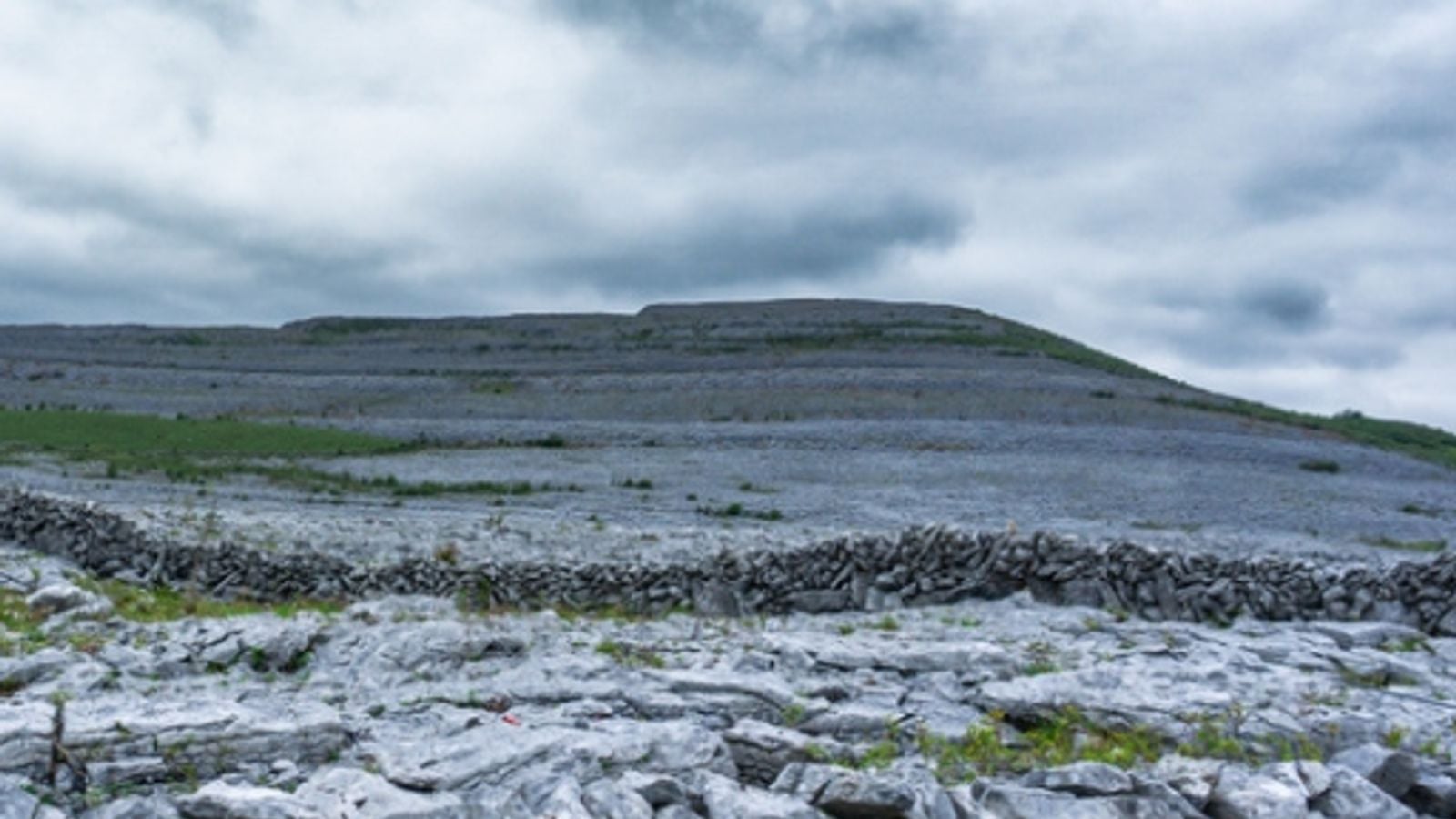
At first glance, the Burren looks like nothing should live here. Miles of bare limestone stretch across the hills of County Clare, grey and cracked, with almost no soil in sight. Scientists call it a karst landscape. Locals have been calling it home for 6,000 years.
A Place That Breaks the Rules
What makes the Burren remarkable is what grows inside it. In spring and early summer, the cracks in the limestone fill with wildflowers that should not exist side by side anywhere on earth.
Mountain avens and purple saxifrage — plants that normally grow only in the Arctic — share space with Mediterranean orchids and species found mainly in Spain and southern France. Botanists have recorded over 70 orchid species here alone. The same square mile can contain plants from two completely different climatic zones.
The reason comes down to the Gulf Stream. Warm Atlantic air moves in from the sea and the limestone absorbs and holds that heat through winter. The stone acts like a slow-release radiator, keeping fragile plants alive when they should freeze. Meanwhile, the deep fissures in the rock — called “grikes” — shelter species from grazing animals and cold winds.
What the Name Actually Means
The Irish word “Boireann” means rocky place. It was not a compliment. Early travellers dismissed the landscape as hostile and barren. A 17th-century officer is said to have noted there was not enough wood to hang a man, not enough water to drown one, and not enough soil to bury one.
The monks who settled at Corcomroe Abbey in the 12th century saw it differently. They called it the fertile rock. They understood what lived between the stones.
The Burren covers around 250 square miles of County Clare, spreading from the southern shore of Galway Bay down toward the Atlantic coast. It is one of the largest areas of limestone pavement in Europe — and one of the least understood.
The People Who Came First
Long before the monks, people recognised this place as significant. There are over 2,500 recorded archaeological sites in the Burren. Ring forts, wedge tombs, holy wells, and standing stones spread across the landscape in a density that has no easy explanation.
The most famous is Poulnabrone Dolmen — a portal tomb that has stood in a limestone field since around 3,600 BCE. The bones of over 30 individuals were found beneath it. This stone table is older than the Egyptian pyramids, and it still stands exactly where it was built, visible from the road, with the same grey sky above it.
☘️ Enjoying this? 64,000+ Ireland lovers get stories like this every week. Subscribe free →
Walking the Burren, you do not need to search for evidence of those who came before. Ring forts appear on nearly every hillside. Over 70 wedge tombs make this one of the highest concentrations of that monument type anywhere in Ireland.
The Connection to the Aran Islands
Stand at the Burren’s coast and look west. The Aran Islands sit just across Galway Bay, and they are, geologically, the same place. The same limestone bed that forms the Burren continues underwater to the islands.
That is why the Aran Islands share the same unusual flora. The same Arctic-meets-Mediterranean mix grows there too. Visiting the Aran Islands gives you a second perspective on the same seabed that rose from the ocean over 300 million years ago — and has been holding secrets ever since.
The Best Time to Visit the Burren
Spring is the season to go. From April through June, wildflowers push up through the grikes and the limestone turns from grey to vivid colour. Bloody cranesbill, spring gentians, and orchids appear across the pavement in waves.
The main stops include Poulnabrone Dolmen, Mullaghmore hill, Corcomroe Abbey, and Caherconnell Stone Fort. The Burren also connects south to the Cliffs of Moher, making it easy to combine both in a single day. For a full guide to the county, County Clare’s complete travel guide has everything you need.
What It Does to You
Visitors to the Burren often describe the same feeling: a quietness that settles on you the longer you walk it. The stone absorbs sound. The wind moves through the grikes. In every direction, grey pavement meets grey sky — and yet everything is alive.
The Burren teaches you something about Ireland in general. The most extraordinary places do not always announce themselves. Sometimes they just sit there, bare and grey, waiting for you to understand what you are looking at.
☘️ You Might Also Love
☘️ Join 64,000+ Ireland Lovers
Every Friday, get Ireland’s hidden gems, local secrets, and travel inspiration — the kind you won’t find in any guidebook.
Free forever · · Unsubscribe anytime
Tours & experiences you might love


Powered by Viator. Some links are affiliate links — we may earn a small commission at no extra cost to you.
Secure Your Dream Irish Experience Before It’s Gone!
Planning a trip to Ireland? Don’t let sold-out tours or packed attractions spoil your journey. Iconic experiences like visiting the Cliffs of Moher, exploring the Rock of Cashel, or enjoying a guided walk through Ireland’s ancient past often sell out quickly—especially during peak travel seasons.

Booking in advance guarantees your place and ensures you can fully immerse yourself in the rich culture and breathtaking scenery without stress or disappointment. You’ll also free up time to explore Ireland’s hidden gems and savour those authentic moments that make your trip truly special.
Make the most of your journey—start planning today and secure those must-do experiences before they’re gone!
Diane
Thursday 7th of May 2026
The Burren was my favorite place when we visited Ireland. I loved the desolate appearance and the cliffs that I found to be as beautiful, if not more so, that the Cliffs of Mohr. I would love to live near the Burren if I lived in Ireland.