

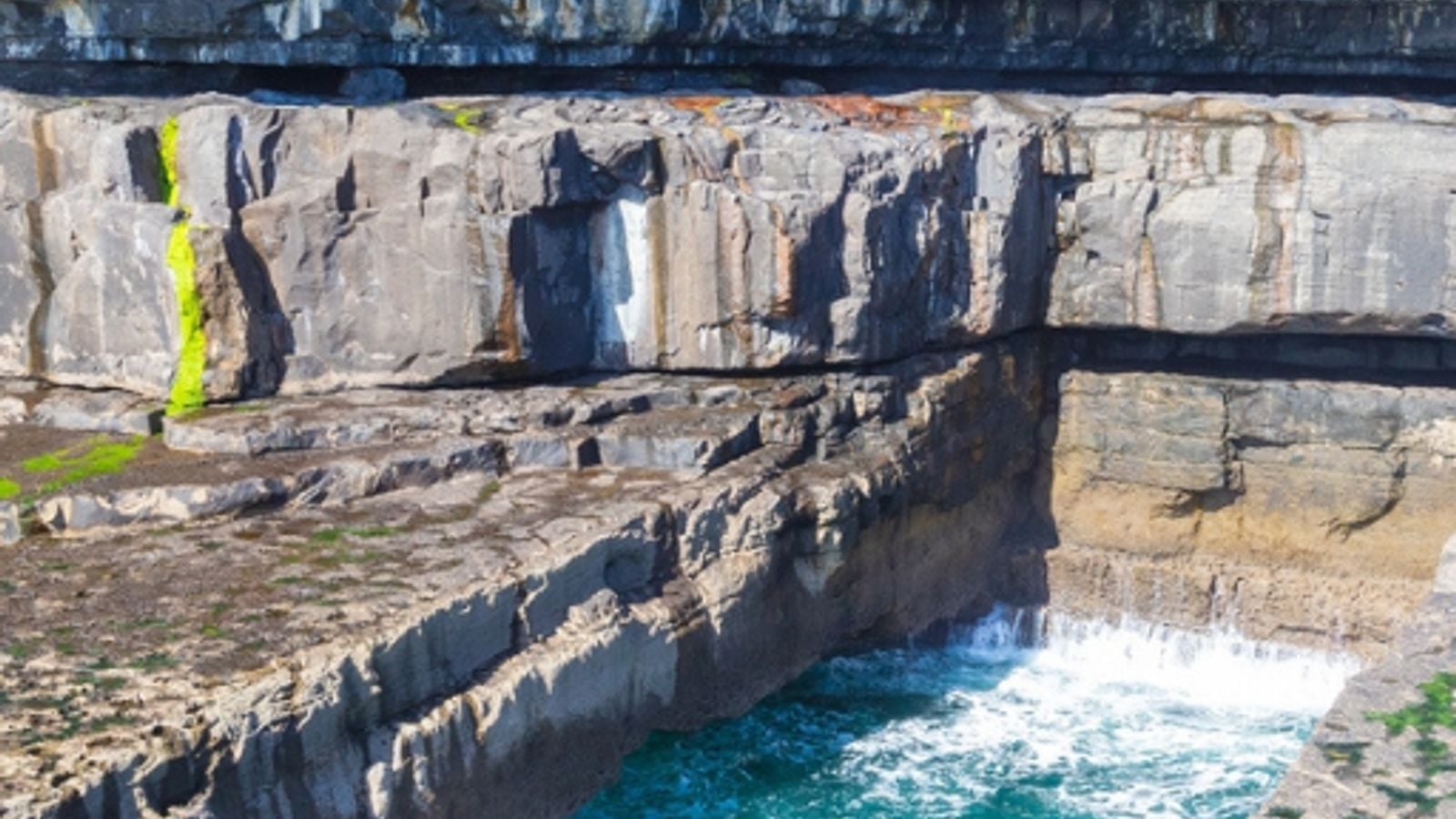
There is a pool on the southern coast of Inis Mór that should not exist. It is almost perfectly rectangular — roughly 25 metres long, cut cleanly into the grey limestone as though shaped by hand. The Atlantic crashes into it through a narrow channel, filling it with clear turquoise water. The ancient islanders had one explanation for how it came to be there. They called it Poll na bPéist: the Hole of the Beast.
A Name That Was Never a Metaphor
In Irish, péist does not mean pest in the modern English sense. It means something far older — a great water serpent, a sea creature of immense power, the kind that lurks in deep water and surfaces only when it chooses.
The Aran Islands have been inhabited for at least five thousand years. The people who named this pool were not speaking loosely. When they said a beast had shaped this place, they meant it. The name was passed down intact through generation after generation of islanders who fished these waters and watched the sea from this very limestone shelf.
Across Ireland, place names containing péist mark spots where the ancients believed something vast lived below the surface. Lough na Péiste in Connacht. Poll na bPéist here on Inis Mór. These are not fairy stories dressed as geography. They are the record of a worldview in which the sea was alive, and dangerous, and owed respect.
The Péist in Irish Mythology
Ancient Irish stories are full of water creatures. The péist appears in tales alongside the Fianna, in the lives of early saints, and in the oral traditions of fishing communities along the Wild Atlantic Way.
The most famous péist in Irish legend haunted Lough Derg in County Clare, where it was said to have been confronted and contained by an early Christian monk. Whether you read these stories as literal belief or as metaphor for the unpredictability of the sea, they point to the same truth: the Irish understood, for thousands of years, that deep water held dangers you could not see.
On an island like Inis Mór, that understanding was not theoretical. It was practical. Men went out in currachs — thin-skinned boats of tarred canvas — on water that could turn savage without warning. The Atlantic around the Aran Islands does not forgive mistakes. In that context, naming a strange pool after a sea monster was not superstition. It was a form of warning passed from father to son.
☘️ Enjoying this? 64,000+ Ireland lovers get stories like this every week. Subscribe free →
The Pool That Has No Easy Explanation
Stand at the edge and look down. The limestone of Inis Mór is karst — formed from compressed shells and sea creatures over millions of years, fractured and widened by water and time. Geologists say the Wormhole was carved by wave action exploiting natural cracks in the rock. The Atlantic forced its way in through one narrow channel, slowly enlarging the fissures, until the rectangular shape emerged.
That is the scientific account. What it does not fully explain is why the shape is so uncannily regular. The right angles are not perfect, but they are close enough that visitors reaching it for the first time often pause and reach for the word “carved.” When you stand there in low morning light, watching the sea push through the inlet and the turquoise filling and emptying below, péist feels less like legend and more like honest description.
The island holds more mysteries than this one pool. Dún Aonghasa, the great stone fort clinging to the clifftop nearby, was built long before the pyramids were finished. Nobody is entirely certain what it was for. If you plan to explore what the Aran Islands hold, give yourself more time than you think you will need.
Finding Your Way to the Hole of the Beast
Poll na bPéist sits on the southern coastline of Inis Mór, roughly forty minutes on foot from Kilronan, the main village. There are no signs pointing to it. Ask in the village and someone will point you right. Bikes can be hired near the ferry pier if the walk feels far.
Ferries run to Inis Mór from Rossaveal in County Galway and from Doolin in County Clare. The crossing takes between thirty minutes and an hour and a half depending on conditions. Go in the morning when the light hits the water at an angle. Go when the sea is not completely flat — the pool is most dramatic when the Atlantic is pushing hard through the channel and the water below is churning. That is when it earns its name.
There are many places in Ireland where something old seems to press close to the surface. The places where the ancient world and this one feel thinnest are often the most alive. Poll na bPéist is one of those places.
The Name Survives for a Reason
The Aran Islands have changed enormously. There are guesthouses now, ferry timetables, and summer visitors arriving in numbers. But the limestone is the same limestone. The Atlantic is the same sea. And the pool sits where it always has, filling and emptying with every tide.
The Irish did not name places carelessly. They named them the way you name something you have to live beside for a very long time — with accuracy, with respect, and with a clear understanding of what it could do to you.
Poll na bPéist has never needed renaming. The beast may not be there. But the hole is exactly as described.
If you are planning a trip to Ireland, the Aran Islands deserve more than a single afternoon. Some places take time to give up what they hold.
☘️ You Might Also Love
Frequently Asked Questions
Are Ireland’s historic sites open to the public?
Many of Ireland’s heritage sites are managed by the Office of Public Works (OPW) and are open to the public year-round, though hours vary seasonally. The Heritage Card (heritageireland.ie) gives unlimited access to OPW-managed sites for a single annual fee — excellent value for heritage enthusiasts.
What is the best way to explore Ireland’s historic sites?
Combining self-guided exploration with occasional guided tours gives the best experience. Local guides bring history to life with stories that aren’t in any guidebook. Many heritage towns offer walking tours — check with the local tourist office on arrival.
How well-preserved are Ireland’s ancient monuments?
Ireland has remarkably well-preserved ancient monuments thanks to its largely rural landscape and relatively low levels of industrial development. Sites like Newgrange, Knowth, and the Rock of Cashel are UNESCO World Heritage sites recognised for their exceptional condition.
Can you visit Ireland’s heritage sites independently or do you need a guide?
Most sites welcome independent visitors and provide informational panels and audio guides. However, for deep historical context and access to areas not open to the public, booking a specialist heritage tour with a qualified Irish guide is highly recommended.
☘️ Join 64,000+ Ireland Lovers
Every Friday, get Ireland’s hidden gems, local secrets, and travel inspiration — the kind you won’t find in any guidebook.
Subscribe free — enter your email:
Already subscribed? Download your free Ireland guide (PDF)
Love more? Join 43,000 Scotland lovers → · Join 30,000 Italy lovers → · Join 7,000 France lovers →
Free forever · · Unsubscribe anytime
Tours & experiences you might love


Powered by Viator. Some links are affiliate links — we may earn a small commission at no extra cost to you.
Secure Your Dream Irish Experience Before It’s Gone!
Planning a trip to Ireland? Don’t let sold-out tours or packed attractions spoil your journey. Iconic experiences like visiting the Cliffs of Moher, exploring the Rock of Cashel, or enjoying a guided walk through Ireland’s ancient past often sell out quickly—especially during peak travel seasons.

Booking in advance guarantees your place and ensures you can fully immerse yourself in the rich culture and breathtaking scenery without stress or disappointment. You’ll also free up time to explore Ireland’s hidden gems and savour those authentic moments that make your trip truly special.
Make the most of your journey—start planning today and secure those must-do experiences before they’re gone!
Subscribe Free