

There’s a sound you hear before you see it. Hooves on tarmac, then on gravel, then on the quiet stone paths that wind through Killarney National Park. It’s a sound that belongs to another century — and yet here it is, perfectly at home today.
What Is a Jaunting Car?
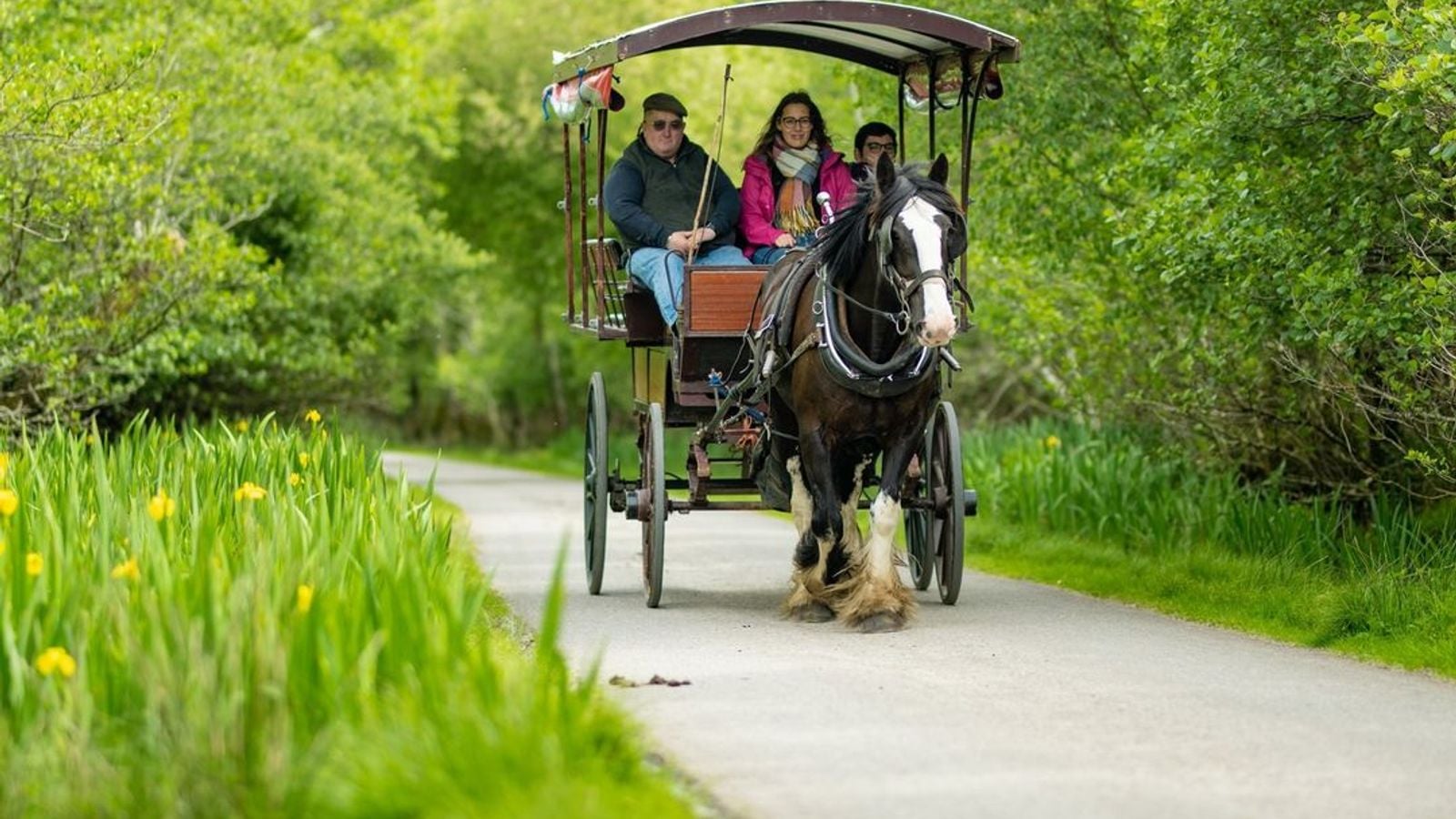
A jaunting car is a traditional Irish horse-drawn carriage where passengers sit sideways, facing out toward the scenery rather than forward. The design is distinctly Irish — visitors from elsewhere often do a double-take when they realise they’re facing the hedgerows rather than the road ahead.
Modern Killarney jaunting cars are typically four-wheeled, drawn by sturdy Clydesdale or draught horses, and hold up to four passengers on the two outward-facing bench seats. The driver — the jarvey — sits up front, reins in hand, with a cap and a story for every bend in the road.
Unlike tourist carriages in many European cities, these aren’t novelty rides around a square. They cover real distances through some of the finest landscape in Ireland.
The Jarveys — and What Makes Them Different
The title “jarvey” comes from an old word for a coachman. But calling a Killarney jarvey a coachman misses most of the point.
These are local men and women — often from families who have held their licensed spots at the national park entrance for three or four generations. Their knowledge isn’t in a guidebook. It’s accumulated across hundreds of trips through the Gap of Dunloe, past Muckross Abbey, and along the shores of Lough Leane.
They know where the red deer come down to drink at dusk. They know which rock the local peregrine uses as a lookout post. And they know how to make a coachload of strangers feel like they’ve just been welcomed into someone’s home county.
The banter is part of it. The unscheduled pause at a viewpoint no one asked for is part of it. You can’t download that.
☘️ Enjoying this? 64,000+ Ireland lovers get stories like this every week. Subscribe free →
Where the Tradition Comes From
Horse-drawn transport has been part of Killarney’s visitor trade since at least the early nineteenth century. When the railways arrived in Kerry in the 1850s, tourists poured in from Dublin and Cork, and the local horse trade grew to meet them.
What made Killarney different was the landscape. The combination of three interconnected lakes, ancient oakwoods, and the MacGillycuddy’s Reeks in the background created a scene that painters and writers had been documenting since the 1700s. Queen Victoria came to see it in 1861, and the horse and carriage was how she saw it.
That reputation drew visitors from across Britain and Europe, and the jarveys evolved to serve them — not just as drivers, but as local experts who knew every route, every shortcut, and every story worth telling.
The Routes That Can Only Be Done This Way
The reason the jaunting car tradition has survived — and thrived — in Killarney specifically comes down to geography. Motor vehicles are restricted from the inner tracks of Killarney National Park, which means the only way to travel certain routes is on foot, by bicycle, or behind a horse.
The Gap of Dunloe is the most famous example. This narrow glacial valley cuts between mountain ranges for about eleven kilometres. There’s a road through it, but it was never built for motor traffic. The horse knows the route better than the map.
The paths through the Muckross estate — past the ruined abbey, along the wooded shores of Muckross Lake — are gentler but no less beautiful. A jaunting car moves at about walking pace along these paths, which is exactly the right speed to watch a heron lift off a reed bed or catch the smell of wild garlic in an old wood.
Why People Keep Coming Back
What’s striking about the Killarney jaunting car is how many visitors return. Not just to Killarney, but specifically to this. Families who came as children bring their own children. People who visited for their honeymoon come back for anniversaries.
It’s not nostalgia exactly. It’s something harder to name — the recognition that slowing down, sitting sideways, and letting someone else do the knowing for a while is genuinely good for you.
If you’re planning a trip to Kerry, the complete Killarney guide covers everything you need to know before you arrive. And for the wider county, County Kerry’s hidden corners go far beyond the tourist trail.
The jaunting car is one of those rare things in Ireland that hasn’t been optimised, franchised, or turned into an app. It survives because the people who drive the carriages believe in what they’re doing — and because the people who climb aboard are, at least for a few kilometres, willing to hand the reins to someone who knows the way.
☘️ You Might Also Love
Tours & experiences you might love


Powered by Viator. Some links are affiliate links — we may earn a small commission at no extra cost to you.
Secure Your Dream Irish Experience Before It’s Gone!
Planning a trip to Ireland? Don’t let sold-out tours or packed attractions spoil your journey. Iconic experiences like visiting the Cliffs of Moher, exploring the Rock of Cashel, or enjoying a guided walk through Ireland’s ancient past often sell out quickly—especially during peak travel seasons.

Booking in advance guarantees your place and ensures you can fully immerse yourself in the rich culture and breathtaking scenery without stress or disappointment. You’ll also free up time to explore Ireland’s hidden gems and savour those authentic moments that make your trip truly special.
Make the most of your journey—start planning today and secure those must-do experiences before they’re gone!