

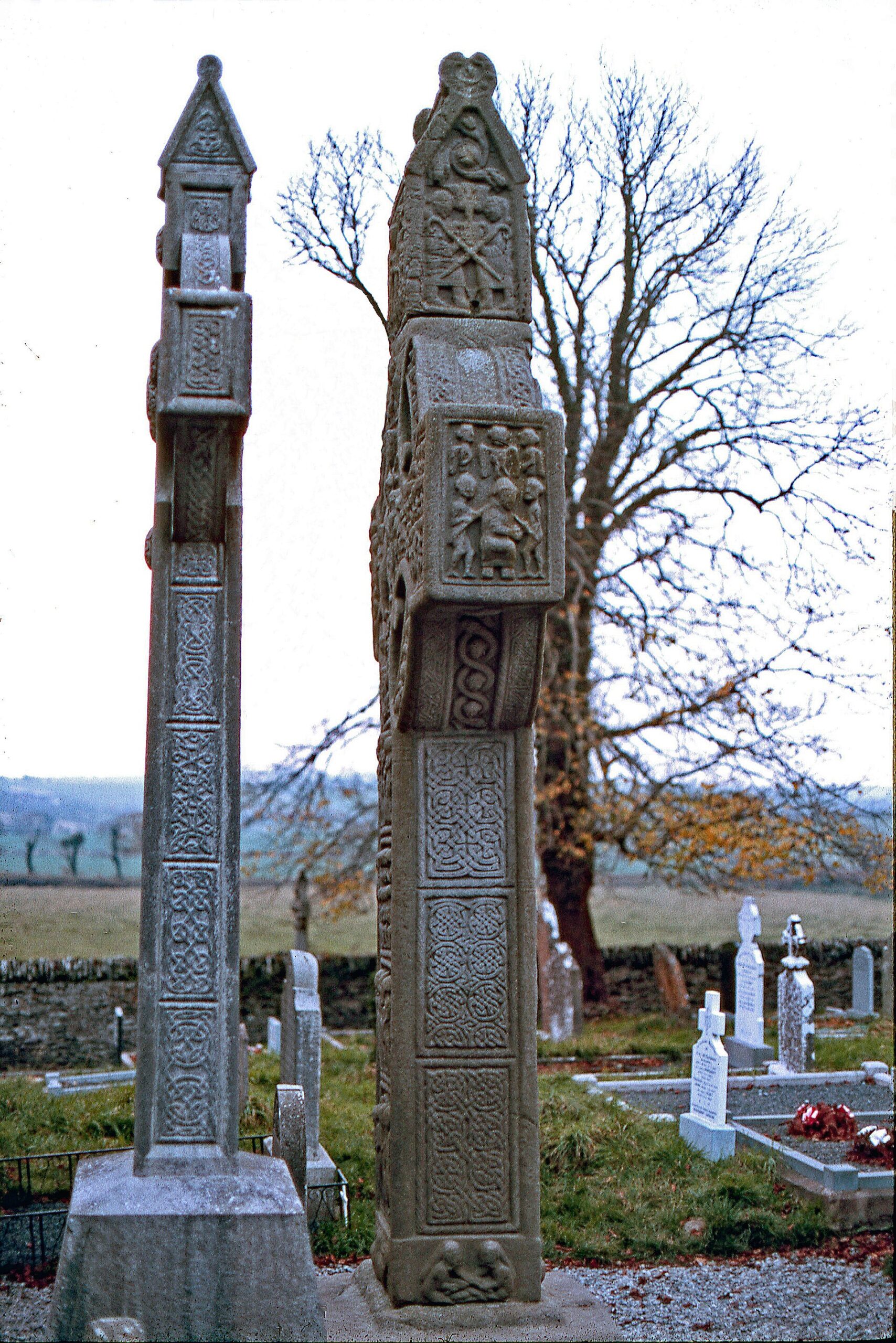
Stand at the foot of Muiredach’s Cross in County Louth and you are looking at a book. Not one with pages, but a stone one — carved around 900 AD, standing five and a half metres tall, and telling stories the people who built it needed everyone to understand.
Most visitors take a photograph and walk on. Very few stop to ask what it’s actually saying.
More Than a Symbol
The Celtic cross — that distinctive shape with a circle joining the arms — is one of the most recognised symbols in the world. You’ll find it on jewellery, tattoos, and roadside gates across Ireland. But the high crosses that stand at Ireland’s ancient monastic sites are something altogether different.
These are not decorations. They are carved narratives — theological arguments rendered in sandstone and granite by monks who had no printing press and no paper.
What they had was stone, extraordinary skill, and an urgent need to communicate.
The Stories Carved Into the Stone
Look closely at Muiredach’s Cross at Monasterboice, or the Cross of the Scriptures at Clonmacnoise, and you begin to see the structure. Each face of the cross is divided into panels. Each panel tells a scene.
On the west face of Muiredach’s Cross, the central scene shows the Last Judgement — Christ weighing souls, with the saved to one side and the damned to the other. Below that, the crucifixion. Below that again, soldiers mocking Christ.
Row after row of scripture, arranged for maximum impact. In a world where most people could not read, these images were the text.
The scenes were carefully chosen. Daniel surviving the lions. Moses striking the rock. The wise men following the star. Each carried a clear moral message that any congregation could grasp at a glance.
The Mystery of the Ring
The most asked question about Irish high crosses is also the one with the most contested answer: why the ring?
That distinctive circle connecting the four arms is unique to Ireland and Scotland. Scholars have argued about it for generations.
One theory holds that the ring was structural — an early engineering solution to stop the heavy stone arms from cracking under their own weight. Another says it represents the sun, linking the new faith to older Celtic solar worship. A third argues it symbolises eternity: the unbroken circle, no beginning and no end.
The most likely answer, historians now suggest, is that it did several things at once. Early Christian missionaries in Ireland were skilled at absorbing existing symbols and giving them new meaning. The sun had been sacred here for thousands of years — as the spirals at Newgrange show. The ring may have made the cross immediately recognisable to people who already understood circular forms as something holy.
☘️ Enjoying this? 64,000+ Ireland lovers get stories like this every week. Subscribe free →
Where the Crosses Stood — and Why
High crosses were not placed at random. They marked the entrance to monasteries, stood at crossroads within monastic enclosures, and sometimes identified the graves of important abbots.
The inscriptions on some crosses reveal their purpose directly. The base of Muiredach’s Cross reads — in Old Irish — “A prayer for Muiredach by whom this cross was made.” A prayer, not a boast. These crosses were acts of devotion as much as acts of craft.
Clonmacnoise, founded on the banks of the River Shannon in 544 AD, once held dozens of crosses. The monks who built these communities understood that stone outlasts timber, parchment, and memory. Their positions along pilgrimage routes and at waterway crossings were entirely deliberate.
Where to See the Best High Crosses in Ireland
The finest collection of high crosses in the world is in Ireland, and most can be visited without a guided tour.
Monasterboice, County Louth — home to Muiredach’s Cross, widely considered the best-preserved high cross on earth. The site is free and open.
Clonmacnoise, County Offaly — a full monastic city on the Shannon, with multiple crosses now housed in a visitor centre to protect them from the weather. The replicas stand where the originals once did.
Ahenny, County Tipperary — two of the oldest high crosses in Ireland, dating to the 8th century, almost entirely covered in interlace rather than figural scenes. Hypnotic in their geometry.
Moone, County Kildare — a tall, slender granite cross with unusually stylised figures that give it an almost abstract quality. Oddly beautiful. If you’re planning a trip to Ireland, add at least one of these sites to your itinerary.
What strikes most visitors, once they understand what they are looking at, is the sheer ambition of it. Someone — many someones, over many years — looked at a rough block of stone and decided it should carry everything that mattered. Every lesson. Every promise. Every warning.
The high crosses of Ireland are not relics of a lost world. They are one of the most confident acts of communication in human history. They are still standing. And they still have things to say.
☘️ You Might Also Love
Free forever · · Unsubscribe anytime
Tours & experiences you might love


Powered by Viator. Some links are affiliate links — we may earn a small commission at no extra cost to you.
Secure Your Dream Irish Experience Before It’s Gone!
Planning a trip to Ireland? Don’t let sold-out tours or packed attractions spoil your journey. Iconic experiences like visiting the Cliffs of Moher, exploring the Rock of Cashel, or enjoying a guided walk through Ireland’s ancient past often sell out quickly—especially during peak travel seasons.

Booking in advance guarantees your place and ensures you can fully immerse yourself in the rich culture and breathtaking scenery without stress or disappointment. You’ll also free up time to explore Ireland’s hidden gems and savour those authentic moments that make your trip truly special.
Make the most of your journey—start planning today and secure those must-do experiences before they’re gone!
Subscribe Free