

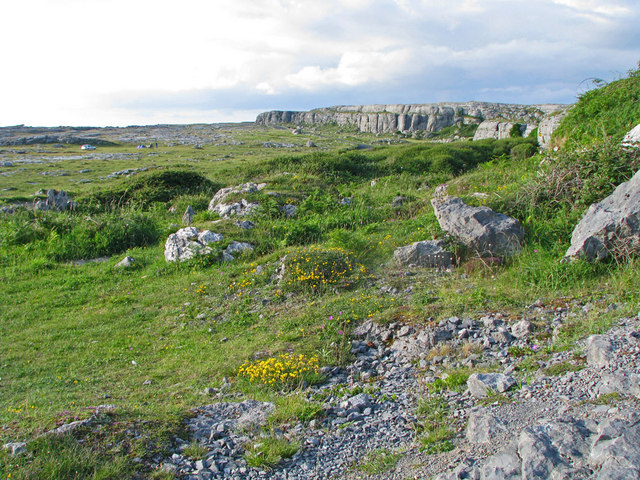
The Burren looks like it should be barren. Grey limestone stretches as far as you can see — ancient rock cracked and tilted, with barely a blade of grass between the stones. Yet this strange landscape in County Clare produces some of the most distinctive food in Ireland, and people travel specifically to eat it.
A Landscape That Feeds Itself Differently
The Burren is limestone karst — roughly 250 square kilometres of exposed rock covering north-west Clare and into Galway. It looks empty. It is not.
In the crevices and fissures of the rock, soil accumulates and wildflowers take hold. Mountain avens, bloody cranesbill, and rare orchids grow in the grykes — species more commonly found in the Alps and the Arctic, growing here side by side because of the Burren’s unique microclimate. It is one of the most botanically diverse places in Europe, per square kilometre.
Cattle and sheep graze on these mineral-rich plants. The result is beef and lamb with a distinct sweetness that chefs noticed long before food writers did. The porous limestone drains quickly, too, keeping the grazing land drier than the boggy ground found elsewhere in the west of Ireland.
The Tradition of Winterage
Most Irish farmers bring their cattle to lower, sheltered ground when winter arrives. Burren farmers do the opposite.
They move their cattle up to the limestone plateau in autumn — a tradition called winterage that dates back thousands of years. The logic is counterintuitive but sound. Snow rarely settles on the porous rock, and the constant mild Atlantic air keeps the limestone warm enough to provide grazing right through the cold months. The herb-rich plants stay accessible when lower pastures are waterlogged and useless.
The cattle come down in spring remarkably healthy, having grazed on a diet unlike anything available on lower ground. This ancient practise is not a heritage performance. It is still happening on Burren farms today, and it shapes the flavour of the beef you eat here.
The Burren Food Trail
In 2012, a group of local food producers came together to create the Burren Food Trail. The idea was straightforward: the Burren produces something specific, and those producers deserved to be celebrated together rather than in isolation.
The trail links artisan producers across the limestone landscape. The Burren Smokehouse in Lisdoonvarna has been cold-smoking Atlantic salmon over beechwood for over 30 years. Burren Gold cheese is made from the milk of cattle that graze the limestone grass. Local honey carries the flavour of wildflowers that grow nowhere else on earth. There are also free-range pork producers, smoked eel, and small-batch dairy operations.
These are not novelty products created for passing tourists. They have distinct flavours shaped by a very particular piece of land — and that is increasingly rare in a world of standardised, industrial produce.
☘️ Enjoying this? 64,000+ Ireland lovers get stories like this every week.
Thinking about it seriously? If you’ve started actually planning a move, our complete the full Move to Ireland guide walks through every step, every cost, and the paperwork that catches most people out.
Where to Eat on the Burren
The Burren rewards those who stop rather than pass through. These are worth building your day around.
Linnane’s Lobster Bar
At the edge of New Quay on the southern shore of Galway Bay, Linnane’s has been pulling lobsters and crabs from the water since 1954. No reinvention, no flourishes — just what comes off the boats, served at the water’s edge with a pint. On a clear day the view across to the Connemara hills is as good as the food.
Burren Smokehouse
Founded by Brigitta and Peter Curtin in Lisdoonvarna, the Burren Smokehouse has been producing cold-smoked salmon for over three decades. They offer tastings and a visitor centre explaining the smoking tradition. It is one of the few places in Ireland where you can buy smoked fish direct from the people who smoke it.
Wild Honey Inn
Lisdoonvarna’s Michelin-recognised Wild Honey Inn has built its menu around Burren produce. The kitchen sources from surrounding farms and treats the landscape as the larder. It is a good reason to visit the town outside of the matchmaking festival.
Six Thousand Years of Farming
The Burren has been farmed for at least 6,000 years. The Poulnabrone Dolmen — one of the most visited prehistoric sites in Ireland — stands on farmland that has been grazed continuously since the Neolithic period. The people who built that tomb kept animals on the same limestone. Their descendants still do.
That continuity matters. The farming practices here have not changed dramatically because the landscape does not allow for it. The same wildflowers, the same limestone, the same Atlantic weather. Generation after generation, farmers have adapted to the Burren rather than the other way around.
When you eat food from the Burren, you are eating something shaped by a very specific place over a very long time. That is not marketing. It is geology and history on a plate.
If you are planning a trip to Ireland, build in time to stop on the Burren rather than simply drive through it. Most visitors pass the grey rock on the way to the Cliffs of Moher and move on. Stop instead. Eat here. The landscape that looks empty has been feeding people for six thousand years — and the food it grows is unlike anything else in Ireland.
☘️ You Might Also Love
☘️ Join 64,000+ Ireland Lovers
Every Friday, get Ireland’s hidden gems, local secrets, and travel inspiration — the kind you won’t find in any guidebook.
Subscribe free — enter your email:
Get the free guide
Enter your email and we will send you straight to the download.
Love more? Join 43,000 Scotland lovers → · Join 30,000 Italy lovers → · Join 7,000 France lovers →
Free forever · · Unsubscribe anytime
Tours & experiences you might love


Powered by Viator. Some links are affiliate links — we may earn a small commission at no extra cost to you.
Secure Your Dream Irish Experience Before It’s Gone!
Planning a trip to Ireland? Don’t let sold-out tours or packed attractions spoil your journey. Iconic experiences like visiting the Cliffs of Moher, exploring the Rock of Cashel, or enjoying a guided walk through Ireland’s ancient past often sell out quickly—especially during peak travel seasons.

Booking in advance guarantees your place and ensures you can fully immerse yourself in the rich culture and breathtaking scenery without stress or disappointment. You’ll also free up time to explore Ireland’s hidden gems and savour those authentic moments that make your trip truly special.
Make the most of your journey—start planning today and secure those must-do experiences before they’re gone!
Subscribe Free