

Standing at the southern tip of Achill Island, a crumbling tower rises above a stretch of bogland and water. It is not particularly tall. There are no information boards beside it, no gift shop, no entry fee. Yet this ruined building — known as Grace O’Malley’s Towerhouse, or Kildavnet Castle — carries more history than almost any site in the west of Ireland.
The view from above is striking. The castle stands alone, outlined against Achill Sound, with the Atlantic stretching beyond. That sense of isolation is real. But so is the weight of the story behind it.
Who Was Grace O’Malley?
Grace O’Malley — known in Irish as Gráinne Mhaol or Granuaile — was born around 1530 into the Ó Máille clan, one of the most powerful maritime families in Connacht. Her father was Eoghan Dubhdara Ó Máille, chieftain of the territory around Clew Bay and the islands off the Mayo coast.
From an early age, Grace showed little interest in the conventional role expected of women in 16th-century Ireland. She led fleets of galleys along the Atlantic coast, controlled sea trade routes, levied tolls on ships passing through her waters, and — when diplomacy failed — resorted to piracy. By midlife, she commanded hundreds of men and was well known to English administrators in Dublin, who viewed her with a mixture of frustration and grudging respect.
In 1593, she sailed to London and met Queen Elizabeth I. The two women reportedly conversed in Latin — though some historians argue the exchange was in English — and Grace refused to bow, arguing she owed no allegiance to the English crown. The meeting is one of the most remarkable encounters in Irish history — two powerful women, from two very different worlds, negotiating face to face.
Grace died around 1603, probably at Rockfleet Castle near Newport. She was somewhere in her seventies. Her legacy lives on across Mayo in the form of castles, sea routes, and a name that has never quite faded. Read the full story in our guide to Grace O’Malley, Ireland’s Pirate Queen.
Want more Irish history and travel guides?
Join over 50,000 readers who get Ireland delivered to their inbox every morning. Subscribe free here →
The Towerhouse on Achill Island
Kildavnet Castle sits near the village of Dookinella, close to the southern shore of Achill Island. It dates from the 15th century — possibly built by the Ó Máille clan — and is a classic Irish tower house: four storeys of stone with thick walls and narrow windows designed for defence rather than comfort.
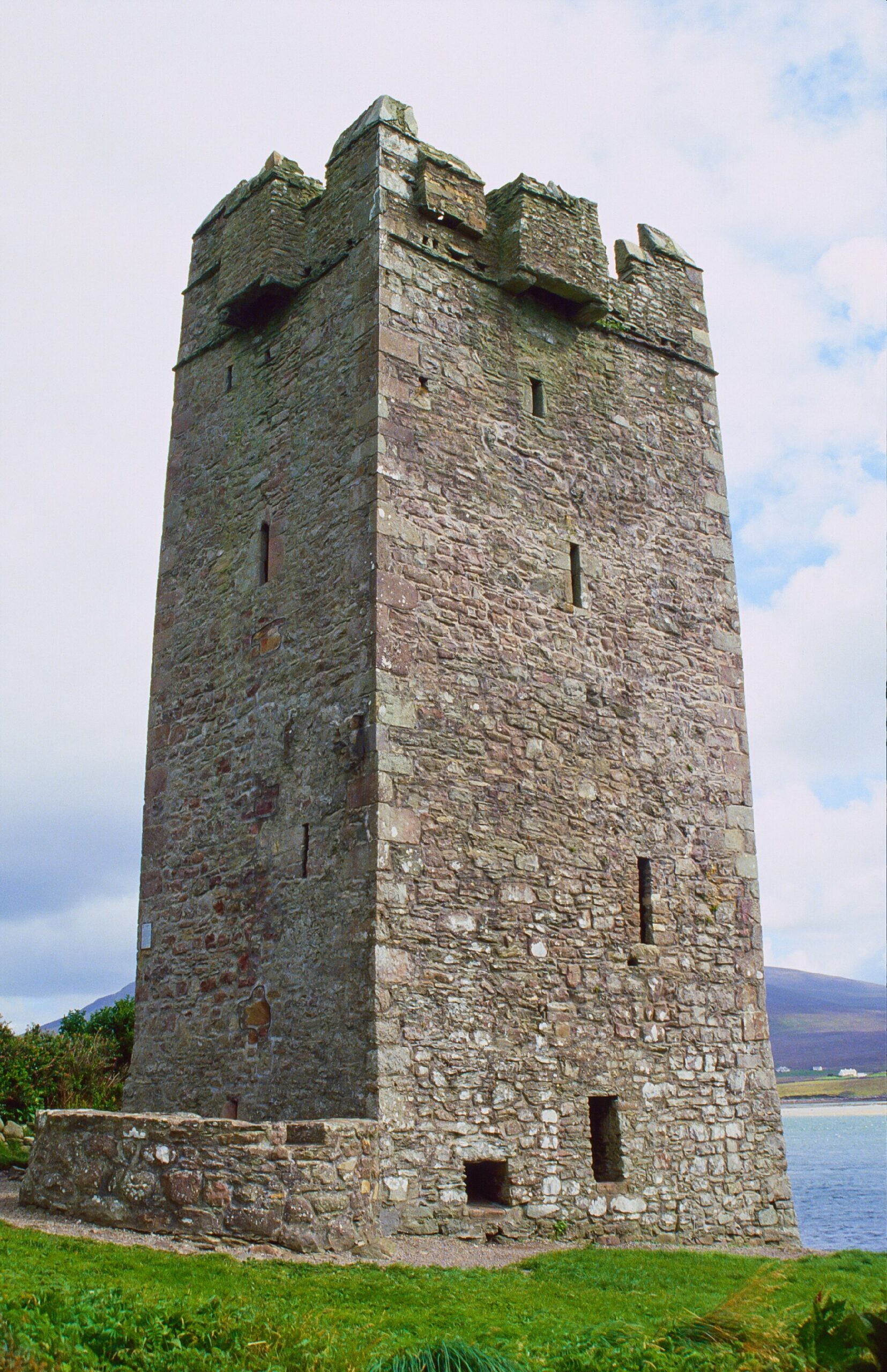
The association with Grace O’Malley is strong but not definitively documented. What is certain is that the Ó Máille clan controlled this part of the coast, and Achill Island — with its access to Achill Sound, the open Atlantic, and the fishing grounds beyond — was strategically important. A tower house here made practical sense. It provided a vantage point over the water and a defensible base for anyone operating along this stretch of coast.
Today the castle is a ruin. The roof is long gone. The interior walls are exposed to the sky. But the structure itself is remarkably intact for a building that is over 500 years old. The stonework is still solid. The window openings are clear. On a dry day, it is possible to walk around the base and take in the surroundings — the water on three sides, the bogland stretching inland, the distant outline of mainland Mayo.
There is a small graveyard adjacent to the castle, containing the ruins of a medieval church. This is Kildavnet Church, also associated with the Ó Máille family. The combination of the tower house, the church ruins, and the waterside setting makes this one of the more atmospheric spots on the island.
What to Expect When You Visit
There is no managed entrance to the site. You park on the roadside — there is a small pull-in — and walk across to the castle. It takes about two minutes on foot. The ground around the base can be muddy after rain, so boots or sturdy shoes are sensible.
The site is freely accessible at any time of year. There are no opening hours, no entry fee, and no facilities. What there is: quiet, wind off the water, and an uninterrupted view that has not changed significantly in five centuries.
The castle is best seen in decent light — overcast days tend to flatten the landscape. On a clear morning, the light off Achill Sound is excellent for photography, and the contrast between the grey stone and the surrounding water and bog makes for a strong composition.
Kildavnet is part of the Granuaile Heritage Trail, a loose collection of sites across County Mayo associated with Grace O’Malley’s life and territory. Other sites on the trail include Rockfleet Castle near Newport, Clare Island (where she is said to be buried), and the O’Malley strongholds around Clew Bay. If you are specifically following Grace O’Malley’s story, spending a day on this trail gives you the most complete picture of her world.
Explore more of Ireland’s hidden history
Our free newsletter covers castles, coastlines, heritage sites, and practical travel tips — every weekday morning. Start your free subscription →
Getting to Achill Island
Achill Island is connected to the mainland by a road bridge — the Michael Davitt Bridge — over Achill Sound, so no ferry is needed. The island is in County Mayo on Ireland’s west coast.
The most practical approach is to drive. From Dublin, the journey takes roughly three and a half hours via the N5 through Longford and Westport. From Westport, it is another 45 minutes to the bridge, and then a short drive south along the island’s eastern coast to reach Kildavnet.
There is no public transport that reaches the southern end of the island in any reliable way. Bus Éireann runs a service to Achill Sound and on to the main village of Achill, but Kildavnet is not served. A car is the only practical option for visiting this site.
If you are staying overnight, the island has a range of accommodation options in and around Achill village and Keel. A base here allows you to cover the southern sites in the morning — Kildavnet, Dooega, the road down to the southwestern tip of the island — and the northern sites including Keem Bay and Croaghaun in the afternoon.
What Else to See on Achill Island
Achill is the largest island off the Irish coast, at roughly 24 kilometres from east to west. It is more than capable of filling a full day, or several.
Keem Bay sits at the far western end of the island, reached by a single-track road that winds along the cliffs above the Atlantic. The bay is small and sheltered, with water that is an unlikely shade of blue. It was once a basking shark fishing station. Today it is one of the most photographed spots in Mayo. It gets busy in summer; arrive early or late in the day if you want it quieter.
Croaghaun is the mountain that overlooks Keem Bay from the west. Its sea-cliffs on the Atlantic side are the highest in Ireland — 688 metres at their peak — but they are largely invisible from the road. The walk to the summit and the cliff edge is not technically difficult, but it is long and involves significant elevation gain. Allow at least four hours for the full route. The views are exceptional on a clear day.
Slievemore is the large quartzite mountain in the northern part of the island. At its base is the Slievemore Deserted Village, a collection of stone cottages abandoned during and after the Famine of the 1840s. The village stretches for around one mile along the hillside. Walking through it is quietly sobering.
Dugort is a small village on the north coast with a beach backed by dunes. It is one of the calmer spots on the island and a good place to stop if you want to get off the main tourist circuit.
The island has a strong connection to the writer Heinrich Böll, the German Nobel laureate who spent summers here in the 1950s and 1960s and wrote about Achill in his Irish Journal. His cottage at Dugort is maintained as a writer’s residency.
Practical Information
Kildavnet Castle: Located on the R319 on the southern shore of Achill Island, near Dookinella. Free access, no facilities. GPS: approximately 53.8808° N, 9.9458° W.
Best time to visit: May to September for the best weather, though Achill can be visited year-round. July and August are the busiest months. September offers good light with noticeably fewer visitors.
Nearest town: Westport (45 minutes by road) has the best range of accommodation, restaurants, and services in the area. Achill village has a small supermarket and a few cafés.
Driving advice: Several roads on Achill are single-track with passing places. Take them slowly, especially on the route to Keem Bay. The road surface is generally good but the drops on the cliff sections are significant.
Planning a trip to the west of Ireland?
Get free daily guides to Ireland’s best places — from well-known landmarks to spots most visitors never find. Join 50,000+ readers free →
Thinking about it for retirement?
If you’ve started thinking seriously about retiring there, our complete our full Retire in Ireland guide covers the visa, healthcare, cost-of-living, and the regions worth shortlisting.
Tours & experiences you might love


Powered by Viator. Some links are affiliate links — we may earn a small commission at no extra cost to you.
Secure Your Dream Irish Experience Before It’s Gone!
Planning a trip to Ireland? Don’t let sold-out tours or packed attractions spoil your journey. Iconic experiences like visiting the Cliffs of Moher, exploring the Rock of Cashel, or enjoying a guided walk through Ireland’s ancient past often sell out quickly—especially during peak travel seasons.

Booking in advance guarantees your place and ensures you can fully immerse yourself in the rich culture and breathtaking scenery without stress or disappointment. You’ll also free up time to explore Ireland’s hidden gems and savour those authentic moments that make your trip truly special.
Make the most of your journey—start planning today and secure those must-do experiences before they’re gone!