

In 1593, Grace O’Malley — known in Irish as Gráinne Mhaol — sailed from County Mayo to Greenwich Palace in London and demanded an audience with Queen Elizabeth I. She was in her early sixties, had no diplomatic title, no army at her back, and no formal standing in the English system of governance. She left the meeting with nearly everything she had asked for. This is the story of Ireland’s most extraordinary sea-chieftain, and where you can still find her legacy on the west coast today.
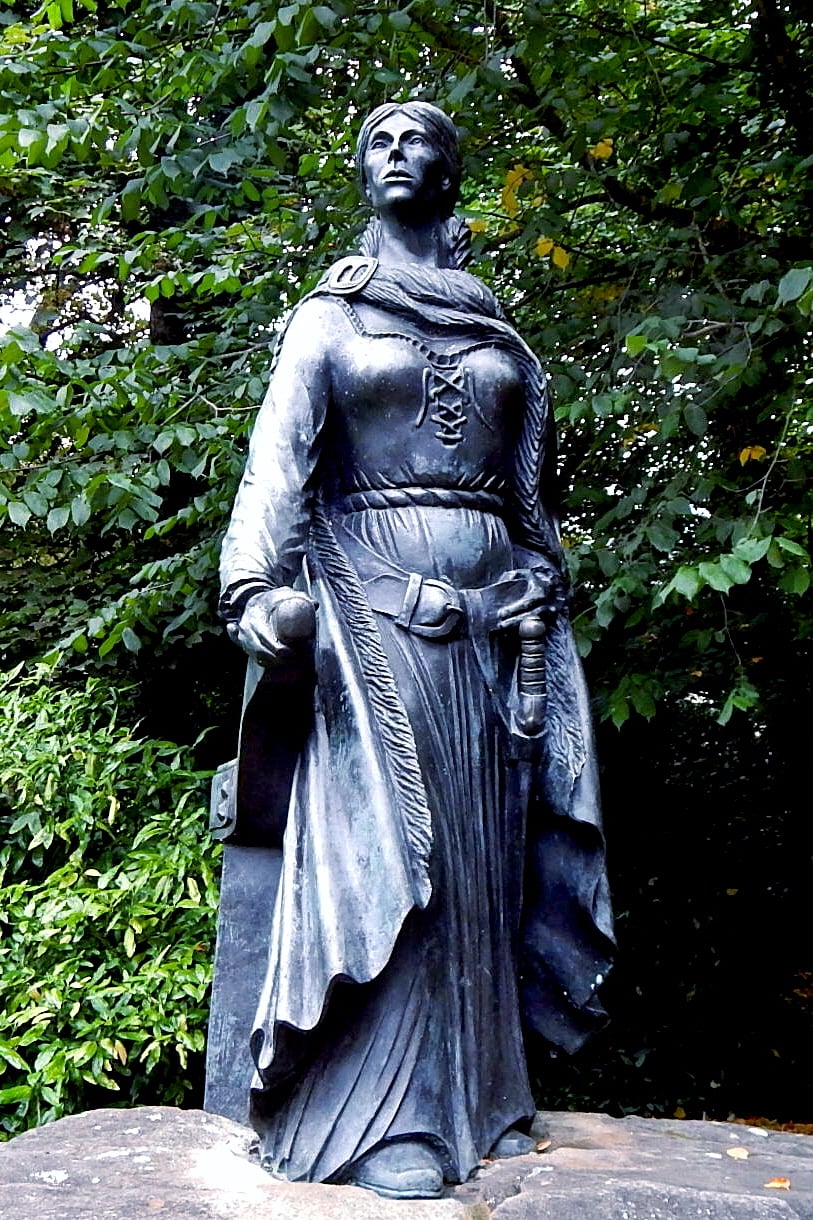
Who Was Gráinne Mhaol?
Grace O’Malley was born around 1530 into the O’Malley clan, the ruling family of the Barony of Murrisk on Ireland’s Atlantic coast. The clan motto, Terra Marique Potens — “powerful on land and sea” — was not a boast. The O’Malleys had controlled these waters for generations, taxing fishing vessels, trading with Spain and Scotland, and treating the sea-lanes of Connacht as their private domain.
Grace grew up in this world and inherited its assumptions entirely. From childhood, she is said to have been drawn to the sea, to ships, and to the kind of authority that came from knowing a coastline better than any rival. By the time she was an adult, she had absorbed every useful lesson her father’s fleet had to teach her — and had begun to surpass him.
She married twice. Her first husband was Dónal O’Flaherty of Galway, with whom she had three children and through whom she gained access to the powerful Flaherty territory. Her second husband was Richard Bourke of Mayo — known as “Iron Richard” — whose castle at Rockfleet on Clew Bay became her principal stronghold. Through marriage, inheritance, and her own forceful personality, she accumulated land, ships, and the loyalty of several hundred fighting men.
Commanding the Seas of Connacht
At the height of her power, Grace O’Malley commanded a fleet of up to 20 galleys — fast, shallow-drafted vessels ideally suited to Ireland’s rocky western coastline, where the larger warships of the English navy could not follow. She used this advantage ruthlessly. Merchant ships entering Clew Bay without permission paid a toll. Those who refused found their cargo redistributed.
Her base of operations was Rockfleet Castle (Carraigahowley), a medieval tower house on the eastern shore of Clew Bay near what is now Newport in County Mayo. The castle was chosen for its position as much as its structure: it sat directly on the water, with a sea gate at its base through which Grace could moor her ships within the walls. Contemporary accounts describe her chaining the mooring rope through the window of her bedroom at night, so that no one could untether a vessel without waking her.
Her trade routes stretched from Connacht to Scotland in the north and the ports of Spain in the south. These were not the routes of a provincial chieftain dabbling in commerce. They were the routes of a serious trading power, and they operated largely outside the control of English authorities who were, at this period, still trying to establish a reliable presence west of the Shannon.
If you are tracing your own Irish ancestry and connections to the west of Ireland, our guide to tracing your Irish roots from America covers the key resources available to diaspora families today. The O’Malley, Bourke, and Flaherty surnames all originate in this same Connacht territory.
A Political Operator in a Dangerous Era
Grace O’Malley was not simply a seafarer who stumbled into politics. She was a calculating operator who understood exactly what the English expansion into Connacht meant for her clan, and who adjusted her tactics accordingly — negotiating when it served her, fighting when it did not, and forming alliances across three provinces to maintain her position.
The English governors who dealt with her were consistently uncertain about how to classify her. She was too powerful to ignore and too politically astute to simply arrest without creating a larger problem. Sir Henry Sidney, who governed Ireland in the 1570s, met her and wrote admiringly of her as “a most famous feminine sea captain.” Sir Richard Bingham, who succeeded him in Connacht, took a far less accommodating view and spent years attempting to break her power entirely.
Bingham had Grace arrested in 1586 and held for a period before she was released. But the harassment of her fleet and her family did not stop. By the early 1590s, two of her sons — Tibbot-ne-Long and Murrough — had been taken by the English, along with her half-brother Dónal-na-Piopa O’Malley. Every local avenue of appeal had been exhausted. There was only one option remaining.
☘️ Enjoying this? 64,000+ Ireland lovers get stories like this every week.
Thinking about it for retirement? If you’ve started thinking seriously about retiring there, our complete our full Retire in Ireland guide covers the visa, healthcare, cost-of-living, and the regions worth shortlisting.
The Voyage to London and the Royal Audience
Grace O’Malley wrote directly to Queen Elizabeth I of England in 1593, setting out her situation and requesting redress. The letter — which survives — is written in a plain, direct style, presenting her case without excessive deference but also without aggression. Elizabeth responded by summoning her to Greenwich Palace.
The meeting between the two women that summer was unprecedented in Elizabethan history. Grace O’Malley arrived not as a supplicant but as a negotiating party. Elizabeth I, arguably the most powerful monarch in Europe at this moment, sat across from a woman whose entire life had been spent outside the systems of authority Elizabeth represented.
Neither spoke the other’s language. Elizabeth had no Irish; Grace had no English. The entire negotiation was conducted in Latin, which both women had learned as part of a classical education that was genuinely rare for women of the sixteenth century. That both of them were capable of conducting complex political business in a third language says something about the calibre of the individuals involved.
Contemporary accounts describe Grace refusing to bow to Elizabeth on the grounds that she did not recognise her as Queen of Ireland — she recognised her only as Queen of England. Whether this episode occurred exactly as described or was embellished later, the substance of what followed is well-documented in the English State Papers held in London.
What Grace O’Malley Demanded — and Received
Grace presented a series of formal articles to Elizabeth setting out her demands. They were specific, concrete, and almost entirely personal rather than political in the broader sense. She was not there to renegotiate the governance of Connacht. She was there to get her family out of English custody and to secure the future of her clan’s trading operations.
Her principal requests were:
- The release of her son Tibbot-ne-Long and her half-brother from English captivity
- The removal — or at minimum the restraint — of Sir Richard Bingham as Governor of Connacht
- The right for her clan to fish and trade freely along the western coast without interference
- Recognition of her status as an independent chieftain with the right to maintain her fleet
Elizabeth’s response was documented in a set of articles she approved and signed. The prisoners were to be released. Bingham was eventually recalled from Connacht and his powers curtailed. Grace was granted the right to pursue her “lawful occasions” by land and sea. The queen also offered Grace a formal title — Countess — which Grace reportedly declined, considering herself already the equal of any such designation in her own territory.
It was one of the most unusual diplomatic encounters of the Elizabethan era. An Irish chieftain with no official standing had sailed across the Irish Sea, walked into the English court, and walked out with what amounted to a direct settlement in her favour.
The Irish contribution to history in this era is often overlooked — for more on the men and women who shaped events on both sides of the Atlantic, see our article on why so many of America’s founders were Irish.
Her Final Years and Where She Is Buried
Grace O’Malley died around 1603 — the same year, as it happens, as Elizabeth I herself. She would have been in her early seventies, an exceptional age for the period. She is reputedly buried at Clare Island Abbey on Clare Island off the coast of County Mayo, in the small medieval church that the O’Malley clan had founded in the fifteenth century. A carved stone in the abbey is sometimes identified as a memorial to her, though the identification is disputed by historians.
Her son Tibbot-ne-Long — the same son whose imprisonment had driven her to London — went on to become Viscount Mayo and one of the most powerful figures in seventeenth-century Connacht. His career, and the dynasty he founded, are a direct consequence of the settlement his mother negotiated in 1593.
Visiting Grace O’Malley’s Ireland: Where to Go
Most of Grace O’Malley’s story is concentrated in County Mayo, and it is entirely possible to spend a day or two visiting the places directly associated with her. Our Ireland trip planning guide is a good starting point for working out a route through the west.
Rockfleet Castle (Carraigahowley)
Rockfleet Castle is Grace O’Malley’s most tangible surviving connection. The tower house stands on the eastern shore of Clew Bay between Newport and Mulranny — you will see it from the road, sitting directly at the water’s edge. It is a small, unrestored building maintained by the Office of Public Works and accessible to visit free of charge. The setting makes everything clear: the water laps directly at the base of the tower, and the bay opens out to the west with Clare Island visible on the horizon. It is not a dramatic visitor attraction, but it is exactly the kind of place that rewards anyone who knows what they are looking at.
Clare Island
Clare Island sits about 5km off the coast of County Mayo, reached by ferry from Roonagh Pier roughly 22km west of Westport. The crossing takes approximately 25 minutes, and ferries run daily during summer. The island has a small permanent population and a dramatic Atlantic coastline of cliffs and beaches. Clare Island Abbey, on the island’s eastern shore, is where Grace O’Malley is said to be buried. The O’Malley carving inside the church is one of the few physical survivals directly associated with the family.
Westport
Westport is the practical base for exploring O’Malley country. The town sits at the southern end of Clew Bay, with Croagh Patrick rising to the south and the island-dotted bay opening to the west. Clew Bay itself — with its 365 islands, one for each day of the year according to local tradition — was Grace’s home waters. Standing at the quayside in Westport and looking out towards Clare Island gives a clearer sense of the geography of her world than any amount of reading.
Frequently Asked Questions About Grace O’Malley
Who was Grace O’Malley and why is she famous?
Grace O’Malley (Gráinne Mhaol, born c. 1530, died c. 1603) was the chieftain of the O’Malley clan of County Mayo and the most powerful seafarer on Ireland’s Atlantic coast during the sixteenth century. She commanded a fleet of up to 20 galleys, defied English authority in Connacht for decades, and sailed to London in 1593 to negotiate directly with Queen Elizabeth I — securing the release of her imprisoned sons and the right of her clan to trade freely.
Where can you visit Grace O’Malley’s castle in Ireland?
Rockfleet Castle (Carraigahowley), near Newport in County Mayo, is Grace O’Malley’s principal surviving stronghold. It sits directly on the shore of Clew Bay and is free to visit. Clare Island, reached by ferry from Roonagh Pier (approximately 22km west of Westport), is her reputed burial place — Clare Island Abbey dates to the fifteenth century and was founded by the O’Malley clan.
Did Grace O’Malley really meet Queen Elizabeth I?
Yes. The 1593 meeting between Grace O’Malley and Elizabeth I is documented in the English State Papers. Both women communicated in Latin, as neither spoke the other’s language. Elizabeth approved the release of Grace’s imprisoned family members and granted her clan the right to pursue lawful trade — making it one of the most extraordinary diplomatic encounters of the Elizabethan era.
☘️ Join 64,000+ Ireland Lovers
Every weekday morning, get Ireland’s hidden gems, local secrets, and travel inspiration — the kind you won’t find in any guidebook.
Subscribe free — enter your email:
📲 Know someone who’d love this? Share on WhatsApp →
Free forever · Unsubscribe anytime
Tours & experiences you might love


Powered by Viator. Some links are affiliate links — we may earn a small commission at no extra cost to you.
Secure Your Dream Irish Experience Before It’s Gone!
Planning a trip to Ireland? Don’t let sold-out tours or packed attractions spoil your journey. Iconic experiences like visiting the Cliffs of Moher, exploring the Rock of Cashel, or enjoying a guided walk through Ireland’s ancient past often sell out quickly—especially during peak travel seasons.

Booking in advance guarantees your place and ensures you can fully immerse yourself in the rich culture and breathtaking scenery without stress or disappointment. You’ll also free up time to explore Ireland’s hidden gems and savour those authentic moments that make your trip truly special.
Make the most of your journey—start planning today and secure those must-do experiences before they’re gone!