

Tír na nÓg is the Irish myth that still haunts the imagination more than any other: a land beyond the western sea where time does not move, nobody grows old, and everything is beautiful beyond description. The story of Oisín — the warrior poet who lived there for 300 years and returned to find his whole world gone — is one of the oldest and most heartbreaking legends Ireland has ever told. It is also one of the most misunderstood. This is the real story, the places in Ireland connected to it, and what it has meant to Irish people for more than a thousand years.
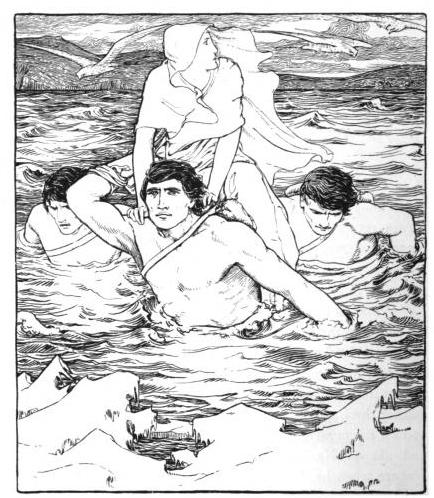
Who Was Oisín?
Oisín (pronounced uh-SHEEN) was the son of Fionn Mac Cumhaill — the legendary warrior chieftain known to many Irish-Americans as Finn McCool. His mother, Sadhbh, was a woman of the Otherworld before a dark druid turned her into a deer. She came to Fionn in human form, became his wife, and carried their son before the curse returned her to deer form. Oisín grew up among the Fianna, his father’s elite warrior band, and became both a great fighter and the greatest poet in Ireland. For generations, his words passed from mouth to mouth across the country. He was not simply a character in a story. For the Irish, Oisín was the last voice of a vanished age.
The Fenian Cycle — the great body of stories surrounding Fionn and the Fianna — dates back at least 1,200 years in written form and far longer in oral tradition. Oisín appears throughout as a bridge between the pagan heroic world and the later Christian era. He alone was said to have lived long enough to meet St Patrick himself and to argue with him about which world had more beauty and worth.
The Night Niamh Came to Ireland
The Fianna were hunting near the lakes of Killarney in County Kerry when a white horse emerged from the water. On its back rode a woman unlike anything the warriors had seen. Her hair was the colour of gold. She wore a cloak of fabric that seemed to shift with light. Flowers braided through her horse’s mane had no name in the Irish tongue. Her name was Niamh Chinn Óir — Niamh of the Golden Hair — and she was a princess of Tír na nÓg.
She had come for Oisín. She had heard his poetry carried on the wind across the western sea, and she had crossed the world to find him. She told him of Tír na nÓg — a land where there is no winter, no hunger, no illness, and no death. Where feasts last for days. Where no one is ever older than the day they arrive. She asked him to come with her, and Oisín, young and restless and drawn to wonder, said yes. He embraced his father Fionn, who wept. He promised he would return. Then he mounted behind Niamh on the white horse, and the horse ran west across the surface of the sea until Ireland was gone from sight.
Fionn Mac Cumhaill reportedly stood watching the sea until his men led him away. He never saw his son again.
☘️ Researching your Irish roots?
Our free step-by-step guide walks you through every record, database, and DNA tool to trace your Irish family — no experience needed.
Get the Free Ancestry Guide →Life in Tír na nÓg — The Land That Stands Still
In Tír na nÓg, Oisín married Niamh and lived as a king. He fought battles — even in the Otherworld there was conflict — and won three great victories in a single day, each against champions who had never lost before him. He hunted deer across plains that stretched without horizon. He feasted in halls lit by some source of light that had nothing to do with the sun. He composed poetry so beautiful that even the people of the Otherworld fell silent to listen.
Time in Tír na nÓg does not pass the way it does in the mortal world. Three years in the Land of Youth equals roughly 300 years in Ireland. Oisín felt he had been there perhaps two or three seasons. He felt no different from the day he arrived. He did not know — could not have known — what was happening to the world he had left behind.
He and Niamh had three children together: two sons named Fionn and Oscar, and a daughter named Plor na mBan, meaning Flower of Women. By any measure, he had been given a life beyond imagining. Yet, around what he believed to be three years into his stay, he began to dream of Ireland.
Why Oisín Chose to Come Home
The longing came gradually. He dreamed of rain on Irish hillsides. He heard in his sleep the sound of hounds giving voice on a hunt through the oak forests of Connaught. He thought of his father Fionn standing on the Hill of Allen in County Kildare, the great central stronghold of the Fianna. He thought of men he had known and stories he had not yet told.
He asked Niamh if he could go back. She tried to dissuade him. She told him that the Ireland he remembered was gone — she knew, though she did not say how much time had truly passed. When she saw that he would not be persuaded, she gave him the white horse and one absolute instruction: do not dismount. Whatever happens in Ireland, she said, do not let your feet touch Irish soil. If you do, you will never return to me.
Oisín promised. He turned the horse east, back toward Ireland, and rode across the sea once more. He arrived on the coast of Ireland near what is now County Clare, where the Burren’s limestone terraces meet the Atlantic.
He found a landscape that had changed entirely. The forests were thinner. The roads were different. The people were smaller. He asked for the Hill of Allen and was told the name but could not recognise the place when he found it — overgrown and empty. He asked where Fionn Mac Cumhaill lived, and the men he asked looked at him strangely and said Fionn had been dead for 300 years.
Ireland was no longer a land of warrior poets and ancient gods. St Patrick had arrived in 432 AD. Christianity had taken hold across the island. The Fianna were gone. The old world had ended without him.
☘️ Enjoying this? 64,000+ Ireland lovers get stories like this every week. Subscribe free →
The Moment Oisín Touched Irish Soil
He came across a group of men struggling to move a large boulder near Kilmallock in County Limerick. They were weak compared to the warriors he had known. He leaned from the saddle to help them. The girth of the saddle snapped. Oisín fell. His feet touched Irish soil.
In an instant — and every version of the tale agrees on this detail — he aged 300 years. The warrior became a blind, white-haired old man. The horse bolted west, back toward the sea, without him. The men who had been struggling with the boulder stood and stared at what had happened to the stranger who had come to help them.
People brought Oisín to St Patrick, somewhere in Munster — County Limerick and County Kerry both claim the honour. The old man and the saint spent his final days in intense conversation. Oisín described Tír na nÓg, the Fianna, his father Fionn, and the world as it had been before Christianity arrived. Patrick tried to comfort him with talk of heaven. Oisín replied — in a line that Irish people have quoted for more than 1,000 years — that if Fionn and his men were in hell, he would rather be with them than in heaven without them.
He died shortly after, still blind, still ancient, having described everything he could remember of the world that was gone.
What the Tír na nÓg Legend Means to the Irish Diaspora
The Irish have always understood the Tír na nÓg story on more than one level. On the surface it is a myth about a magical land. Beneath that, it is about time — about how quickly the world changes while you are not watching. Oisín left for what he thought was a brief adventure. He returned to find his father dead 300 years, the language changed, the landscape barely recognisable, everything he loved turned to dust.
For the millions of Irish men and women who emigrated during the 18th, 19th and 20th centuries and found themselves unable to return, this myth carried a very specific weight. The story of Oisín is the story of every Irish emigrant who left and could not go back. Even today, Irish-Americans who visit Ireland for the first time often report a version of this feeling: the country they imagined from their grandparents’ stories is real and not real at the same time. The place exists. The world they were told about does not.
W.B. Yeats wrote a poem called The Wanderings of Oisin in 1889 — one of the earliest major works of the Irish Literary Revival, running to more than 600 lines. He understood what the myth was doing: it carried grief for a vanished world, and did it in a way that preserved the beauty of what was lost rather than simply mourning it.
The Real Places in Ireland Connected to the Legend
Several locations across Ireland claim connections to the Oisín myth. All of them are worth visiting.
The Lakes of Killarney, County Kerry — The three lakes — Lough Leane, Muckross Lake, and the Upper Lake — are surrounded by the ancient oak woods of Killarney National Park. This is where Niamh’s white horse emerged from the water to find Oisín. The park covers roughly 25,000 acres and contains some of the oldest native woodland in Ireland, with Lough Leane — the largest of the three lakes — still the centrepiece of the view.
Glenosheen, County Limerick — A quiet valley in the Ballyhoura Mountains, associated in local tradition with Oisín’s birth and early years. Fionn’s Fianna once ranged through this territory. The valley name translates as Oisín’s Glen in Irish.
The Glen of Aherlow, County Tipperary — The glen runs for around 13 kilometres between the Galtee Mountains and Slievenamuck Ridge. Oisín is said to have composed some of his most famous poetry here. The Fianna hunted throughout this valley, and the landscape today looks much as it would have in the mythological age. For more on the wider area, see our guide to County Tipperary.
The Burren, County Clare — Oisín returned from Tír na nÓg along the Clare coast, and the Burren with its extraordinary limestone plateau already feels like a place outside normal time. More than 70 megalithic tombs dot the landscape, the oldest dating back 5,000 years. The Burren National Park is free to enter and covers around 1,800 hectares.
Kilmallock, County Limerick — The town near which Oisín fell from his horse and touched Irish soil. Today Kilmallock contains significant medieval ruins including a 13th-century Dominican Friary with much of its original stonework intact. Nearby Limerick city makes a good base for exploring the area — see our guide to visiting Limerick.
Tír na nÓg in Irish Life Today
The name Tír na nÓg appears constantly in Irish life. Several hundred pubs across Ireland and the Irish diaspora carry the name. Streets in Dublin and Cork bear it. Niamh is one of Ireland’s most popular girls’ names — tens of thousands of women in Ireland today are called Niamh, and the name is widespread among Irish-Americans and Irish Australians. Oisín consistently appears in Ireland’s top 20 boys’ names, used by tens of thousands of Irish families each year. These are not the names of forgotten characters. They are the names of people walking around Irish cities today, carrying the myth with them without necessarily knowing it.
The image of Tír na nÓg as a land lying just beyond the western horizon shows up in poetry, in music, and in the way Irish speakers use the phrase tír (country/land) with a particular weight that English does not quite have. To say that something belongs to Tír na nÓg is to say that it is beautiful, that it cannot last, and that searching for it might cost you everything.
That is perhaps why the legend has never quite gone away. Three hundred years pass in what feels like three. The world you left behind is unrecognisable when you return. The horse that carried you home bolts before you can catch it. These are things that Irish people have recognised — about emigration, about history, about the way time works — for over 1,000 years. The names change. The myth stays.
What is Tír na nÓg in Irish mythology?
Tír na nÓg (Land of Youth) is the Otherworld in Irish mythology — a land beyond the western sea where nobody ages, nobody dies, and everything is eternally beautiful. It is the most famous of the Otherworld realms described in the Fenian and Mythological Cycles of Irish literature, and the legend dates back at least 1,200 years in written form.
What happens in the story of Oisín and Tír na nÓg?
The warrior poet Oisín, son of Fionn Mac Cumhaill, goes to Tír na nÓg with Niamh of the Golden Hair. He lives there for what feels like three years but is actually 300. When he returns to Ireland, he falls from his enchanted white horse, touches Irish soil, and instantly ages three centuries. He dies shortly after, having described his life in Tír na nÓg to St Patrick.
Where in Ireland can I visit places connected to the Tír na nÓg legend?
The Lakes of Killarney in County Kerry are where Niamh’s white horse emerged from the water. Glenosheen in County Limerick is linked to Oisín’s birth. The Glen of Aherlow in County Tipperary connects to Fianna hunts. The Burren in County Clare marks Oisín’s return from the sea. Kilmallock in County Limerick is near where he fell from his horse and touched Irish soil.
☘️ Join 64,000+ Ireland Lovers
Every weekday morning, get Ireland’s hidden gems, local secrets, and travel inspiration — the kind you won’t find in any guidebook.
Subscribe free — enter your email:
Get the free guide
Enter your email and we will send you straight to the download.
📲 Know someone who’d love this? Share on WhatsApp →
Love more? Join 43,000 Scotland lovers → · Join 29,000 Italy lovers → · Join 7,000 France lovers →
Free forever · Unsubscribe anytime
Tours & experiences you might love


Powered by Viator. Some links are affiliate links — we may earn a small commission at no extra cost to you.
Secure Your Dream Irish Experience Before It’s Gone!
Planning a trip to Ireland? Don’t let sold-out tours or packed attractions spoil your journey. Iconic experiences like visiting the Cliffs of Moher, exploring the Rock of Cashel, or enjoying a guided walk through Ireland’s ancient past often sell out quickly—especially during peak travel seasons.

Booking in advance guarantees your place and ensures you can fully immerse yourself in the rich culture and breathtaking scenery without stress or disappointment. You’ll also free up time to explore Ireland’s hidden gems and savour those authentic moments that make your trip truly special.
Make the most of your journey—start planning today and secure those must-do experiences before they’re gone!