

There are places in Ireland that don’t simply feel old. They feel continuous — as if the centuries haven’t stacked up so much as pooled, layer on quiet layer, into something the present world has no word for. Temple House, a 17th-century estate outside Ballymote in County Sligo, is one of those places.
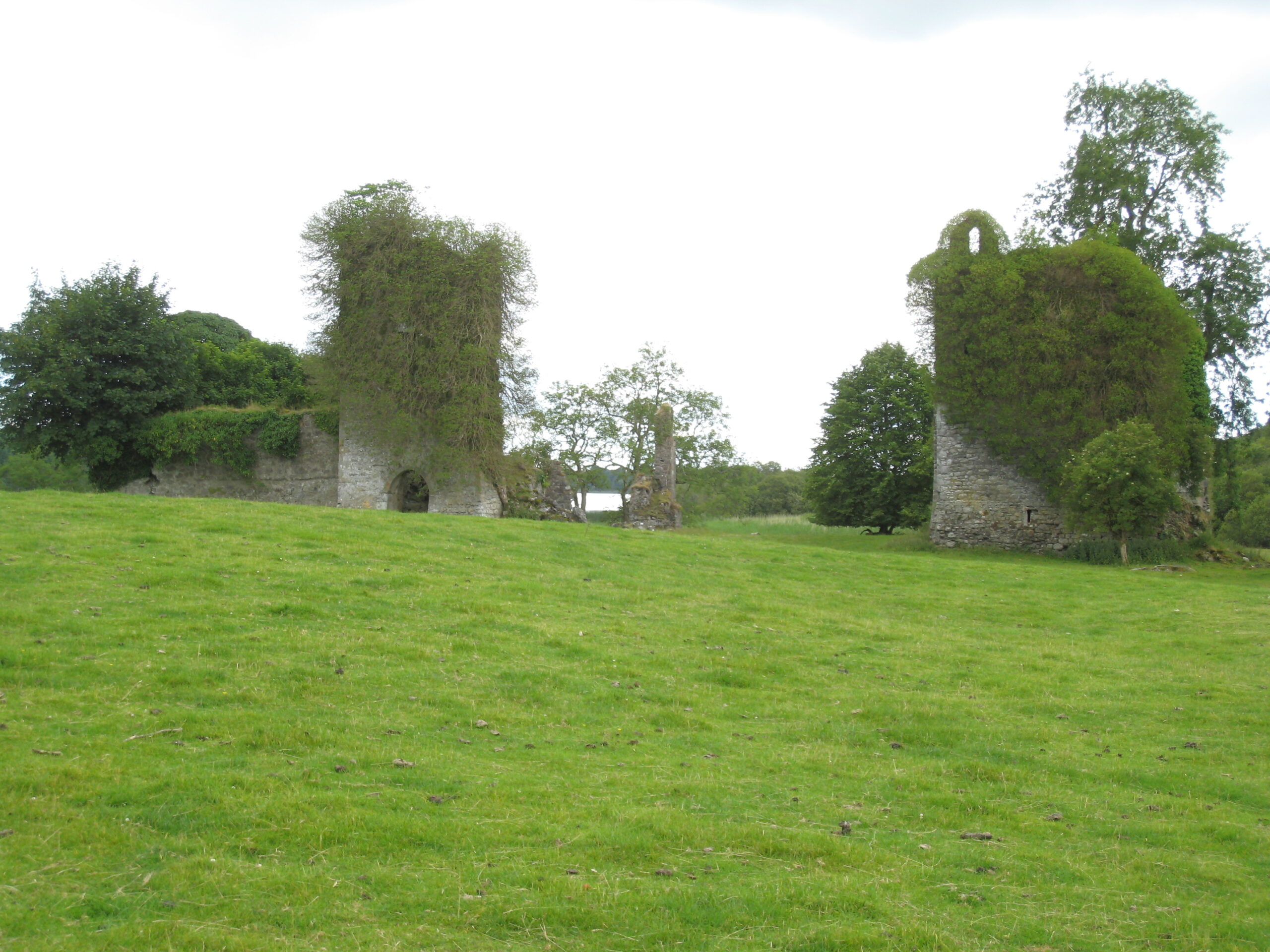
The house has been in the Perceval family since 1665. That’s not a typo. The same family. Three hundred and sixty years of unbroken connection to one piece of ground — to one lake, one set of wooded walks, one ruined medieval castle reflected in still water at dusk. Roderick Perceval, who manages the estate today, can trace his family’s ownership back further than most countries have existed in their current form.
A castle before the house
The name “Temple House” predates the Georgian mansion by several centuries. The Knights Templar built a castle here around 1181, and what remains of it — a romantic ruin at the edge of the lake — is still one of the estate’s most striking features. You can walk to it. It will take you five minutes and three hundred years.
The Templars came for the same reasons anyone would: the land here is rich, the water plentiful, and Lough Templehouse — a roughly 300-acre lake at the heart of the estate — was then, as now, one of the finest pike fishing lakes in Connacht. When the order was dissolved in the early 14th century, the castle passed through several hands before the Percevals arrived in 1665 and simply never left.
The estate today
Temple House sits on roughly 1,000 acres of farmland, woodland and lakeside meadow. The Georgian mansion — built in the 1820s on the foundations of an earlier house — overlooks the lake from a gentle rise. It’s a proper country house: high ceilings, family portraits, furniture that has been in the same rooms for generations, drawing rooms that feel lived-in rather than staged.
The Percevals have opened Temple House to guests for decades. The shift toward exclusive-use rental in recent years suits the scale of the place — you get the house, or a substantial part of it, rather than a room in it, with a separate self-catering cottage for smaller groups. Mornings arrive with nothing more scheduled than a walk to the castle ruin or a session on the lake. The estate provides rowing boats; the lake provides the pike. Whether you take them up is entirely your own affair.
County Sligo beyond the gate
Temple House is well placed for anyone who wants to explore northwest Ireland properly rather than in passing. Sligo town is twenty minutes south, with its good restaurants, its association with W.B. Yeats, and its surprisingly strong contemporary arts scene centred on the Model and the Hawk’s Well Theatre.
Knocknarea — the hill with the massive cairn believed to be the tomb of Queen Maeve — is visible from parts of the estate on a clear day and takes roughly an hour to climb. Carrowmore, the largest megalithic cemetery in Ireland and one of the oldest in Europe, is not far beyond it. Lissadell House, the 19th-century home of the Gore-Booth family that Yeats immortalised in verse, is an easy drive north.
The coast here — particularly around Strandhill and Rosses Point — is wild and relatively uncrowded. Surfers have been coming to Strandhill for long enough that the village has grown the infrastructure around it, but it retains a quality of being genuinely at the edge of things, looking west across open Atlantic. For a fuller itinerary, see our guide to planning a weekend in Sligo.
Why Temple House matters
Ireland has no shortage of beautiful old properties to stay in. What makes Temple House different is the continuity — the sense that the place has been tended rather than restored, that the history here isn’t a backdrop but an ongoing story the Percevals are still writing.
Roderick Perceval knows this landscape the way you can only know a place you’ve known since childhood. That knowledge shows itself quietly: in the advice about where to walk, in the information about the water levels on the lake, in the easy familiarity with which the family moves through rooms that have held their name for three and a half centuries.
For Love Ireland readers planning time in the west — particularly those interested in heritage, landscape, and the kind of quiet that asks something of you — Temple House is worth a long look.
Practical
Temple House, Ballymote, Co. Sligo. Exclusive-use and self-catering stays, fishing, walking, cycling. Bookings and current availability at templehouse.ie.
For more on County Sligo — from Yeats country to the Wild Atlantic Way coast — subscribe to the Love Ireland newsletter: 64,000 readers who love Ireland as much as you do.
By Alex Monroe, Synpro Media.
☘️ Join 64,000+ Ireland Lovers
Every weekday morning, get Ireland’s hidden gems, local secrets, and travel inspiration — the kind you won’t find in any guidebook.
Subscribe free — enter your email:
📲 Know someone who’d love this? Share on WhatsApp →
Love more? Join 43,000 Scotland lovers → · Join 29,000 Italy lovers → · Join 7,000 France lovers →
Free forever · Unsubscribe anytime
Tours & experiences you might love


Powered by Viator. Some links are affiliate links — we may earn a small commission at no extra cost to you.
Secure Your Dream Irish Experience Before It’s Gone!
Planning a trip to Ireland? Don’t let sold-out tours or packed attractions spoil your journey. Iconic experiences like visiting the Cliffs of Moher, exploring the Rock of Cashel, or enjoying a guided walk through Ireland’s ancient past often sell out quickly—especially during peak travel seasons.

Booking in advance guarantees your place and ensures you can fully immerse yourself in the rich culture and breathtaking scenery without stress or disappointment. You’ll also free up time to explore Ireland’s hidden gems and savour those authentic moments that make your trip truly special.
Make the most of your journey—start planning today and secure those must-do experiences before they’re gone!