

The Six Mythological Invasions of Ireland: How the Ancient Irish Explained Where They Came From
The mythological invasions of Ireland — recorded in the 11th-century Lebor Gabála Érenn (the Book of Invasions) — describe six successive peoples who conquered Ireland before the Gaels arrived. This ancient text, compiled by medieval monks from far older oral traditions, is Ireland’s mythological creation story. It explains where the Irish came from, why the land is sacred, and how the gods themselves once walked its hills. For anyone tracing Irish ancestry, it is the deepest root of all: the mythological bedrock beneath every Irish family tree.
☘️ Researching your Irish roots?
Our free step-by-step guide walks you through every record, database, and DNA tool to trace your Irish family — no experience needed.
Get the Free Ancestry Guide →What Is the Lebor Gabála Érenn — the Book of Invasions?
The Lebor Gabála Érenn — usually translated as the Book of the Takings of Ireland — is a collection of poems and prose narratives first compiled in the 11th century AD. The stories it contains are far older, drawn from centuries of oral tradition. Medieval Irish monks gathered these accounts and wove them into a single, sweeping mythological history of Ireland from the creation of the world to the arrival of the Gaelic Irish.
The text mattered enormously to the Gaelic aristocracy. Every noble family could trace its lineage through the text’s genealogical lists, connecting living people to the mythological founders of Ireland. The Book of Invasions was not merely a story — it was an ancestral record, a claim to political legitimacy, and a sacred geography of Ireland, all in one document. It survives today in multiple medieval manuscripts, the most important of which is the Book of Leinster, compiled around 1150–1160 AD.
The First Invasion: Cessair and the Flood
Cessair — a granddaughter of Noah — led the first people to arrive in Ireland. According to the mythology, she came to Ireland 40 days before the Biblical flood, believing the island lay at the edge of the world and would escape God’s wrath. She arrived with 50 women and 3 men, landing somewhere along the west coast — many scholars associate the myth with the coastline of County Cork or the Shannon estuary.
The flood came anyway. Every member of Cessair’s people drowned — except one man: Fintan mac Bóchra. Fintan survived by transforming himself. First into a salmon, then an eagle, then a hawk. He lived for 5,500 years, witnessing every subsequent invasion of Ireland. He appears again and again in Irish mythology as the great witness, the one who remembers everything. Fintan became the living memory of Ireland itself.
Why the Cessair Invasion Matters for Ancestry Research
The Cessair invasion establishes a motif that runs through all Irish mythology: Ireland as a land shaped by waves of arrival, loss, and transformation. For diaspora families tracing their roots, this is the very beginning of the story — the mythological acknowledgement that Ireland was always a land of comings and goings, of people arriving and reinventing themselves. The same story has repeated across every generation, including those who left during the Famine years and those who are searching for their Irish roots today.
The Second Invasion: Partholón and the First Civilisation
Three hundred years after the flood, Partholón arrived with his followers from a land to the west — possibly Iberia or Scythia, depending on which version of the text you read. His people transformed Ireland from a near-uninhabitable wilderness into something resembling a civilised land. They cleared four new plains, created seven new lakes, and established the first trades in Ireland: brewing, farming, cooking, and hospitality.
They also fought and won Ireland’s first mythological battle — against the Fomorians, the dark, misshapen beings of chaos who appear in Irish mythology as the forces of disorder and destruction. But a plague eventually destroyed Partholón’s people. It struck them during the month of May, killing all 9,000 survivors in a single week. Tradition holds they lie buried on the plain of Sean Mag in present-day County Meath — within a few kilometres of what would later become the Hill of Tara. Archaeologists have found evidence of massive early Bronze Age activity across the Boyne Valley, which some interpret as a distant echo of this mythological memory.
☘️ Enjoying this? 64,000+ Ireland lovers get stories like this every week. Subscribe free →
The Third Invasion: Nemed and the People of the Sacred Land
Nemed (“sacred” or “privileged” in Old Irish) arrived from Scythia with four ships, 44 people per vessel. His people settled Ireland for a generation, clearing forests and founding new plains. But they suffered terribly under the Fomorians, who extracted a brutal annual tribute: two-thirds of their children, their grain, and their milk — an arrangement that reads, in mythological terms, as a memory of conquest and forced servitude.
After Nemed’s death, his people fought back. They attacked the Fomorians’ great tower on the island of Tory, off the coast of what is now County Donegal, and almost won — but the sea rose against them. Most drowned. The survivors scattered across Europe in three groups, and those groups would return to Ireland as the next two waves of invaders.
The Fourth Invasion: The Fir Bolg — Ireland’s Five Provinces
The Fir Bolg (“men of bags”) descended from Nemed’s people. Greek slave-masters had enslaved them and forced them to carry bags of soil up rocky hillsides. When they escaped, they built boats from their bags and sailed back to Ireland. Their legacy is remarkable: they divided the island into five provinces — Ulster, Munster, Leinster, Connacht, and Meath — a division that still echoes in the four modern provinces of Ireland today.
The Fir Bolg ruled Ireland for 37 years. Under their last king, Eochaid mac Eirc, Ireland knew such peace that no one heard a thunderclap. The land stayed fertile, rivers ran full, and the king administered justice perfectly. The people who came after them remembered the Fir Bolg era as a golden age of order and stability.
The First Battle of Mag Tuired ended it — fought near present-day Lough Arrow in County Sligo — where the most extraordinary people in all of Irish mythology defeated the Fir Bolg.
The Fifth Invasion: The Tuatha Dé Danann — Ireland’s Gods Arrive
The Tuatha Dé Danann — the “tribes of the goddess Danu” — came from four magical northern cities: Falias, Gorias, Finias, and Murias. From each city they brought a legendary treasure that represents a fundamental pillar of civilisation:
- From Falias: the Lia Fáil (Stone of Destiny) — which screamed when Ireland’s true king stood upon it. It is said to stand on the Hill of Tara today.
- From Gorias: the spear of Lugh — so powerful that no battle was ever sustained against it.
- From Finias: the sword of Nuada — from which no one ever escaped once it was drawn.
- From Murias: the Cauldron of the Dagda — from which no one ever went away hungry.
These four objects — justice, military power, righteous authority, and abundance — represent everything a legitimate civilisation requires. Every Irish king who ever claimed legitimacy needed to possess or embody all four qualities. The symbolism is extraordinarily durable: it shows up in the Irish constitutional tradition, in medieval kingship rituals, and in popular culture to this day.
The Two Great Battles of the Tuatha Dé Danann
The Tuatha Dé Danann fought two legendary battles. In the First Battle of Mag Tuired, they defeated the Fir Bolg. In the Second Battle of Mag Tuired — the most dramatic conflict in all of Irish mythology — they faced and destroyed the Fomorians, led by the terrible Balor of the Evil Eye, whose gaze could kill an entire army.
Lugh — the sun god and Balor’s own grandson — killed him by driving a sling-stone through his grandfather’s eye just as it opened against the Tuatha Dé Danann forces. This battle — which may preserve a distant mythological memory of real prehistoric conflicts between agricultural and hunter-gatherer peoples — was fought near present-day Sligo. Local tradition still marks the site, near Moytirra on the eastern shore of Lough Arrow, approximately 290 kilometres west of Dublin.
The Tuatha Dé Danann ruled Ireland for 297 years. Then came the Gaels. (For the full story of these divine invaders, see our complete guide to the Tuatha Dé Danann.)
The Sixth Invasion: The Milesians and the Birth of the Irish People
The sons of Míl Espáine — the Milesians — came from Iberia (modern-day Spain and Portugal). Their story is remarkable for its legal and diplomatic detail. When they arrived on Irish shores, the Tuatha Dé Danann did not simply surrender. Instead, they asked the Milesians to withdraw nine waves out to sea while they deliberated on what to do.
The Milesians agreed — demonstrating the Irish mythological value of fair dealing even between rivals. But the Tuatha Dé Danann raised a magical storm to drive them permanently away. Their chief poet, Amergin, countered with one of the oldest poems in the Irish language — a remarkable incantation in which he claims to be the wind, the wave, the salmon in the river, the hill, and the fire:
“I am the wind on the sea. I am the wave of the sea. I am the sound of the sea. I am the ox of seven combats. I am the dewdrop in the sun. I am the fairest of flowers…”
Amergin’s Song — one of the oldest surviving poems in the Irish language, written down c. 600–800 AD
Amergin calmed the storm. The Milesians landed. They defeated the Tuatha Dé Danann in battle, and the two peoples divided Ireland: the Milesians took the upper world — the hills, plains, and shores — while the Tuatha Dé Danann retreated underground into the sídhe (fairy mounds). They became the aos sí, the fairy folk, the supernatural inhabitants of a parallel Ireland just beneath the surface of the real one. This is why every ring fort, fairy mound, and earthwork in Ireland carries a layer of supernatural significance — and why local people even today are sometimes reluctant to disturb them. (Read more about why Ireland’s gods went underground and never really left.)
What the Six Invasions Reveal About Irish Identity
The six invasions are not history in any archaeological sense. Modern genetic research confirms that major influxes from Iberia reached the Irish population during the Neolithic and Bronze Age — a remarkable coincidence with the Milesian mythology. But the text’s primary purpose is to explain not bodies in the ground but ideas in the mind. Here is what the mythology communicates:
- Ireland was always shaped by arrivals. Every wave of people transformed the island. Irish identity is not rooted in a single origin but in a layered, cumulative story of peoples who came, suffered, adapted, and survived.
- The gods are still here. The Tuatha Dé Danann did not vanish — they went underground. Ireland’s more than 40,000 recorded ring forts and earthworks are each potentially an entrance to their world. The mythology is physically present in the landscape.
- Language is power. Amergin’s poem stopped a storm. In Irish mythology, words have real force. This belief in language as a sacred act runs through Irish literary culture from the medieval period to Seamus Heaney and beyond.
- Loss is written into the land. Every invasion group is eventually destroyed or displaced. Ireland’s mythology is saturated with beautiful, tragic endings — a feature that would resurface in the Famine, in emigration, and in centuries of colonial displacement. The mythology prepared the Irish to understand catastrophe as part of a larger story that does not end.
Where to Encounter the Mythological Invasions in Ireland Today
The mythological Ireland of the Book of Invasions is not abstract. It exists in specific places you can visit:
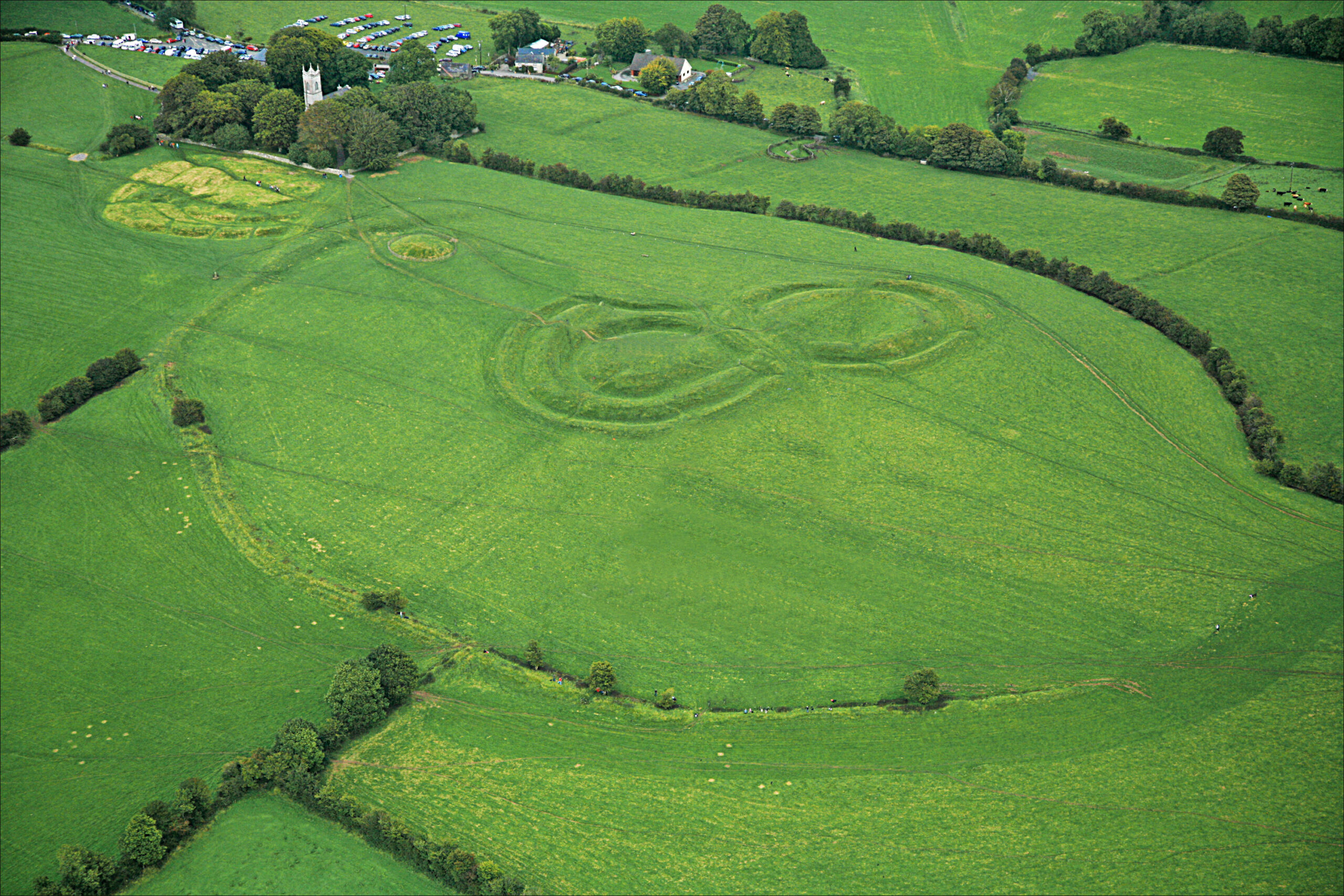
- The Hill of Tara, County Meath — sacred centre of Ireland since the Neolithic period (c. 3000 BC). The Lia Fáil still stands here. Free to enter; 46 kilometres north-west of Dublin.
- Lough Arrow, County Sligo — traditional site of both Battles of Mag Tuired. The surrounding landscape contains numerous megalithic tombs associated with the mythological battles.
- Tory Island, County Donegal — the Fomorians’ stronghold, still inhabited by a close-knit Irish-speaking community of approximately 140 people (2022 census). Accessible by ferry from Magheroarty.
- Newgrange, County Meath — a passage tomb built c. 3200 BC, associated in mythology with the Dagda and the Tuatha Dé Danann. Its entrance aligns precisely with the winter solstice sunrise each year.
- Knocknarea, County Sligo — the cairn at its summit, visible for kilometres around, is said in mythology to be the tomb of Queen Maeve. Archaeologically it dates to approximately 3500 BC.
FAQ: The Mythological Invasions of Ireland
What is the Book of Invasions and when was it written?
Irish monks first compiled the Lebor Gabála Érenn (Book of Invasions) in the 11th century AD, drawing on oral traditions that are several centuries older. It records six successive mythological invasions of Ireland, from the pre-Flood people of Cessair to the Milesians — the mythological ancestors of the Gaelic Irish. The text survives in multiple medieval manuscripts; Trinity College Dublin holds the most important, the Book of Leinster (c. 1150–1160 AD).
How many mythological invasions of Ireland are there?
The mythology records six invasions: Cessair’s people (who came before the Biblical flood), Partholón’s people, Nemed’s people, the Fir Bolg, the Tuatha Dé Danann, and the Milesians. Each group either builds upon, defeats, or displaces the previous one. The Tuatha Dé Danann — the divine beings of Irish mythology — draw the most fascination. The Milesians never destroyed them; instead the Tuatha Dé Danann retreated into the fairy mounds scattered across the Irish landscape, where mythology says they remain today.
Where did the Milesians come from in Irish mythology?
The Milesians (the sons of Míl Espáine) came from Iberia — the region of modern-day Spain and Portugal. Modern genetic research has found significant evidence of a migration from Iberia to Ireland during the Neolithic and Early Bronze Age, roughly 2500–2000 BC. This does not confirm the mythology, but it suggests the oral tradition may preserve a distant cultural memory of real population movements spanning thousands of years.
Is Amergin’s Song the oldest poem in the Irish language?
Amergin’s incantation — said to have been sung as he first set foot on Irish soil — ranks among the oldest surviving poems in the Irish language. Scribes wrote the version we have around 600–800 AD. Scholars place it among the earliest examples of lyric poetry in any European vernacular language, and readers in Ireland still quote it today.
Where is the Lia Fáil — the Stone of Destiny — today?
The Lia Fáil is said to stand on the Hill of Tara in County Meath, where it has occupied that ground since at least the early medieval period. According to mythology, it screamed when Ireland’s rightful High King stepped upon it. Some scholars argue a later monument replaced the original stone, and that medieval Scots carried the real Lia Fáil to Scotland — where it became the Stone of Scone, central to British coronation ceremonies for more than 700 years. The Hill of Tara is open year-round, free to visit, and lies 46 kilometres north-west of Dublin.
If your family roots trace to Ireland, the mythological invasions are the deepest layer of that inheritance — a story of arrival, transformation, and survival that has shaped everything about Irish identity. The diaspora experience of leaving, adapting, and carrying Ireland in the memory is the latest chapter in the same story that began with Cessair stepping ashore before the flood came. Our Irish Townlands Ancestry Research Guide can help you connect your own family’s chapter to the longer Irish story.
☘️ Join 64,000+ Ireland Lovers
Every weekday morning, get Ireland’s hidden gems, local secrets, and travel inspiration — the kind you won’t find in any guidebook.
Subscribe free — enter your email:
Already subscribed? Download your free Ireland guide (PDF)
📲 Know someone who’d love this? Share on WhatsApp →
Love more? Join 43,000 Scotland lovers → · Join 29,000 Italy lovers → · Join 7,000 France lovers →
Free forever · Unsubscribe anytime
Tours & experiences you might love


Powered by Viator. Some links are affiliate links — we may earn a small commission at no extra cost to you.
Secure Your Dream Irish Experience Before It’s Gone!
Planning a trip to Ireland? Don’t let sold-out tours or packed attractions spoil your journey. Iconic experiences like visiting the Cliffs of Moher, exploring the Rock of Cashel, or enjoying a guided walk through Ireland’s ancient past often sell out quickly—especially during peak travel seasons.

Booking in advance guarantees your place and ensures you can fully immerse yourself in the rich culture and breathtaking scenery without stress or disappointment. You’ll also free up time to explore Ireland’s hidden gems and savour those authentic moments that make your trip truly special.
Make the most of your journey—start planning today and secure those must-do experiences before they’re gone!