

County Tipperary offers some of Ireland’s most impressive medieval landmarks, dramatic landscapes, and rich heritage. The county is home to the Rock of Cashel — one of the most visited sites in the entire country — as well as Cahir Castle, Holy Cross Abbey, and a string of unspoilt market towns that most tourists never reach. Whether you have a day or a week, Tipperary rewards every kind of traveller.
The Rock of Cashel: Tipperary’s Iconic Landmark
No visit to Tipperary is complete without the Rock of Cashel. This dramatic cluster of medieval buildings sits atop a limestone outcrop that rises 60 metres above the surrounding plain, making it visible for miles in every direction. The site includes a 12th-century round tower, a Romanesque chapel, a Gothic cathedral, and a 15th-century castle — all clustered together on one extraordinary hilltop.
The Rock served as the seat of the Kings of Munster for centuries. The Church received it as a gift in 1101. Brian Boru, the High King of Ireland, used it as a royal stronghold. According to tradition, St Patrick baptised the King of Munster here in the 5th century and used a shamrock to explain the Christian Trinity — one of the most enduring stories in Irish history.
The Cathedral at the Rock dates to the 13th century and still stands largely intact despite centuries of weather and conflict. Cormac’s Chapel, consecrated in 1134, contains some of the best-preserved Romanesque carvings in Ireland. Entry costs €8 for adults (€6 concession, €4 children) and the ticket includes a guided tour. The Rock is open year-round, though arriving early on a clear morning means you beat both the crowds and the coach tours.
- Opening hours: 9am–5:30pm (mid-Mar–mid-Oct), 9am–4:30pm (mid-Oct–mid-Mar)
- Adult entry: €8 | Concession: €6 | Child: €4
- Guided tours: Included with admission
- Getting there: 90 km south of Dublin via the M8 motorway — roughly 90 minutes’ drive
- Parking: Free car park at the base of the Rock
What to See at the Rock of Cashel
Allow at least 90 minutes here. The round tower stands 28 metres tall. Cormac’s Chapel is the highlight — its carved tympanum above the north doorway is a masterpiece of Irish Romanesque art, and faint remnants of 12th-century frescoes are still visible inside. The Hall of the Vicars Choral houses the original St Patrick’s Cross (the cross on the Rock itself is a replica). On a clear day, views stretch across the Golden Vale for 30 km in every direction.
☘️ Researching your Irish roots?
Our free step-by-step guide walks you through every record, database, and DNA tool to trace your Irish family — no experience needed.
Get the Free Ancestry Guide →Cahir Castle: One of Ireland’s Best-Preserved Medieval Fortresses
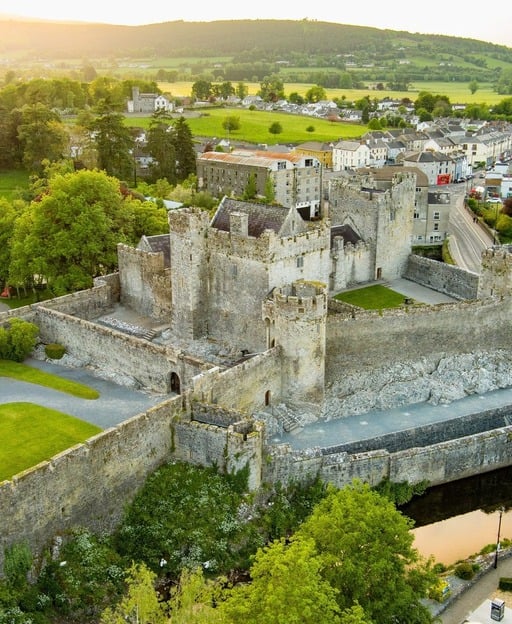
Cahir Castle sits at the heart of Cahir town, rising from a rocky island in the River Suir. It is one of the largest and best-preserved medieval castles in Ireland. Builders started work in the 13th century. The Butler family — one of the most powerful Anglo-Norman dynasties in Irish history — expanded it greatly in the 15th and 16th centuries.
In 1599, the Earl of Essex besieged the castle with cannon fire — damage from the bombardment is still visible on the outer walls. Cromwell accepted its surrender without resistance in 1650, which is why so much of the structure survived. The castle contains a great hall, a keep, towers, and several defensive courtyards, all remarkably complete for a building of its age.
Entry costs €5 for adults and €3 for children. An audio-visual presentation gives context to the castle’s long history, and the riverside setting makes for excellent photographs at any time of day. A pedestrian bridge connects the castle grounds directly to the town centre, so combining both in a single visit is easy.
- Location: Castle Street, Cahir, Co. Tipperary
- Adult entry: €5 | Child: €3
- From Cashel: 18 km south on the N24 — about 20 minutes by car
- Butler family ownership: From 1375 until the 20th century — over 500 years
Holy Cross Abbey: A Working Medieval Monastery
Holy Cross Abbey stands beside the River Suir near the village of Holycross, 14 km north of Cashel. King Donal Mór O’Brien of Munster founded it in 1169 to house a relic of the True Cross — hence the name. It became one of the most important pilgrimage sites in medieval Ireland, attracting thousands of visitors annually at its peak.
In 1975, the local community restored the abbey and reopened it as a working parish church — one of the very few functioning medieval monastic churches in Ireland. The restoration preserved the original 15th-century stonework, including beautifully carved sedilia (stone seating for clergy) and a remarkable hunting scene carved into one of the nave columns. The grounds are freely accessible and worth an hour of your time.
Clonmel: Tipperary’s County Town
Clonmel sits on the River Suir and is the largest town in County Tipperary. Its historic core has Georgian architecture, narrow laneways, and a lively range of independent cafés and pubs. The Main Guard on Sarsfield Street — a handsome 17th-century civic building — is one of the most photographed structures in the county.
Clonmel has two notable historic claims. It is the birthplace of Laurence Sterne, the 18th-century author of Tristram Shandy. It also gave rise to the Bianconi coaching service — the first public transport network in Ireland, launched in 1815 and eventually running 4,000 km of routes across the country. The Tipperary County Museum on Parnell Street covers the county’s full history and is free to enter.
Nenagh and the Shores of Lough Derg
Nenagh is the principal town of North Tipperary. In its centre stands Nenagh Castle, a Norman tower house nearly 30 metres tall dating to the early 13th century. Theobald Walter, founder of the Butler dynasty, built it shortly after 1200. The adjacent Heritage Centre explores North Tipperary’s history in depth.
North Tipperary borders Lough Derg, the largest lake on the River Shannon. The Lough Derg Blueway water trail runs 160 km along the lake’s shoreline and is popular for kayaking and paddleboarding. The nearby village of Dromineer on the Tipperary shore has a marina and is a convenient starting point for lake activities between April and October.
The Tipperary Heritage Way
The Tipperary Heritage Way covers 56 km through the heart of the county. It runs from the Vee Gap near Clogheen in the south to Cashel, following the River Suir through Ardfinnan, Cahir, and Golden. The marked route passes through river valleys, farmland, and historic towns. Most walkers complete it in 2–3 days with overnight stops at the towns along the way.
Shorter walks from the trail are ideal for day visitors. The section from Cashel to Hore Abbey — a roofless Cistercian monastery visible from the Rock and founded in 1272 — takes about 90 minutes each way and offers striking views of the Rock from the valley below. The trail is waymarked throughout and free to walk.
Thurles: Where the GAA Was Born
Thurles holds a significant place in Irish sporting and cultural history. The Michael Cusack and a group of Irish sport enthusiasts founded the Gaelic Athletic Association (GAA) here on 1 November 1884, at Hayes’s Commercial Hotel on Liberty Square. A plaque marks the exact spot. Semple Stadium in Thurles has a capacity of 45,690 and hosts some of the biggest hurling matches in Ireland each summer.
Builders completed the Cathedral of the Assumption in Thurles between 1857 and 1879, working in Romanesque Revival style. Its interior contains Italian marble altarpieces and detailed mosaic floors that took craftsmen decades to complete. Entry is free and the cathedral is open daily throughout the year.
Swiss Cottage: A Nash-Designed Thatched Retreat
Just outside Cahir, Swiss Cottage is one of the most unexpected buildings in Ireland. The John Nash designed the thatched cottage ornée — the same architect who shaped Buckingham Palace’s original facade and Regent Street in London. The Butlers built it around 1810 as a romantic rural retreat. Inside, French hand-printed wallpapers cover the walls alongside original Regency furnishings.
The OPW manages the cottage and entry costs €5 for adults and €3 for children. It sits in woodland beside the River Suir, a 10-minute walk from Cahir Castle. Combining both in a single visit works well and fills a comfortable half-day.
Best Time to Visit County Tipperary
May, June, and September are the best months to visit Tipperary. The weather is mild, the days are long, and the main sights are accessible without the peak July and August crowds. The Rock of Cashel is most atmospheric in early morning light, particularly in spring and autumn when mist sits in the valley below.
- Best weather: May, June, September
- Fewest crowds: October–April (especially weekday mornings)
- Average July temperature: 18°C (64°F)
- Annual rainfall: Around 900 mm, distributed fairly evenly across the year
Getting to County Tipperary
Tipperary is one of Ireland’s most accessible inland counties. Dublin to Cashel is 160 km via the M8 motorway — about 90 minutes’ drive. Cork is 85 km from Cashel. Shannon Airport in County Clare sits 60 km from Nenagh, making Tipperary a practical first destination for travellers arriving from North America.
Rail serves both Clonmel and Thurles. Trains from Dublin Heuston reach Thurles in approximately 1 hour 40 minutes. Bus Éireann operates regular services between Dublin, Cork, and Cashel, with the Dublin–Cashel journey taking around 2 hours 15 minutes by express coach.
☘️ Enjoying this? 64,000+ Ireland lovers get stories like this every week. Subscribe free →
Frequently Asked Questions About County Tipperary
What is the best thing to see in County Tipperary?
The Rock of Cashel is the single most impressive sight in County Tipperary and one of the great medieval landmarks in all of Ireland. The complex of buildings — including Cormac’s Chapel (consecrated 1134), a 28-metre round tower, and a Gothic cathedral — sits on a dramatic limestone outcrop 60 metres above the surrounding plain. Most visitors spend 1.5 to 2 hours exploring the site.
Is County Tipperary worth visiting?
Yes — Tipperary is one of Ireland’s most underrated counties. It has three major medieval monuments (Rock of Cashel, Cahir Castle, Holy Cross Abbey), a 56-km walking trail through the countryside, and market towns with genuine character. The county attracts far fewer overseas tourists than Kerry or Galway, which means shorter queues and lower accommodation prices. It works well as a two-day destination or as a side trip from Cork or Dublin.
How do I get from Dublin to the Rock of Cashel?
The Rock of Cashel is 160 km from Dublin — about 90 minutes by car via the M8 motorway. Bus Éireann runs regular express services from Dublin Busáras to Cashel town; the journey takes around 2 hours 15 minutes and the Rock is a 10-minute walk from the bus stop. There is no train station in Cashel, but Thurles (20 km north) is on the Dublin–Cork main line.
What is County Tipperary famous for?
County Tipperary is famous for the Rock of Cashel, its exceptional hurling tradition (the county has won the All-Ireland hurling championship 28 times), and the well-known First World War song “It’s a Long Way to Tipperary,” written by Jack Judge and Harry Williams in 1912. The Butler dynasty left its mark all across Tipperary, with castles, abbeys, and tower houses spread through the landscape.
When is the best time to visit the Rock of Cashel?
May, June, and September offer the best combination of mild weather and manageable crowds at the Rock of Cashel. Early morning visits (the Rock opens at 9am) are recommended in July and August, when coach parties begin arriving from about 10am onwards. Winter mornings are often quiet and atmospheric, with mist sitting low over the Golden Vale below.
If your family carries Tipperary roots — surnames like Ryan, Kennedy, Butler, O’Brien, or Lonergan are deeply embedded in this county’s history — our free Irish Ancestral Heritage Guide includes county-level emigration records and townland maps to help you trace exactly where in Tipperary your people came from. Explore the free guide here.
☘️ Join 64,000+ Ireland Lovers
Every weekday morning, get Ireland’s hidden gems, local secrets, and travel inspiration — the kind you won’t find in any guidebook.
Subscribe free — enter your email:
Already subscribed? Download your free Ireland guide (PDF)
📲 Know someone who’d love this? Share on WhatsApp →
Love more? Join 43,000 Scotland lovers → · Join 29,000 Italy lovers → · Join 7,000 France lovers →
Free forever · Unsubscribe anytime
Tours & experiences you might love


Powered by Viator. Some links are affiliate links — we may earn a small commission at no extra cost to you.
Secure Your Dream Irish Experience Before It’s Gone!
Planning a trip to Ireland? Don’t let sold-out tours or packed attractions spoil your journey. Iconic experiences like visiting the Cliffs of Moher, exploring the Rock of Cashel, or enjoying a guided walk through Ireland’s ancient past often sell out quickly—especially during peak travel seasons.

Booking in advance guarantees your place and ensures you can fully immerse yourself in the rich culture and breathtaking scenery without stress or disappointment. You’ll also free up time to explore Ireland’s hidden gems and savour those authentic moments that make your trip truly special.
Make the most of your journey—start planning today and secure those must-do experiences before they’re gone!