

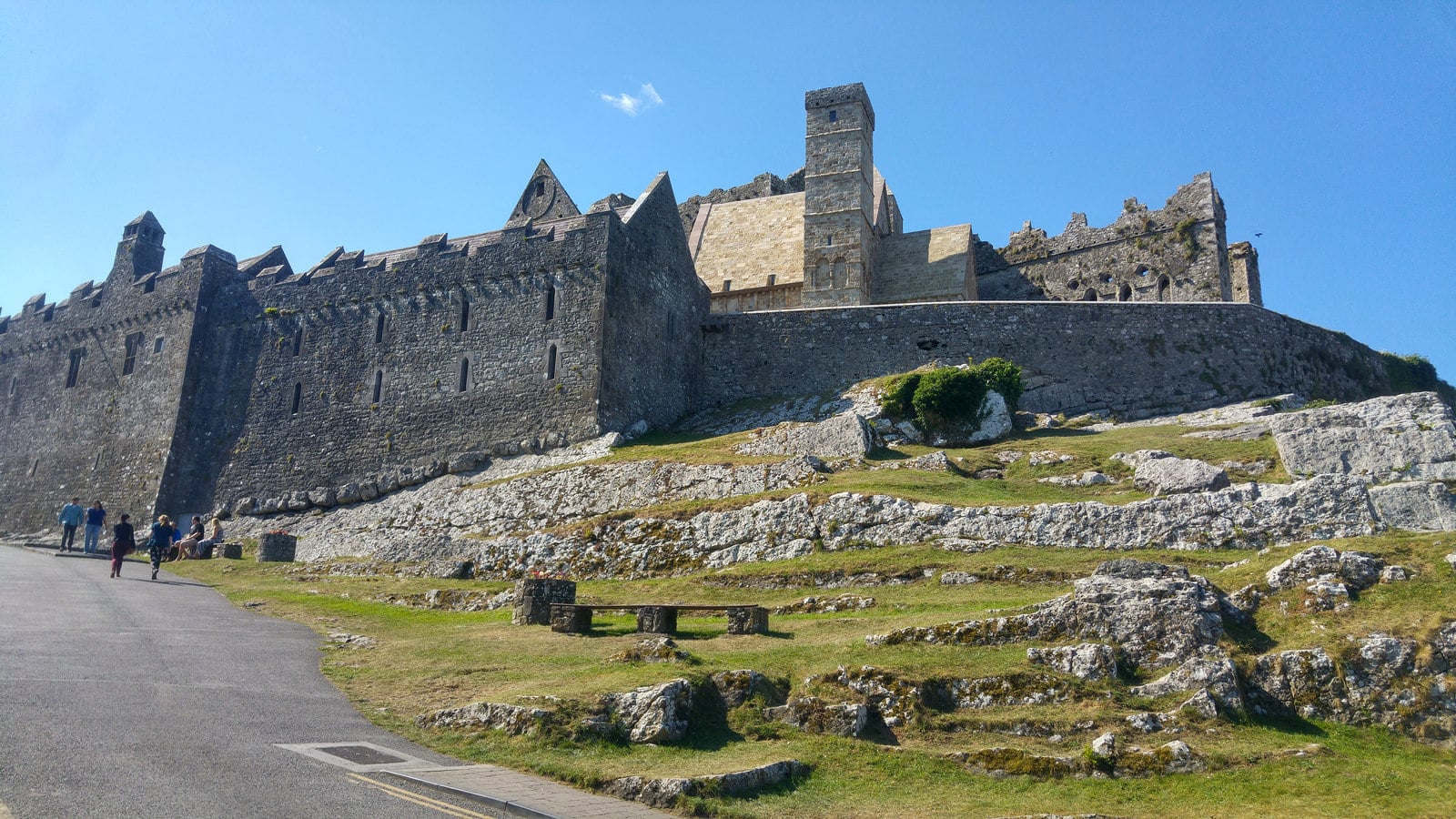
The Rock of Cashel rises dramatically from the Tipperary plain, a collection of medieval stone buildings perched on a limestone outcrop that has defined this part of Ireland for over 1,000 years. Also known as Cashel of the Kings and St Patrick’s Rock, this site carries more Irish history per square metre than almost anywhere else in the country. If you’re planning a trip to Ireland and you have time for just one inland landmark, this should be it.
Love Ireland? Subscribe to our free newsletter and get the best of Ireland delivered straight to your inbox every week.
The History Behind the Rock
The Rock of Cashel has been a seat of power since at least the 4th century AD. Irish legend holds that the devil himself bit a chunk out of the Devil’s Bit Mountain in County Tipperary — and spat it out when he saw St Patrick standing at Cashel, creating the rocky outcrop that stands today.
More reliably, records show that the Eóganacht dynasty used the Rock as their royal seat from around 370 AD. It remained a stronghold of the Kings of Munster for centuries. In 977 AD, Brian Boru — the High King who would later defeat the Vikings at the Battle of Clontarf in 1014 — was inaugurated as King of Munster here.
In 1101, King Muirchertach Ua Briain handed the Rock over to the Catholic Church. That decision transformed Cashel from a political seat into one of the most important ecclesiastical centres in Ireland. The buildings you see today were constructed primarily between the 12th and 15th centuries.
What’s on the Rock
The site covers roughly an acre on top of the limestone hill. Entry is through the Hall of the Vicars Choral, a 15th-century building that has been restored and now serves as the main reception and exhibition space. Inside, you’ll find the original St Patrick’s Cross, a 12th-century high cross that was brought indoors to protect it from weathering. A replica stands in its place outside.
Moving through the site, the main structures you’ll encounter are:
Cormac’s Chapel — Built between 1127 and 1134, this is considered the finest example of Romanesque architecture in Ireland. The chapel has twin towers, elaborately carved doorways, and interior stone carvings that have survived remarkably well. The sarcophagus inside is traditionally linked not to Cormac himself but to his brother Tadhg Mac Cárthaigh, who succeeded him as King of Munster.
The Cathedral — The Gothic cathedral is the largest structure on the Rock, built in the 13th century. Much of it is now a roofless shell, but the walls, nave, and choir are largely intact. The carved stonework on the doorways and windows gives a good sense of how grand this building once was. The cathedral was damaged during the Cromwellian siege of 1647, when the town of Cashel was attacked by Lord Inchiquin — an event that killed hundreds of people sheltering inside.
The Round Tower — Standing about 28 metres tall, the round tower is one of the oldest structures on the Rock, dating to around 1101 AD. Round towers like this were built all across Ireland in the early Christian period. They served as bell towers, landmarks, and — most likely — places of refuge when Viking raids threatened local communities.
The Cemetery and Crosses — The grounds of the Rock contain a number of grave slabs and Celtic crosses, some dating back to the early medieval period.
Exploring Ireland’s ancient places? Sign up to our free weekly newsletter for stories, guides, and local recommendations delivered straight to your inbox.
Cormac’s Chapel — Worth a Closer Look
Cormac’s Chapel is often described by historians as a turning point in Irish architecture. Before it was built, Irish religious buildings tended to follow a simpler, functional style. Cormac’s Chapel introduced full Romanesque decoration to Ireland — the interlacing stonework, carved capitals, blind arcading, and detailed tympanum over the north doorway are all features borrowed from continental European church-building.
The north doorway tympanum features a carved scene that historians have debated for years. It shows a centaur shooting a lion, which is an unusual image for a Christian chapel. Some believe it reflects the influence of manuscript illumination traditions; others see it as a symbol of good triumphing over evil.
The interior retains fragments of 12th-century fresco painting, which is exceptionally rare in Ireland. Most medieval wall paintings were lost to weather, reformation, or neglect. The faint traces here are among the oldest surviving painted surfaces in Irish religious architecture.
Planning Your Visit
The Rock of Cashel is managed by the Office of Public Works (OPW) and is open year-round, with seasonal hours.
Opening times:
- Mid-March to mid-October: 09:00–17:30
- Mid-October to mid-March: 09:00–16:30
The site is closed 24–26 December. As an exposed hilltop site, it can close at short notice in severe weather — check social media or call ahead if conditions are poor.
Admission (2026 prices):
- Adults: €8
- Seniors: €6
- Children/Students: €4
- Family: €20
Allow at least 90 minutes to explore the site properly. Guided tours of the main site run throughout the day and are included in the admission price. Access to the interior of Cormac’s Chapel is by separate guided tour only — tickets cost extra and are only available on-site, with limited capacity, so arrive early if this is a priority. The Rock can get busy during summer, particularly on weekends. If you’re visiting between June and August, aim for opening time or late afternoon to avoid peak crowds.
Getting to Cashel
Cashel town is in County Tipperary, roughly midway between Dublin and Cork. By road:
- From Dublin: 1 hour 45 minutes via the M8 motorway
- From Cork: 1 hour via the M8
- From Limerick: 45 minutes via the N24
There is a car park at the base of the Rock, signposted from the town centre. The walk up to the entrance is short but fairly steep in places — the path is paved and manageable for most visitors, though those with limited mobility should be aware it is not entirely flat.
By public transport, Bus Éireann operates a service between Dublin Busáras and Cork that stops in Cashel. Check timetables directly with Bus Éireann before travelling, as services vary by day.
What to See Nearby
Cashel town itself is worth an hour of your time. Hore Abbey, a ruined Cistercian monastery dating to the 13th century, sits at the base of the Rock and can be viewed from the outside at no cost. The Bolton Library in the town holds a collection of rare books and manuscripts, including some from the medieval period.
Further afield, the Swiss Cottage at Cahir (about 15 minutes by car) is an unusual 19th-century thatched cottage ornée built for the Earl of Glengall. Cahir Castle, in the same town, is one of the best-preserved Norman castles in Ireland and is also managed by the OPW.
The drive between Cashel and Kilkenny (about 40 minutes north) passes through good Tipperary farmland and offers easy access to Kilkenny Castle and the medieval mile of the city.
Why the Rock of Cashel Matters
It is easy to visit a site like the Rock of Cashel and see it primarily as a photo opportunity — and it undeniably is one. The views from the top of the hill across the Tipperary plain are exceptional on a clear day. But the Rock earns its place on any Ireland itinerary for what it actually represents.
This is where Irish kings were made. Where the Church and the State in early Ireland intertwined. Where one of the oldest surviving examples of Romanesque architecture in the country still stands, largely intact, nearly 900 years after it was built.
Not many places in the world carry that kind of layered history so openly. The Rock of Cashel wears it plainly, in stone, on a hill for everyone to see.
Planning a trip to Ireland? Subscribe to our free newsletter for honest travel tips, local stories, and hidden gems — no spam, just Ireland.
Thinking about it seriously?
If you’ve started actually planning a move, our complete the full Move to Ireland guide walks through every step, every cost, and the paperwork that catches most people out.
Tours & experiences you might love


Powered by Viator. Some links are affiliate links — we may earn a small commission at no extra cost to you.
Secure Your Dream Irish Experience Before It’s Gone!
Planning a trip to Ireland? Don’t let sold-out tours or packed attractions spoil your journey. Iconic experiences like visiting the Cliffs of Moher, exploring the Rock of Cashel, or enjoying a guided walk through Ireland’s ancient past often sell out quickly—especially during peak travel seasons.

Booking in advance guarantees your place and ensures you can fully immerse yourself in the rich culture and breathtaking scenery without stress or disappointment. You’ll also free up time to explore Ireland’s hidden gems and savour those authentic moments that make your trip truly special.
Make the most of your journey—start planning today and secure those must-do experiences before they’re gone!