

Here is a test you can run in any pub in Ireland. Take out your passport and hold it next to your pint glass. Both objects carry the same ancient symbol — the Irish harp, the national emblem, the thing that has been associated with this island since at least the 13th century. But look closely enough, and you will notice something odd: the two harps face in opposite directions. The straight edge that forms the back of the instrument sits on the left side of the Guinness logo and on the right side of the national emblem. They are mirror images of each other, and almost no one who holds both objects in the same afternoon ever notices.
The reason runs through a glass case in Trinity College Dublin, a late Victorian trademark office, the founding of the Irish state, a committee that included W.B. Yeats, and a legal memo from 1983 which shows the awkwardness had not entirely resolved even six decades on.
Why the harp mattered in the first place
The harp has been the symbol of the island of Ireland — not just its kings, not just its rebels, but its national identity as a whole — for a long time. The Wijnbergen Roll, a European roll of armorial bearings dating to around 1280, already shows a golden harp on a blue field as the arms of the King of Ireland. When Henry VIII declared Ireland a kingdom in 1541, the harp became its official emblem, and Irish coins struck under the Tudors carried a crowned harp. The United Irishmen in 1798 borrowed it too, with the motto “It is new strung and shall be heard.”
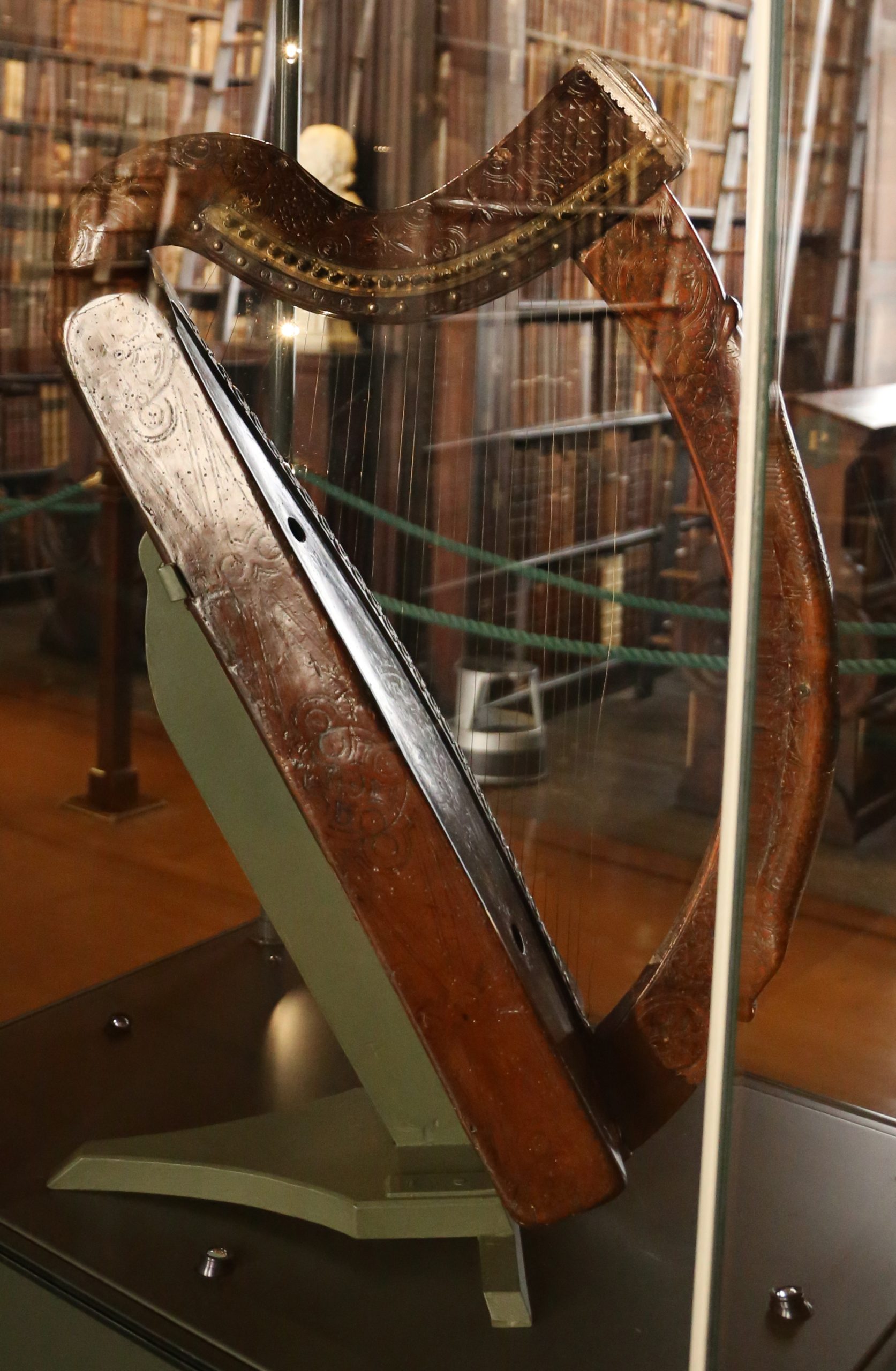
The specific harp at the centre of this story is a real object, sitting in a glass case in the Long Room of the Old Library at Trinity College Dublin. It has belonged to the college since 1782, when William Conyngham of Slane Castle donated it. Despite being universally known as the “Brian Boru harp,” it has nothing to do with Brian Boru: the High King of Ireland died at the Battle of Clontarf in 1014, but the instrument is dated by scholars to the 14th or 15th century. George Petrie, the 19th-century Irish antiquarian, placed it in “the fourteenth, or more probably the early part of the fifteenth century.” The Brian Boru connection is legendary, not historical.
What it is, definitively, is one of the three oldest surviving medieval Gaelic harps — a wire-strung cláirseach — alongside the Queen Mary and Lamont harps. It has a small, low-headed shape, brass pins for 29 strings, and the O’Neill coat of arms carved into it. It is one of the most resonant objects in Ireland, which is precisely why, when it came time to put something on a bottle of Guinness, the brewery’s eye fell on it. The same Old Library also houses the Book of Kells, whose own strange history is told in the Book of Kells and its 1007 theft.
The company that moved first
Guinness began incorporating the harp into its bottle labels in 1862. The choice was deliberate: a symbol so specifically and undeniably Irish that it would distinguish the product in a crowded market and communicate something about provenance and quality in a single glance. The brewery was by then already over a century old and exporting widely, and the harp served as a kind of guarantee — the visual equivalent of saying: this is the real thing, from the real place. The brewery’s founding deal is a story in itself: the 9,000-year lease that built Guinness.
For fourteen years, the symbol sat on the labels with no formal legal protection. Then, in January 1876, the United Kingdom’s Trade Marks Registration Act 1875 came into force, creating a national register of protected marks for the first time. A Bass Brewery employee famously queued through the night outside the Registrar’s office on New Year’s Eve to ensure his company’s red triangle became the very first registered trademark in British legal history. Guinness registered its harp later that same year, making it one of the earliest trademarks in the entire system.
The practical effect was durable: from 1876 onward, Guinness held legal rights over its version of the harp, and rivals could not simply copy it. The symbol that had represented Ireland for seven centuries now also had a certificate in a government filing cabinet in London.
The problem that arrived in 1922
The Irish Free State came into existence in December 1922, after centuries of struggle and years of negotiation. The new government needed everything a state requires: a constitution, a flag, institutions, a seal, an emblem. For the emblem, the choice was obvious to virtually everyone involved: the harp. It was ancient. It was specifically Irish in a way that the shamrock, though beloved, had never quite been in heraldic terms. And it carried seven centuries of legitimate national symbolism.
The problem was that the most recognizable version of the harp already belonged to a brewery.
Guinness’s trademark covered the right-facing version of the instrument — with the straight soundboard on the left side of the image. The new Irish state could not simply adopt the same design without risking a confrontation with one of Ireland’s largest and most internationally prominent companies. The solution the government reached was as simple as it was elegantly awkward: flip it. Turn the whole thing around. Give the national emblem the straight edge on the right side instead of the left, making it a mirror image of the Guinness logo. Both harps would draw from the same source — both were interpretations of the Brian Boru harp at Trinity — but they would be legally distinguishable, facing in opposite directions.
It is a measure of how quickly the decision was settled that on August 28, 1923 — less than a year after the state was founded — the Executive Council chose the Trinity College harp for the Great Seal of the Irish Free State (the seal itself was completed in 1925). The scholar George Sigerson had urged the new government to adopt the harp as a symbol of the entire nation rather than any particular political faction. The Executive Council agreed with the sentiment. The execution required a small concession to trademark law.
A Yorkshire sculptor and a poet on a committee
Choosing a direction for a symbol and giving it a specific, authoritative form are two different things. In 1926, Ireland’s Minister for Finance, Ernest Blythe, was persuaded by two members of the new Free State Senate — W.B. Yeats and Oliver St. John Gogarty — to set up a committee of experts to oversee the design of the new nation’s coinage. Yeats, who chaired the committee, was famously exacting about aesthetics. He insisted on a closed competition with invited artists rather than an open call, arguing that the best designers would not bother to enter otherwise.
The full commission went to Percy Metcalfe, an English sculptor from Yorkshire who was relatively little-known at the time. Metcalfe’s harp design — based on the Trinity College instrument — was adopted for the new Irish coinage that entered circulation in December 1928, and it became the template for the state harp on Irish coinage ever since. The competing designs were exhibited publicly at the Dublin Metropolitan School of Art in November 1928. Maud Gonne, surveying the full range of Metcalfe’s work — a barnyard collection featuring a hen, pig, wolfhound, salmon, hare, bull, horse, and woodcock across eight denominations — remarked that the set was missing a jackass. The harp on the obverse attracted less commentary.
Sixty years later, the anxiety persisted
If you assumed the matter had been resolved cleanly in 1922 and never thought about again, a set of state papers from 1983 would correct you. In that year, the Irish government began exploring whether to formally register the harp emblem as an international trademark through the World Intellectual Property Organization. An incident in 1981, when a German court ruled that Ireland’s Export Board could not prevent foreign companies from using the shamrock on their own trademarks, had focused official minds on protecting national symbols.
The legal adviser handling the question was Arthur F. Plunkett of the Attorney General’s office. Plunkett commissioned patent agents to advise on what could be registered, and their answer tells you everything about the lasting power of Guinness’s 1876 filing: Ireland should register only the left-facing, nine-stringed version of the harp. Registering a right-facing version, they warned, might interfere with Guinness Brewery’s use of its own harp logo. Guinness had been using the right-facing harp “some fifty years or more before the founding of the state,” and the government had no intention of picking a fight it might not win.
Ireland registered a left-facing harp with WIPO in 1984. Not both orientations. Just the one.
That is how complete Guinness’s original claim had been. Sixty-one years after Ireland gained independence, the state’s own lawyers were still navigating around an 1876 registration for a beer label.
Two harps, one island
Both symbols are now so thoroughly established that the difference between them is genuinely invisible to most people who encounter them — which is, when you think about it, exactly how an effective trademark is supposed to work. The Guinness harp is the right-facing one, with the straight soundboard on the left side of the image. The state harp — on the euro coin, the passport cover, the presidential seal — is the left-facing one, with the straight soundboard on the right.
They are not identical in every detail, and both have evolved through successive redesigns. The Guinness version was significantly modernized in 1968 by designer Gerry Barney, who simplified the lines and reduced the string count for cleaner reproduction. But the directional distinction has held constant throughout — a small architectural fact embedded in the most ordinary objects in Irish life, passed daily between a million hands without comment.
The medieval instrument in Trinity’s Long Room does not face either way, strictly speaking — it is a three-dimensional object in a glass case, and you can walk around it. But both harps are, in the end, interpretations of the same thing: a 14th- or 15th-century instrument of uncertain origin, donated to a university in 1782, adopted by a brewery in 1862, registered as intellectual property in 1876, and then mirrored by a government that arrived forty-six years too late to claim the original orientation.
The next time you are in Ireland with a passport and a pint within arm’s reach, take a moment to hold them together. Ireland is the only nation on earth to have a musical instrument as its national emblem. And even that instrument, on its two most visible surfaces, cannot quite agree on which way to face.
For more of the island’s emblems, see our guide to Irish Celtic symbols and their meanings, and if you want to see Trinity’s harp in person, start with our Dublin travel guide.
Tours & experiences you might love


Powered by Viator. Some links are affiliate links — we may earn a small commission at no extra cost to you.
Secure Your Dream Irish Experience Before It’s Gone!
Planning a trip to Ireland? Don’t let sold-out tours or packed attractions spoil your journey. Iconic experiences like visiting the Cliffs of Moher, exploring the Rock of Cashel, or enjoying a guided walk through Ireland’s ancient past often sell out quickly—especially during peak travel seasons.

Booking in advance guarantees your place and ensures you can fully immerse yourself in the rich culture and breathtaking scenery without stress or disappointment. You’ll also free up time to explore Ireland’s hidden gems and savour those authentic moments that make your trip truly special.
Make the most of your journey—start planning today and secure those must-do experiences before they’re gone!