

What’s your Irish county’s signature dish? ☘️
Different counties claim different dishes — Your County’s Signature Food tells you which one your county is known for, with a short story behind it.
Dublin Coddle Recipe: The Hearty One-Pot That Has Warmed Dublin’s Kitchens for Centuries
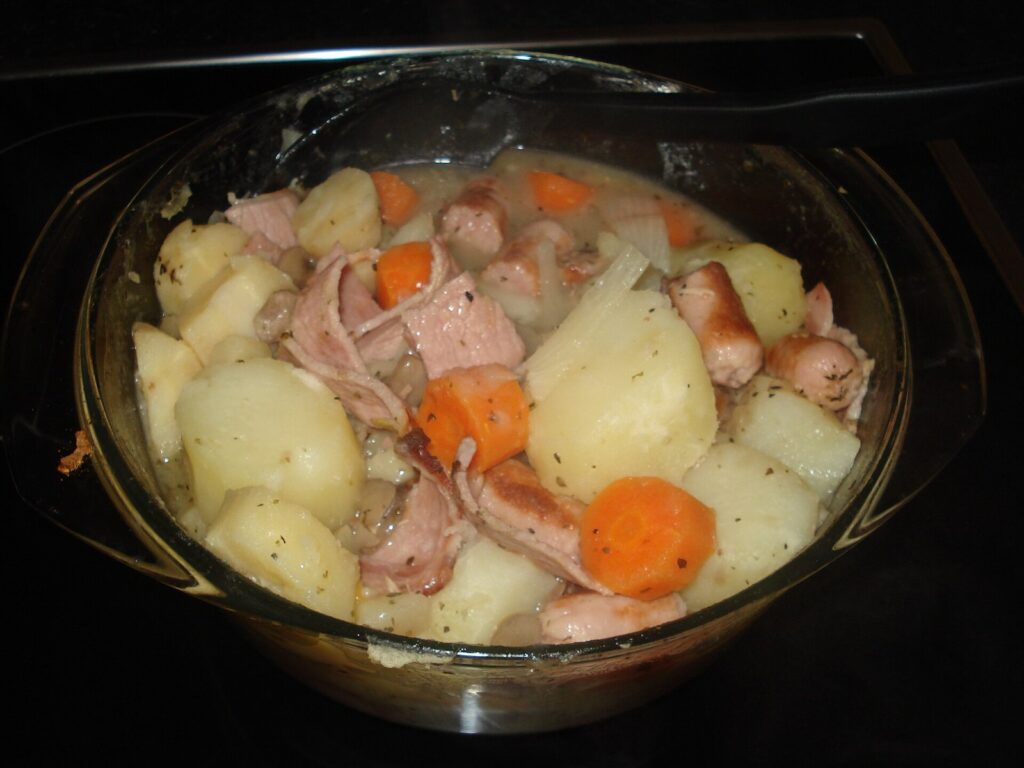
If there is one dish that belongs entirely and unmistakably to Dublin, it is coddle. Not to Ireland in the broad sense — to Dublin specifically, to its northside tenements and southside terraces alike, to Saturday nights and cold Sunday mornings, to mothers who made it without a recipe and grandmothers who made it before them. It is a dish born of economy and practicality: leftover sausages and bacon, potatoes that needed using up, an onion or two, and enough water to bind it all into something deeply satisfying. Other Irish counties have been known to raise an eyebrow at coddle’s modest appearance — it is, by any honest measure, a pale and unshowy thing — but Dubliners have always known better. The proof, as they say, is in the eating.
The dish has been simmering in Dublin’s consciousness for at least three centuries. Jonathan Swift, dean of St Patrick’s Cathedral and one of Dublin’s most famous residents, is said to have been fond of it, and the dish is generally reckoned to date from at least the eighteenth century. Coddle was the ideal food for Dublin’s working poor: cheap cuts, nothing wasted, everything cooked slowly in one vessel over a low heat. The name is usually linked to the verb to coddle, meaning to cook gently (as in coddled eggs), which may itself trace back to caudle, a warm, gentle drink or gruel once given to invalids — a fitting origin for something so comforting and restorative.
The defining characteristic of an authentic Dublin coddle is its cooking liquid: plain water rather than stock, and rarely ale or cider, however tempting those additions might seem. The slow simmer draws flavour from the sausages and rashers themselves, creating a broth that is lightly smoky, savoury, and entirely its own thing. There are no herbs beyond parsley, no tomatoes, no thickening agents. It is simplicity taken seriously, and that restraint is precisely what makes it so good.
Ingredients
Serves 4 · Prep 20 minutes · Cook 1 hour 30 minutes
- 8 good-quality pork sausages (about 450g / 1lb)
- 8 back rashers (streaky bacon works too), roughly chopped — about 250g / 9oz
- 900g / 2lb floury potatoes (such as Rooster or Kerr’s Pink), peeled and thickly sliced
- 3 large onions, peeled and thickly sliced
- 600ml / 1 pint boiling water
- Salt and plenty of freshly ground black pepper
- A generous handful of fresh flat-leaf parsley, roughly chopped
Method
- Preheat your oven to 160°C / 140°C fan / 325°F / Gas Mark 3.
- In a large frying pan over a medium-high heat, lightly brown the sausages on all sides — you are not cooking them through at this stage, just giving them a little colour. Set aside. In the same pan, quickly cook the chopped rashers for two to three minutes until they begin to colour. Set aside with the sausages.
- In a large lidded casserole dish or heavy-based pot, layer half the sliced potatoes across the bottom, followed by half the onions. Season well with salt and plenty of black pepper.
- Lay the sausages and rashers over the onion layer, then cover with the remaining onions and finish with the remaining potatoes on top. Season again generously.
- Pour the boiling water carefully over the layers. Scatter over half the chopped parsley, then press the top layer of potatoes down gently so everything is just covered or nearly so.
- Place the lid on the casserole and transfer to the preheated oven. Cook for 1 hour 30 minutes, checking once or twice and pressing the potatoes down if needed.
- Remove the lid for the final 15 to 20 minutes to allow the top potatoes to take on a little golden colour and for the broth to concentrate slightly.
- Scatter over the remaining fresh parsley and bring the pot straight to the table. Serve in deep bowls with thick slices of white soda bread to mop up every last drop of broth.
Tips
- Use proper Dublin sausages where possible — a high-pork-content butcher’s sausage will give you a far richer broth than anything pale and anonymous from a supermarket shelf.
- Choose floury potatoes that will soften and drink in the broth rather than waxy varieties that stay firm and separate.
- Do not be tempted to add stock — the broth that forms from the water, pork fat, and potato starch is mild and clean in a way that stock would overpower.
- Coddle tastes even better the next day — leftovers reheated gently on the hob are a thing of genuine joy.
- Season boldly with black pepper: it is not a background note in this dish, it is one of the defining flavours.
There is something quietly moving about a dish this old and this faithful — still made in Dublin homes almost exactly as it was made hundreds of years ago, still bringing people to the table on cold evenings, still prompting the same satisfied silence that good, honest food always earns. Whether you are cooking it in Dublin itself or recreating a little piece of the city somewhere far from the Liffey, Dublin coddle has an extraordinary ability to make wherever you are feel, just for a moment, like home.
More on coddle: read why Dublin workers left a pot on the stove every Saturday night, the Saturday-night story of coddle and James Joyce, where to find coddle in Dublin, or see Ireland’s 10 most beloved traditional dishes.
☘️ Join 64,000+ Ireland Lovers
Every weekday morning, get Ireland’s hidden gems, local secrets, and travel inspiration — the kind you won’t find in any guidebook.
Subscribe free — enter your email:
Already subscribed? Download your free Ireland guide (PDF)
📲 Know someone who’d love this? Share on WhatsApp →
Love more? Join 43,000 Scotland lovers → · Join 29,000 Italy lovers → · Join 7,000 France lovers →
Free forever · Unsubscribe anytime
Tours & experiences you might love


Powered by Viator. Some links are affiliate links — we may earn a small commission at no extra cost to you.
Secure Your Dream Irish Experience Before It’s Gone!
Planning a trip to Ireland? Don’t let sold-out tours or packed attractions spoil your journey. Iconic experiences like visiting the Cliffs of Moher, exploring the Rock of Cashel, or enjoying a guided walk through Ireland’s ancient past often sell out quickly—especially during peak travel seasons.

Booking in advance guarantees your place and ensures you can fully immerse yourself in the rich culture and breathtaking scenery without stress or disappointment. You’ll also free up time to explore Ireland’s hidden gems and savour those authentic moments that make your trip truly special.
Make the most of your journey—start planning today and secure those must-do experiences before they’re gone!