

In the autumn of 1007, someone crept into the stone church at Kells in County Meath and stole Ireland’s most precious possession. The Book of Kells — centuries in the making — was gone. The thieves stripped its jewelled golden cover and abandoned the manuscript in the dark.
Two months and twenty nights later, a monk found it face-down in the ground.
The golden cover has never been found. And nobody has ever fully explained how the book came to exist in the first place.
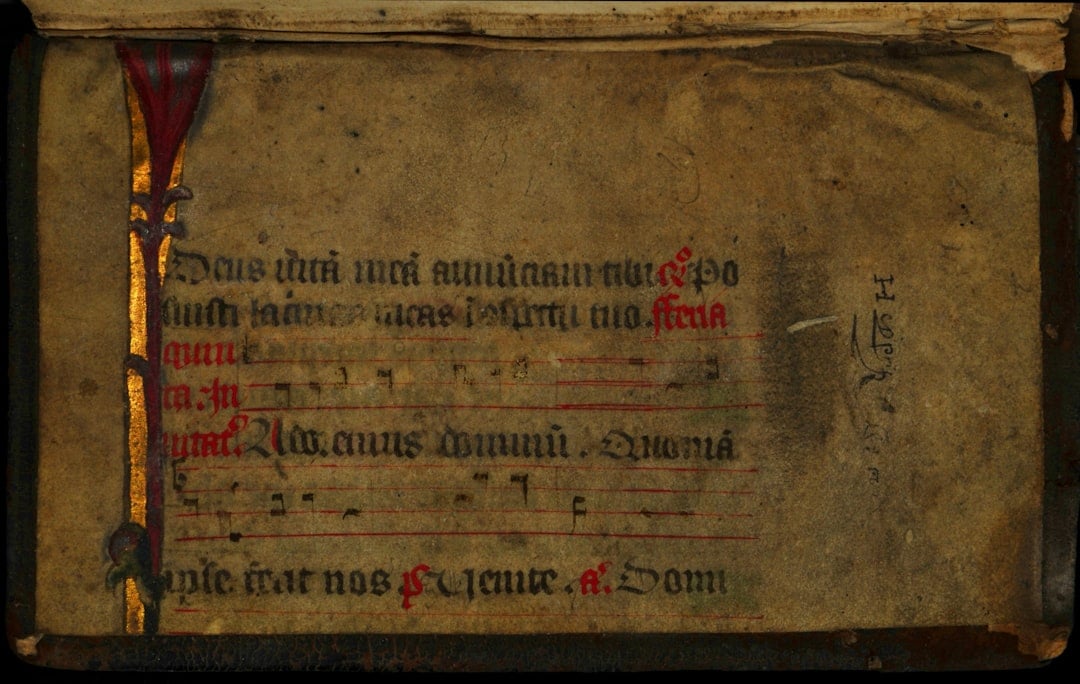
Made at the Edge of the World
Most historians believe the Book of Kells began on Iona — a tiny island off the western coast of Scotland, barely three miles long. In the sixth century, the Irish monk Columcille sailed to Iona and founded a monastery. For two centuries, his followers produced manuscripts of extraordinary skill.
Around 800 AD — the exact date is still debated — a team of monks began working on what would become the most intricate illuminated manuscript in history.
They needed vellum: the dried, stretched skin of calves. Scholars estimate around 185 calves gave their skins to produce the 680 surviving pages. Every sheet had to be scraped to translucent thinness. Every colour had to be sourced, ground, and prepared by hand.
The unmistakable blue came from lapis lazuli — a pigment mined in what is now Afghanistan and carried to Ireland by Mediterranean traders. Reds and oranges came from red lead and orpiment. Rich greens came from verdigris, made by corroding copper. These colours still glow after 1,200 years.
Details No Human Eye Was Meant to See
Turn to folio 34r — the Chi-Rho page, where the name of Christ first appears in the Gospel of Matthew — and you see a design that fills a surface no larger than a dinner plate. It contains tens of thousands of spirals, interlocking knots, and layered shapes.
Under modern magnification, scholars have found creatures hidden deep inside the knotwork that no medieval reader could have seen with the naked eye. A cat and two kittens playing with a mouse. Birds sharing what appears to be a communion wafer. Tiny faces tucked into decorative loops.
The monks put them there anyway. One theory holds this was an act of pure devotion — images made for God alone, never intended for human eyes. Another, more charming explanation is that the monks were simply enjoying themselves.
What nobody disputes is the sheer scale of the achievement. Some pages are estimated to contain over one million individual marks. Remarkably, no two pages of the Book of Kells are the same.
Why Iona Could Not Keep It
In 795 AD, Vikings raided Iona. They returned in 802, and again in 806 — that final raid killed 68 members of the community.
After the massacre, the survivors fled. Many sailed back to Ireland, eventually settling at a new monastery at Kells in County Meath — chosen partly because it sat well away from the coast. If you explore County Meath today, the ruins of that monastery still stand quietly in the centre of the town.
Here is the great unresolved question: did the monks carry the Book of Kells from Iona already completed, or did they finish it at Kells? Some scholars argue the finest pages could only have been produced in Iona’s established scriptorium. Others point to evidence that major sections were created in Ireland.
The book is named after Kells. But it may not have been born there.
☘️ Enjoying this? 64,000+ Ireland lovers get stories like this every week. Subscribe free →
The Theft That Accidentally Saved Everything
The Annals of Ulster recorded the 1007 theft in blunt terms: “The great Gospel of Columcille, the chief relic of the western world, was wickedly stolen in the night from the western sacristy of the great stone church of Cenannos.”
Cenannos — the Irish name for Kells.
The thieves wanted the jewelled golden cover, known as a cumdach. They ripped it free and abandoned the 340 vellum leaves as worthless. It was an act of desecration that, entirely by accident, saved everything. Had the pages themselves held any value to them, the Book of Kells might have been torn apart and scattered across medieval Ireland.
The manuscript was found buried underground two months later — sodden and damaged, but intact. The cover was gone forever. The round towers that stood guard over Irish monasteries, like the remarkable structures explored in why Irish monks built towers with doors no one could reach from the ground, were partly designed to protect exactly these kinds of treasures from raiders.
From Kells to Dublin — and the Whole World
The Book remained at Kells for centuries. During the upheavals of the 1650s, the Bishop of Meath brought it to Dublin for safekeeping. In 1661, it was given to Trinity College Dublin, where it has remained ever since.
Today, over half a million people visit it each year. If you are planning a trip to Ireland, Trinity College is well worth including in your visit. The Long Room library alone — 65 metres of dark oak shelving, 200,000 ancient books, marble busts of scholars lined up in silence — is one of the most extraordinary rooms in Europe.
The Book of Kells sits in a controlled environment, one page turned every few months. You can see, but not touch. Which feels right. Some things are too important to handle.
The Question That Remains Open
Was the Book of Kells created on Iona? At Kells? In both places, by a community scattered across the Irish Sea by Viking raids? Scholars have debated this for generations without reaching a firm answer.
Perhaps that uncertainty is part of what keeps it alive. The monks who made it never signed their names. They left no notes about their methods or intentions. They made something extraordinary and allowed it to speak entirely for itself.
It still does — 1,200 years later, in a glass case in Dublin, in a room full of people leaning forward to look at something they cannot quite believe was made by human hands.
☘️ You Might Also Love
Tours & experiences you might love


Powered by Viator. Some links are affiliate links — we may earn a small commission at no extra cost to you.
Secure Your Dream Irish Experience Before It’s Gone!
Planning a trip to Ireland? Don’t let sold-out tours or packed attractions spoil your journey. Iconic experiences like visiting the Cliffs of Moher, exploring the Rock of Cashel, or enjoying a guided walk through Ireland’s ancient past often sell out quickly—especially during peak travel seasons.

Booking in advance guarantees your place and ensures you can fully immerse yourself in the rich culture and breathtaking scenery without stress or disappointment. You’ll also free up time to explore Ireland’s hidden gems and savour those authentic moments that make your trip truly special.
Make the most of your journey—start planning today and secure those must-do experiences before they’re gone!