

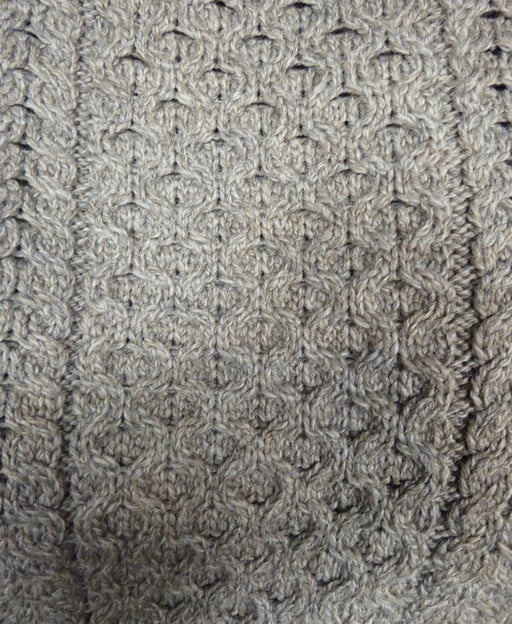
Count the stitches on a genuine Aran sweater and you are reading a deliberate vocabulary: the twisting cable for a fisherman’s ropes, the diamond for the small fields walled off across the islands, the basket stitch for the creel of a good catch. What most people take for an ancient garment is actually barely a century old — the earliest surviving examples date to the early 1900s, and the sweater only became a global object of desire after it landed on the pages of fashion magazines in the 1950s. This is Guide № 011 in The Love Ireland Guide series.
Get the Full Collectible Guide (Free PDF)
The Aran Sweater — in a beautifully designed, printable booklet. The Love Ireland Guide № 011.
Where It Comes From
The sweater is named for the three Aran Islands — Inis Mór, Inis Meáin and Inis Oírr — strung across the mouth of Galway Bay off Ireland’s west coast. Life there was built on fishing and small-scale farming on thin, hard-won soil, and the heavy cream-coloured jumper was practical clothing for men working the currachs and the fields. The islands remain Irish-speaking (Gaeltacht) communities today, reachable by Aran Island Ferries from Rossaveel, and the knitting tradition is still very much alive on Inis Meáin in particular.
The wool itself matters. The classic sweater is knitted in báinín (pronounced “bawneen”), the natural, undyed cream wool of the sheep, and in the earliest island versions the natural lanolin was often left in the fibre to help shed water and sea spray. That off-white colour, not any dye, is what your eye reads as “Aran.”
How the Stitches Work
A finished Aran is a grid of raised panels, and each recurring pattern has a name and a widely-repeated meaning. The cable stitch echoes the ropes and nets of the fisherman; the diamond is said to represent the field-walls or the mesh of a net, and sometimes a wish for wealth; the honeycomb stands for the hard-working bee; the tree of life speaks to family and continuity. Whether the islanders originally attached these exact symbolic meanings — or whether later writers and sellers supplied them — is genuinely debated among historians, so they are best enjoyed as tradition rather than documented fact.
A single traditional sweater can carry more than a hundred thousand stitches and take a skilled hand weeks to complete by hand. That labour is why an authentic hand-knit Aran costs many times what a machine-knit lookalike does — and why the real thing is still knitted to order by island and mainland makers.
From Island Work Clothes to Fashion Icon
The Aran’s leap from the islands to the world happened fast. Playwright J.M. Synge described the islanders and their knitting in his 1907 book The Aran Islands, and by the mid-to-late 1950s magazines were publishing Aran knitting patterns for home knitters. The Clancy Brothers, performing across America in the early 1960s in their mothers’ hand-knit off-white jumpers, turned the sweater into shorthand for Irishness itself. Marilyn Monroe had bespoke Arans knitted for her for the 1960 film Let’s Make Love, and Steve McQueen wore a cream cable-knit in The Thomas Crown Affair (1968) — widely circulated photos of Grace Kelly in one add to the legend too, though that image’s date and origin are harder to pin down — and the garment has never really left the fashion cycle since.
Where to See and Buy the Real Thing
On the islands, The Aran Sweater Market operates from Kilronan on Inis Mór and traces its stock to island knitting families. For a more contemporary, design-led take, the Inis Meáin Knitting Company has knitted luxury Aran-influenced pieces on the middle island since 1976 and sells to high-end stores worldwide. On the mainland, established names such as Blarney Woollen Mills and Carraig Donn stock a wide range. To understand the older folk context of Irish knitting and rural craft, the National Museum of Ireland – Country Life in Co. Mayo is the place to go.
When buying, it helps to know that “hand-knit,” “hand-loomed” and “machine-knit” are three different things at three very different prices. A true hand-knit is made entirely on needles by one knitter; hand-loomed is worked on a manual knitting frame; machine-knit is mass-produced. All can be good sweaters — but only the first justifies the top price.
Myths Worth Retiring
Myth: Each Irish clan had its own secret Aran pattern, used to identify drowned fishermen washed ashore. This is the most famous Aran story and almost certainly a 20th-century invention, popularised partly by a line in Synge’s play Riders to the Sea and later by sellers. There is no reliable evidence of registered “clan” patterns, and knitters freely borrowed and combined stitches.
Myth: The Aran sweater is an ancient Celtic garment. The sweater as we know it is a product of roughly the early 1900s, not antiquity. Its rise was recent enough that its explosion in popularity is documented in living fashion history.
Myth: Real Arans only come in cream. Cream báinín is the classic, but Aran-stitch sweaters have long been knitted in greys, greens and other natural and dyed shades. Colour alone does not make or break authenticity — construction and stitch-work do.
Frequently Asked Questions
Are Aran sweaters itchy?
Traditional báinín wool has some natural texture, so a very old-style sweater can feel firm against bare skin. Many modern makers now use merino or softer-spun lambswool blends that are far gentler, so if softness matters to you, ask what fibre a given sweater is knitted from before buying.
How should I care for a wool Aran sweater?
Hand-wash in cool water with a wool-safe detergent, or use a dedicated wool cycle, then reshape it and dry it flat rather than hanging it, which stretches the shoulders. Wool does not need frequent washing — airing it out between wears is usually enough.
Can I visit the islands where they’re made?
Yes. All three Aran Islands are open to visitors year-round, with regular ferries from Rossaveel (and seasonal sailings from Doolin), plus small-plane flights. Inis Mór is the largest and busiest; Inis Meáin is the quietest and the strongest surviving centre of commercial hand-knitting.
More The Love Ireland Guides
The Love Ireland Guide is a numbered series — one tightly focused subject at a time, each with its own downloadable collectible edition. Guide № 001 is Irish Soda Bread, Guide № 002 is St. Patrick’s Day, Guide № 003 is The Claddagh Ring, Guide № 004 is Guinness — The Pour, The Pint, The Ritual, Guide № 005 is Irish Pub Etiquette, Guide № 006 is Irish Slang & Hiberno-English, Guide № 007 is The Irish Wake, Guide № 008 is Irish Whiskey, Guide № 009 is The Irish Trad Session, Guide № 010 is St. Brigid’s Cross, This is Guide № 011. More editions are on the way.
☘️ Join 64,000+ Ireland Lovers
Every week, get hidden stories, local secrets, and travel inspiration from people who live and love it.
Subscribe free — enter your email:
Tours & experiences you might love


Powered by Viator. Some links are affiliate links — we may earn a small commission at no extra cost to you.
Secure Your Dream Irish Experience Before It’s Gone!
Planning a trip to Ireland? Don’t let sold-out tours or packed attractions spoil your journey. Iconic experiences like visiting the Cliffs of Moher, exploring the Rock of Cashel, or enjoying a guided walk through Ireland’s ancient past often sell out quickly—especially during peak travel seasons.

Booking in advance guarantees your place and ensures you can fully immerse yourself in the rich culture and breathtaking scenery without stress or disappointment. You’ll also free up time to explore Ireland’s hidden gems and savour those authentic moments that make your trip truly special.
Make the most of your journey—start planning today and secure those must-do experiences before they’re gone!