

McDonald and MacDonnell in Ireland: How a Scottish Clan Name Became Irish
McDonald, MacDonnell, McDaniel, Donaldson: Patrick Woulfe called MacDonnell “one of our most numerous surnames”, and yet the largest group of Irish MacDonnells came from Scotland. The Irish form is Mac Domhnaill, “son of Domhnall”.
Here is the story behind the name: the Highland soldiers who crossed to Ireland, the family that took the Glens of Antrim and Dunluce Castle and where to search if yours is a McDonald or MacDonnell.
The Highland soldiers who crossed the water
In Irish Names and Surnames (1923) Woulfe says the Scottish MacDonalds took their name from Domhnall, grandson of Somhairle, thane of Argyll, in the twelfth century, and that they were “the most powerful and warlike of all the Highland clans”. In the fourteenth and fifteenth centuries “the MacDonalds came over in large numbers to Ireland, where they became famous as leaders of gallowglasses”, the heavily armed soldiers hired by Irish lords. They were rewarded with land, and Woulfe notes a settlement in Leinster, in Laois and Wicklow, as early as the middle of the fifteenth century. We tell the wider story in our guide to the real clans and battle traditions of Ireland, including the gallowglass.
The Glens of Antrim and Dunluce
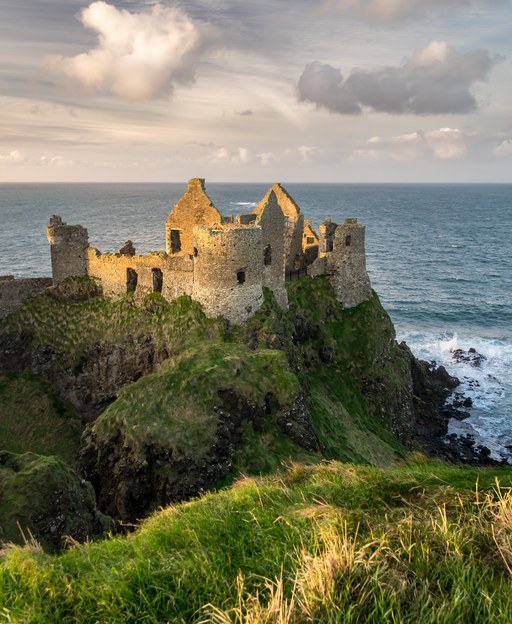
The family that left the deepest mark is the one in Antrim. Woulfe says that around 1400 John Mór, son of the Lord of the Isles, married the heiress of MacEoin Bissett, which brought the Glens of Antrim into the family, and that about 1520 they made a permanent settlement there. The Dictionary of Irish Biography tells the next chapter through Sorley Boy MacDonnell: Scots from the Western Isles were moving into the Glens in the 1530s and 1540s, and in August 1585 Sorley Boy recaptured Dunluce Castle, and after his submission in 1586 was granted most of the Route and the constableship of Dunluce. His son Randal was created Viscount Dunluce in 1618 and Earl of Antrim in 1620 (see the DIB entry for Sir Randal MacDonnell).
Dunluce itself is on the north Antrim coast, and we have a full Dunluce Castle guide on history and visiting. Woulfe’s verdict is that “the great bulk of our Irish MacDonnells belong to this race”.
McDonald, MacDonnell, McDaniel: the spellings
Woulfe’s list of forms includes M’Donaill, MacDonald, MacDonnell, MacDaniel, Donaldson and Donald, because Domhnall was anglicised as both Donald and Daniel. In your own family’s papers you may find the “Mc” and “Mac” prefixes swapped, an “ell” or “ald” ending, or a Daniel hiding in the middle. Search every form.
Where to search for your McDonald or MacDonnell
- Pick a county first. Our guides: County Antrim family records, County Fermanagh family records, County Clare family records, County Wicklow family records and County Laois family records. Names have many variants and several separate families, so a shared spelling does not prove a shared ancestor.
- Civil records. IrishGenealogy.ie gives access to births 1864 to 1925, marriages 1845 to 1950 and deaths 1871 to 1975; non-Catholic marriages are recorded from 1845 and Catholic marriages from 1864.
- Census. The National Archives of Ireland has the 1901 and 1911 censuses online, and the 1926 census was published online in April 2026. Try each spelling.
- Land records. Griffith’s Valuation (1847 to 1864) on Ask About Ireland shows who held land in which townland, so you can see which spellings cluster where.
- Then the parish. Once you have a townland, our guide to finding your ancestral townland explains the next steps.
☘️ Join 64,000+ Ireland Lovers
Every weekday morning, get Ireland’s hidden gems, local secrets, and travel inspiration — the kind you won’t find in any guidebook.
Subscribe free — enter your email:
Free forever · Unsubscribe anytime
For more on how Irish surnames formed and where they were found, see our guides to what your Irish surname says about where your family came from, where the most common Irish surnames come from and what your Irish surname reveals about your family’s origins.
Checked November 2026. Record ranges and online collections change, so confirm each step on the official pages.
Secure Your Dream Irish Experience Before It’s Gone!
Planning a trip to Ireland? Don’t let sold-out tours or packed attractions spoil your journey. Iconic experiences like visiting the Cliffs of Moher, exploring the Rock of Cashel, or enjoying a guided walk through Ireland’s ancient past often sell out quickly—especially during peak travel seasons.

Booking in advance guarantees your place and ensures you can fully immerse yourself in the rich culture and breathtaking scenery without stress or disappointment. You’ll also free up time to explore Ireland’s hidden gems and savour those authentic moments that make your trip truly special.
Make the most of your journey—start planning today and secure those must-do experiences before they’re gone!