

Before barmbrack took over Halloween, the dish that marked the night in Irish homes was a bowl of colcannon. A ring might be hidden in it to tell your fortune, and in some places a share was left out for the fairies. This is the story of Colcannon Night, and how to make the potatoes and cabbage at its centre.
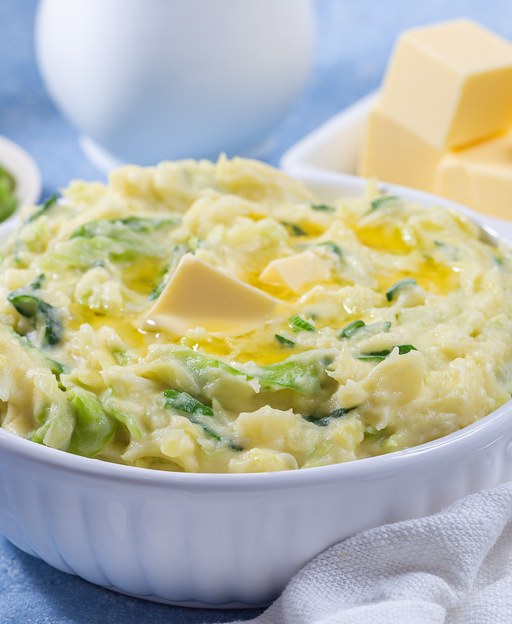
Cook the Irish classics at home ☘️
Get our free Irish cooking recipes, from soda bread to stew, step by step.
Colcannon Night
Irish Heritage News, writing on the folklore, says colcannon (cál ceannann) was the food that marked Halloween night as special. Accounts in the 1930s Schools’ Folklore Collection show it eaten in almost every county, though less often in Cork, Kerry, Limerick, Offaly and Donegal. It was especially popular in Wexford and elsewhere in Leinster, and in Connacht.
So closely was it tied to the night that in parts of Leinster, Halloween itself became known as “Colcannon Night”. In much of Connacht and parts of Ulster the dish was affectionately called “cally” or “callie”.
The ring in the bowl
In many parts of Ireland a ring was hidden in the colcannon before it was served. Some homes added other small things too: a coin (a threepenny bit, sixpence, shilling or, if you were very lucky, a half-crown), a thimble, a piece of cloth, a button or a bean.
- The ring foretold marriage within a year.
- The coin meant luck or wealth, though in some places it meant the opposite.
- The thimble meant a tailor for a husband.
- The button or cloth meant you would never marry, or would be poor.
- The bean stood for good fortune or prosperity.
The meanings changed from region to region and often contradicted one another. The same customs were later passed on to the barmbrack. If you want the Halloween story from the other side, see our Irish Halloween and Samhain guide and our piece on the colcannon folk song and the hidden ring.
A share for the good people
In Leinster and Connacht there was also a belief that some of the dish should be left out, on a spoon or in a bowl, for the fairies, the “good people”, the púca or the poor souls. In Lettera, Co. Galway, the first plate of colcannon was kept for the fairies, and no salt was added to their share.
How it was made, and eaten
Traditionally the potatoes and cabbage were boiled together in one big pot over an open fire, then pounded with a wooden pounder or beetle, before the butter and new milk went in. New milk was milk very recently drawn from a cow, chosen for its creaminess. It was usually eaten on its own or with oaten bread, everyone sharing from the same bowl or plate with large spoons.
The basic list is potatoes, cabbage, milk and butter, and the extras depended on where you lived: onions, spring onions, baby leeks, chives, parsley, parsnips or carrots, and in some places curly kale instead of cabbage. In Wexford the big outer cabbage leaves were sometimes used as a lid on the pot to hold the steam. In certain counties, “colcannon” simply meant mashed potato or champ, with no cabbage at all. Today it is more likely to turn up as a side dish with bacon.
How to make colcannon (serves 4)
These quantities follow the traditional recipe in the Irish Heritage News piece. We have already given our own take in our colcannon recipe, and if you like your mash with spring onion only, try champ.
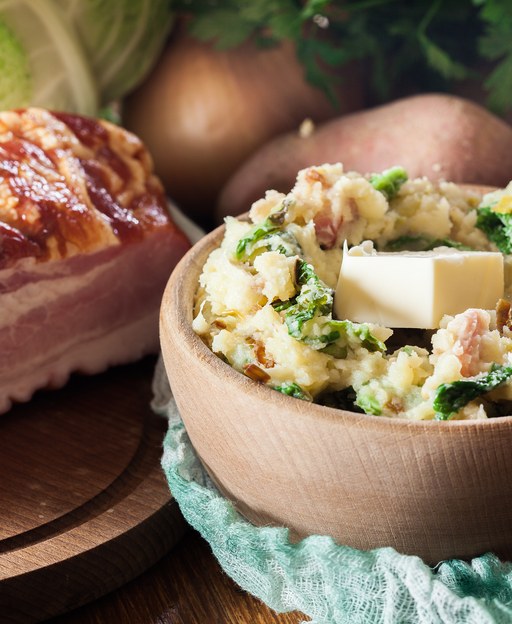
Ingredients
- 1 kg floury potatoes (Golden Wonders or Kerr’s Pinks), peeled and diced
- 400 g savoy cabbage (or curly kale), finely sliced
- About 100 ml whole milk
- 3 tablespoons salted butter, plus a knob to serve
- Salt and white pepper
- Optional: 1 bunch spring onions, finely sliced, or a small bunch of chopped parsley
Method
- Put the potatoes in a large pot of cold, salted water, cover and bring to the boil.
- After about 10 minutes, when they are starting to soften, pour off two-thirds of the water, cover again and let them steam on a low heat until tender.
- Meanwhile, boil the cabbage in a little water in a separate pot until soft. Drain, season and stir in a small knob of butter.
- Drain the potatoes and return them to the pot. Bring the milk to the boil in another pan.
- Mash the potatoes while warm, adding the hot milk and most of the butter until smooth and creamy.
- Stir in the cabbage and seasoning (and the spring onions or parsley, if using). It should be soft but not runny: add more milk or butter if needed.
- Serve at once in a hot bowl, with a well in the centre for a generous knob of butter to melt.
If you hide a ring, coin or button the old way, wrap it in parchment paper first.
Want more Irish kitchen classics? ☘️
Our free Irish cooking recipes are made for home cooks, wherever you live.
Would you have wanted the ring, or the coin?
Sources
- Learn to make colcannon, Ireland’s traditional Halloween dish, Irish Heritage News, 30 October 2025 (drawing on the 1930s Schools’ Folklore Collection)
Checked November 2026.
Secure Your Dream Irish Experience Before It’s Gone!
Planning a trip to Ireland? Don’t let sold-out tours or packed attractions spoil your journey. Iconic experiences like visiting the Cliffs of Moher, exploring the Rock of Cashel, or enjoying a guided walk through Ireland’s ancient past often sell out quickly—especially during peak travel seasons.

Booking in advance guarantees your place and ensures you can fully immerse yourself in the rich culture and breathtaking scenery without stress or disappointment. You’ll also free up time to explore Ireland’s hidden gems and savour those authentic moments that make your trip truly special.
Make the most of your journey—start planning today and secure those must-do experiences before they’re gone!