

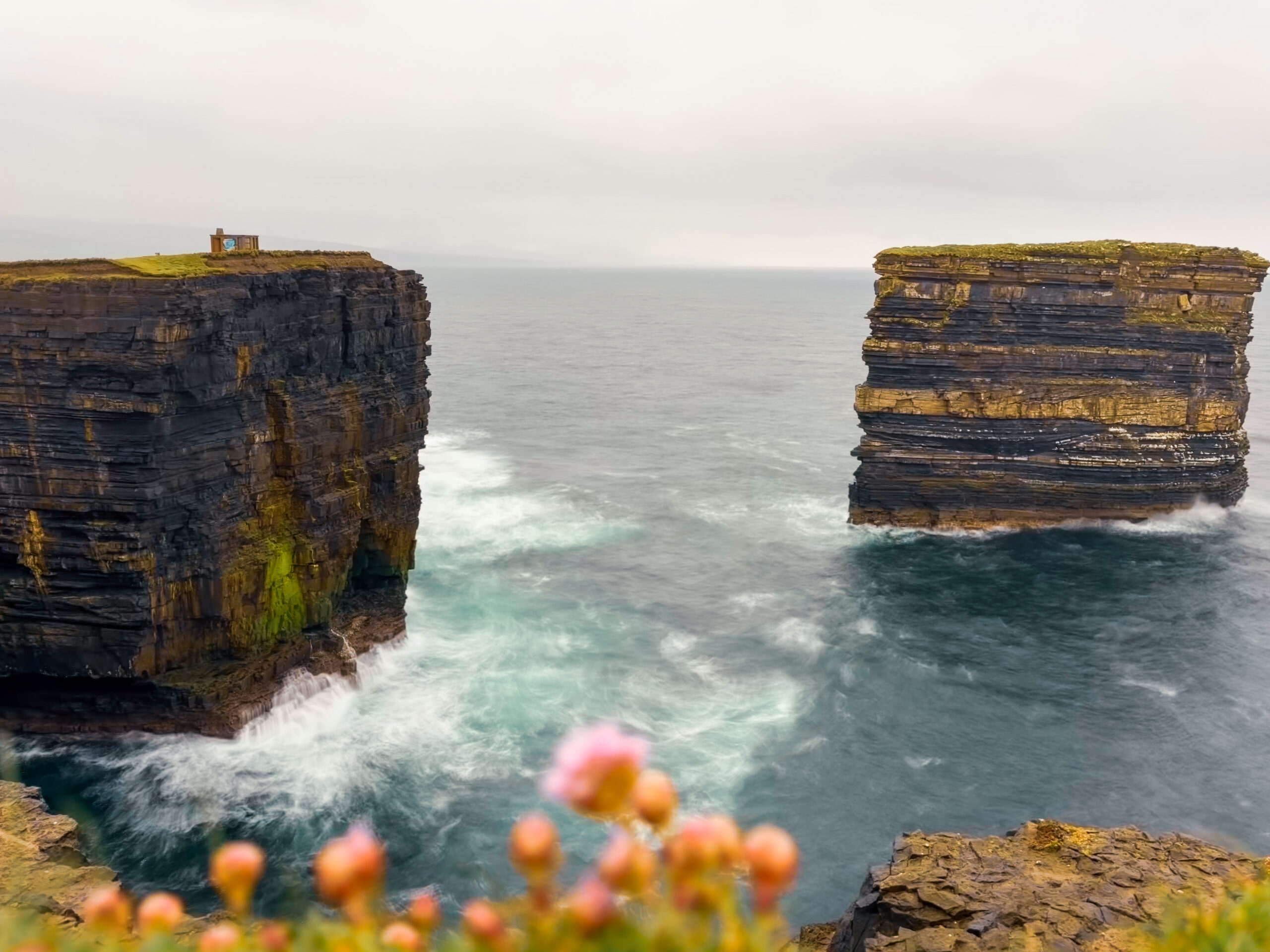
Standing at the edge of Downpatrick Head on a clear day, you understand immediately why the Wild Atlantic Way was routed through County Mayo. The cliffs drop sharply into churning water below, and a few hundred metres offshore, a 45-metre sea stack rises out of the Atlantic with a flat, grass-covered top — completely cut off from the land. That stack is called Dún Briste, meaning “broken fort,” and it is one of the most distinctive natural landmarks in Ireland.
This is not a polished, well-signposted tourist attraction. It is a raw stretch of north Mayo coastline that rewards those who make the effort to get there. Here is everything you need to know before you go.
Love discovering places like this?
Join thousands of Ireland lovers who get the best hidden gems, travel tips and local stories every week. Subscribe to our free newsletter →
Where Is Downpatrick Head?
Downpatrick Head sits on the north Mayo coast, roughly 5 kilometres north of the village of Ballycastle. It lies along the Wild Atlantic Way between Killala Bay to the east and the Belmullet Peninsula to the west. The nearest large town is Ballina, approximately 24 kilometres to the south-east.
The headland itself juts out into the Atlantic Ocean, which means it gets the full force of Atlantic weather coming in from the west and north. On calm days it is an open, green headland with sweeping views. In a storm, the blowhole near the cliff edge — known locally as Poll na Seantainne — can shoot jets of seawater high into the air, driven by the pressure of waves forcing through an underground cave system beneath the headland.
The Story Behind Dún Briste
The sea stack visible from the headland is Dún Briste — the broken fort. It stands roughly 45 metres tall and is topped with a surface of grass and rock. According to historical records, the stack separated from the headland in 1393 during a violent storm that caused part of the cliff to collapse into the sea. Archaeological evidence found on the flat top of the stack confirms it was once inhabited: when researchers landed by helicopter on it in 1980, they found the remains of buildings believed to be medieval, along with field systems, that had been completely isolated for nearly 600 years.
The geology of the area is also striking. The layered sedimentary rock visible in the stack and the surrounding cliffs was formed around 350 million years ago during the Carboniferous period. The horizontal banding you can see in the cliff faces records millions of years of deposits laid down in shallow tropical seas — a reminder that what is now the north Mayo coast once sat near the equator.
The Connection to St Patrick
The “Patrick” in Downpatrick Head refers to Ireland’s patron saint. Local tradition holds that St Patrick passed through this part of Mayo during his missionary travels in the 5th century. Near the top of the headland, there is a small bullaun stone — a basin-shaped depression in a rock — that is associated with the saint, along with a holy well dedicated to him.
The headland was also the site of a real tragedy during the 1798 Rebellion. Twenty-five Irish and French soldiers took shelter on a ledge at the bottom of the Poll na Seantainne blowhole, but the tide came in before their ladders could be replaced, and all of them drowned. A plaque was installed at the blowhole in 2014, as part of a Spirit of Place commemorative project, to mark the site. It is simple and easy to miss, but it gives the headland an extra layer of human history beyond the geological and mythological.
More Mayo magic in your inbox
From County Mayo to the Cliffs of Moher, we cover every corner of Ireland worth knowing about. Get the free newsletter →
What to See and Do at Downpatrick Head
The main activity at Downpatrick Head is walking. There is a looped walking trail around the headland that takes most visitors between 45 minutes and an hour at a relaxed pace. The path leads you along the clifftop, past the blowhole, and to the best viewpoints for Dún Briste. The ground can be uneven in places, and there are no barriers right at the cliff edge, so care is needed — particularly with children.
Wildlife is plentiful here. Seabirds including fulmars, razorbills, and guillemots use the cliff faces for nesting from spring through summer. Grey seals are often spotted in the waters below, particularly around the base of Dún Briste. In autumn and winter, the headland can be a useful spot for observing sea ducks and divers moving along the coast.
Photography is a major draw. The combination of the stack, the cliff edges, the open Atlantic, and the dramatic Mayo sky makes it a popular location at most times of day. Early morning visits before the summer tourist traffic arrives give you the headland largely to yourself, and the low-angle light in the morning works well for cliff photography.
There is no café or visitor centre on site. Ballycastle village, a short drive away, has a small café and a community centre. If you plan a longer day in the area, the town of Ballina has a fuller range of restaurants, shops, and accommodation.
How to Get There
From Ballina, take the R314 north towards Killala, then follow signs for Ballycastle. From Ballycastle, Downpatrick Head is signposted along a narrow road heading north for approximately 5 kilometres. There is a small car park at the headland with space for around 20 vehicles, along with an information board and public toilets (seasonal availability).
There is no public transport directly to the headland. If you are not driving, Ballycastle can be reached by bus from Ballina, but the final few kilometres to the head would need to be walked or cycled. The road is quiet but narrow, so cycling is manageable for most adults.
The nearest airport with scheduled flights is Ireland West Airport Knock, approximately 65 kilometres south, which has rental car facilities — the most practical option for exploring this part of Mayo. Sligo Airport, roughly 70 kilometres east, is closer as the crow flies but has had no scheduled passenger services since 2011 and is not a practical arrival point for visitors.
When to Visit
Downpatrick Head is open year-round and free to visit. The peak months are June through August, when the days are longest and the weather is most likely to cooperate. That said, north Mayo weather is unpredictable in any season, and even summer days can bring Atlantic squalls. Layering is always the right approach.
Visiting in autumn or winter, particularly after a storm, gives you the chance to see the blowhole at its most dramatic. The spectacle of seawater erupting from the ground is one that most visitors on a summer afternoon miss entirely. If you want to time a visit for this, check the weather forecast for Atlantic swells arriving from the west — typically 24 to 48 hours after a storm system passes, the headland sees the most active conditions.
Spring is also a strong option. The grassland on the headland is vivid green through April and May, seabirds return to the cliffs, and visitor numbers are lower than peak summer. Parking is rarely an issue outside July and August.
Nearby Places Worth Including on Your Route
Downpatrick Head works well as part of a broader north Mayo itinerary. A few kilometres west, the Ceide Fields is one of the most significant Neolithic sites in Europe — a Stone Age field system preserved beneath a blanket bog for over 5,000 years. There is a visitor centre on site with guided tours.
The town of Killala, a short drive to the east, has a round tower and a history connected to the 1798 Rebellion, when French forces landed in Killala Bay in support of the United Irishmen uprising. The Belleek Woods outside Ballina is a river woodland park well suited to a quiet walk. Further south, Foxford has a well-regarded woollen mill with tours.
For accommodation, the options closest to Downpatrick Head are self-catering properties around Ballycastle and Killala, with more choice in Ballina or along the coast towards Belmullet. If you are touring the Wild Atlantic Way, Downpatrick Head fits naturally into the stretch between Killala and Belmullet, a drive that is consistently one of the most scenic on the route.
Plan your Ireland trip with us
Every week, our newsletter features practical guides, hidden gems and local tips to help you make the most of Ireland. It’s free and you can unsubscribe any time. Join the community →
Downpatrick Head is not the easiest place to reach, and that is part of what makes it worth the effort. The isolation, the geology, the seabirds, and the sight of Dún Briste standing alone in the Atlantic — it is a combination that is hard to find anywhere else in Ireland. If you are planning a trip to Mayo, make room for it.
☘️ Join 64,000+ Ireland Lovers
Every weekday morning, get Ireland’s hidden gems, local secrets, and travel inspiration — the kind you won’t find in any guidebook.
Subscribe free — enter your email:
📲 Know someone who’d love this? Share on WhatsApp →
Free forever · Unsubscribe anytime
Tours & experiences you might love


Powered by Viator. Some links are affiliate links — we may earn a small commission at no extra cost to you.
Secure Your Dream Irish Experience Before It’s Gone!
Planning a trip to Ireland? Don’t let sold-out tours or packed attractions spoil your journey. Iconic experiences like visiting the Cliffs of Moher, exploring the Rock of Cashel, or enjoying a guided walk through Ireland’s ancient past often sell out quickly—especially during peak travel seasons.

Booking in advance guarantees your place and ensures you can fully immerse yourself in the rich culture and breathtaking scenery without stress or disappointment. You’ll also free up time to explore Ireland’s hidden gems and savour those authentic moments that make your trip truly special.
Make the most of your journey—start planning today and secure those must-do experiences before they’re gone!