

There are ruined castles all over Ireland, but few demand as much effort to reach as Dunlough Castle. Sitting on the western tip of the Mizen Peninsula in West Cork, on a headland called Three Castles Head, this 13th-century fortress rises above sheer Atlantic cliffs — with no car park, no signage, no café, and no crowds. Getting there means a proper walk across open farmland and cliff-top terrain. What you find at the end is one of the most dramatic medieval sites in the country. This guide covers the history, the route, what to expect on the ground, and the practical details you need before you go. Want more stories about Ireland’s hidden corners? Join our free weekly newsletter — delivered every week to thousands of Ireland lovers worldwide.
Where Is Dunlough Castle?
Dunlough Castle sits at Three Castles Head, on the far western tip of the Mizen Peninsula in County Cork. The nearest village is Goleen, and the closest town is Schull, roughly 25 kilometres to the east by road. The Mizen Peninsula is already one of the more remote parts of Ireland — Three Castles Head pushes even further west, into open Atlantic headland with no permanent settlement nearby.
The headland itself forms a dramatic natural boundary. On three sides, cliffs drop steeply to the ocean. A freshwater lake called Lough Fadda sits immediately behind the castle, adding to the sense of isolation. On a clear day, the views stretch out to the Fastnet Rock lighthouse and beyond. On a stormy day, it is raw and wild in a way that very few places in Ireland still are.
The History of Three Castles Head
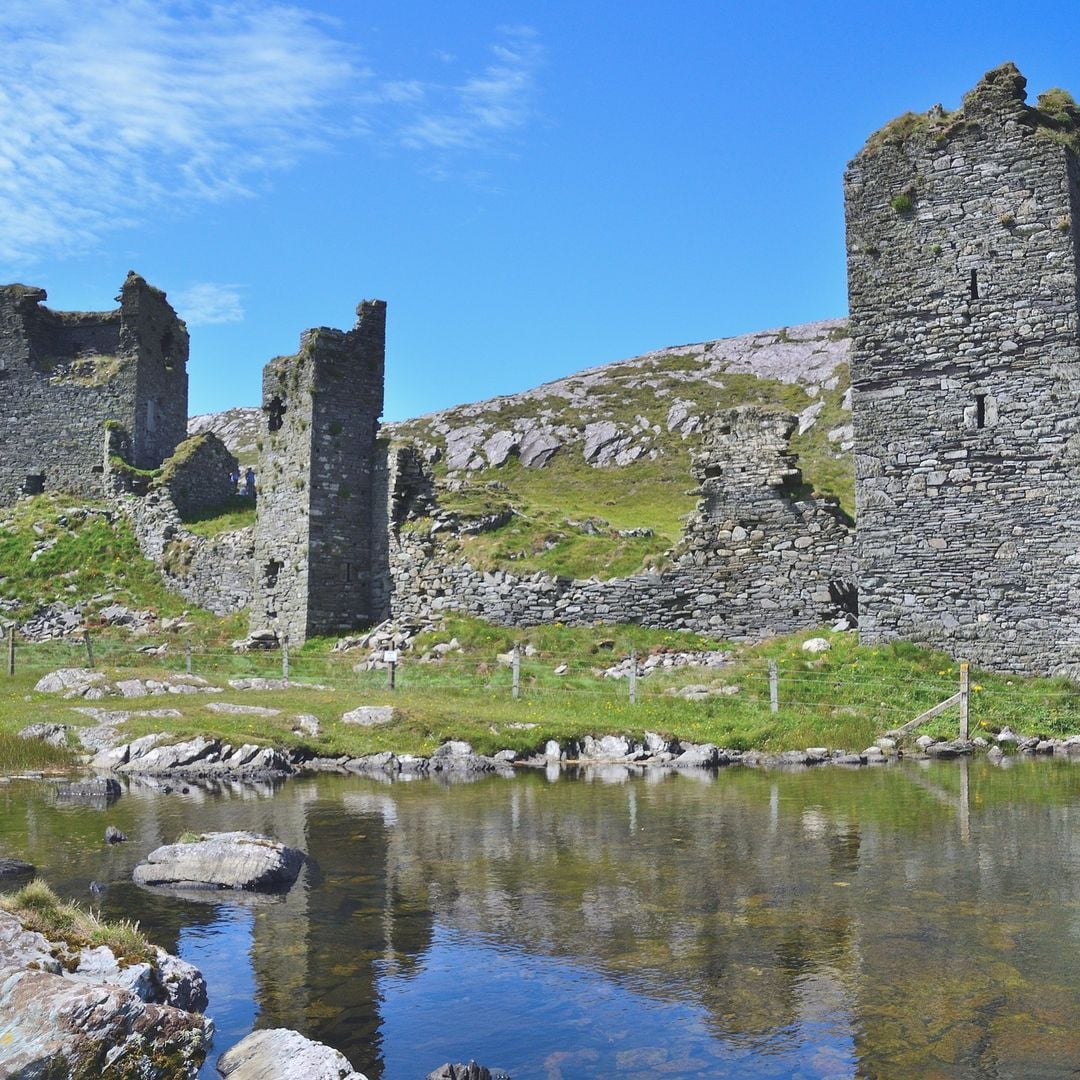
The name is accurate: three fortified tower houses survive on the site, each roughly three storeys high, linked by a substantial enclosing wall running from the cliff edge to the shore of Lough Fadda. The eastern tower is thought to have served as a gatehouse, the western tower as the main residence, and the central tower for storage and lookout.
The castle was founded in 1207, most likely by Donagh O’Mahony, chief of the O’Mahony clan, one of the dominant Gaelic Irish dynasties of south-west Cork during the medieval period. The O’Mahonys controlled much of this coastline and built a series of tower houses along the Mizen and Sheep’s Head peninsulas to defend their territory and monitor shipping lanes. Dunlough was positioned at an extreme point of the coastline — not for ease of access, but for visibility. From the cliff top, any approaching vessel would have been visible from a considerable distance. The location made it a useful lookout and a defensible stronghold, even if it was never a large or particularly powerful fortification by Irish standards.
The castle remained in O’Mahony hands for centuries. Following the Tudor conquest of Munster and the gradual collapse of Gaelic lordship in the region, the family’s power eroded. The castle was confiscated by the Crown in 1627 and fell into ruin. It has been unoccupied ever since.
How to Get There
There is no official trailhead or car park at Three Castles Head. Access begins from a small roadside parking area reached by following minor roads west from Goleen — the last section is narrow and unsigned. The road is narrow, so park carefully and do not block farm gates.
From the parking area, you walk across private farmland. There is a well-worn route but no formal waymarked trail. The landowners have traditionally allowed access for walkers, but this is not a right of way — treat the land accordingly. Close all gates behind you, keep dogs on leads, and stay off any crops or grazing areas.
The walk to the castle takes approximately 20 to 35 minutes each way, depending on your pace and the conditions underfoot. The terrain is rough in places — boggy ground, uneven grass, and steep sections near the cliff edge. Good walking boots are essential. The path is not suitable for buggies or wheelchairs. Total distance for the return walk is roughly 3 kilometres. There is no shelter on the headland, so bring waterproof clothing regardless of the forecast. The weather on the Mizen Peninsula can change quickly.
The Walk: What to Expect
The route climbs gradually from the road, passing through a series of fields before the terrain opens out onto higher ground. As you gain height, the shape of the headland becomes clear — you are walking out onto a narrow finger of land with the Atlantic dropping away on both sides.
The cliffs at Three Castles Head are roughly 100 metres high. There are no barriers or fences near the edge. Keep a safe distance, particularly in strong wind, and keep children and dogs under close supervision throughout.
Lough Fadda comes into view before the castle does — a still, dark lake sitting in a shallow depression just behind the headland. The contrast between the lake and the sea below the cliffs is striking. The castle ruins appear on the cliff edge beyond the lake, silhouetted against the sky. The main structure still standing is the tower house, which rises to several storeys in places despite centuries of neglect. The surrounding wall, once enclosing a substantial courtyard, survives in sections. The stonework is rough and unrestored — this is not a managed heritage site, and there are no information boards. What you get is the raw ruin as it is.
What You’ll See at the Top
The castle itself is open — there are no locked gates or admission fees. You can walk through the ruins and explore the remaining interior spaces, though the floors and upper levels are long gone. Take care with loose stonework, and do not attempt to climb the walls.
The views from the headland are the other main draw. To the south and west, the Atlantic stretches to the horizon. On a clear day, the Fastnet Rock — Ireland’s most southerly lighthouse, roughly 13 kilometres from the Cork coast — is visible. To the north, the Mizen Peninsula and Dunmanus Bay open out, with the hills of the Sheep’s Head Peninsula beyond.
The location is also good for wildlife. Grey seals are regularly seen in the waters below the cliffs. Choughs — the red-billed crow found on Ireland’s Atlantic coast — are often present on the headland. Peregrine falcons nest on cliffs in this area. Bring binoculars if you have them.
Best Time to Visit
Three Castles Head is accessible year-round, but conditions vary significantly by season. Summer (June to August) gives the best chance of clear skies and dry ground, and the long evenings allow for a late afternoon visit without rushing. July and August also bring the most visitors, though numbers here are never large — this remains a genuinely quiet site even in peak season.
Spring and autumn offer good walking conditions with far fewer people. The light in September and October is often excellent for photography. Winter visits are possible but demand full waterproofs and solid footwear — the ground becomes waterlogged and the wind at the cliff edge can be severe. Avoid visiting in heavy rain or strong gales. The path can become slippery, and the cliff edge is genuinely dangerous in those conditions.
Practical Tips Before You Go
Parking: Small roadside area west of Goleen, reached via minor roads off the R591. No facilities.
Footwear: Waterproof walking boots are required. Trail runners are manageable in dry conditions but will not protect you if the ground is wet.
Weather: Check the Met Éireann forecast for West Cork before setting out. Wind speeds on the headland can be significantly higher than in the village.
Dogs: Allowed but must be kept on leads at all times due to livestock and the cliff edge.
Mobile signal: Weak or absent in places. Download offline maps before leaving.
No facilities: No toilets, no water, no food available anywhere near the site. Bring everything you need.
Respect the land: This is private farmland with informal access. Stick to the established route, close gates, and take all litter with you.
Getting to the Mizen Peninsula
The Mizen Peninsula is roughly 115 kilometres south-west of Cork City. The drive takes around 2 hours from Cork, following the N71 to Skibbereen and then the R592 west through Ballydehob and Schull. From Schull, continue west along the R591 towards Goleen and Three Castles Head.
There is no public transport to Three Castles Head. A car is essential. The nearest accommodation options are in Schull, which has hotels, B&Bs, and self-catering properties. Skibbereen, a larger town, has a wider range of options. For a wider look at what the region has to offer, see our guide to West Cork activities and sights.
While you are in the area, the tip of the Mizen Peninsula at Mizen Head — about 6 kilometres further west — has a visitor centre and signal station built on dramatic sea stacks, connected by a reinforced concrete arch bridge. It makes a natural second stop on the same day. The Beara Peninsula, just north across Dunmanus Bay, is another exceptional area for coastal walking and scenery.
Thinking about it seriously?
If you’ve started actually planning a move, our complete the full Move to Ireland guide walks through every step, every cost, and the paperwork that catches most people out.
Tours & experiences you might love


Powered by Viator. Some links are affiliate links — we may earn a small commission at no extra cost to you.
Secure Your Dream Irish Experience Before It’s Gone!
Planning a trip to Ireland? Don’t let sold-out tours or packed attractions spoil your journey. Iconic experiences like visiting the Cliffs of Moher, exploring the Rock of Cashel, or enjoying a guided walk through Ireland’s ancient past often sell out quickly—especially during peak travel seasons.

Booking in advance guarantees your place and ensures you can fully immerse yourself in the rich culture and breathtaking scenery without stress or disappointment. You’ll also free up time to explore Ireland’s hidden gems and savour those authentic moments that make your trip truly special.
Make the most of your journey—start planning today and secure those must-do experiences before they’re gone!
Subscribe Free