

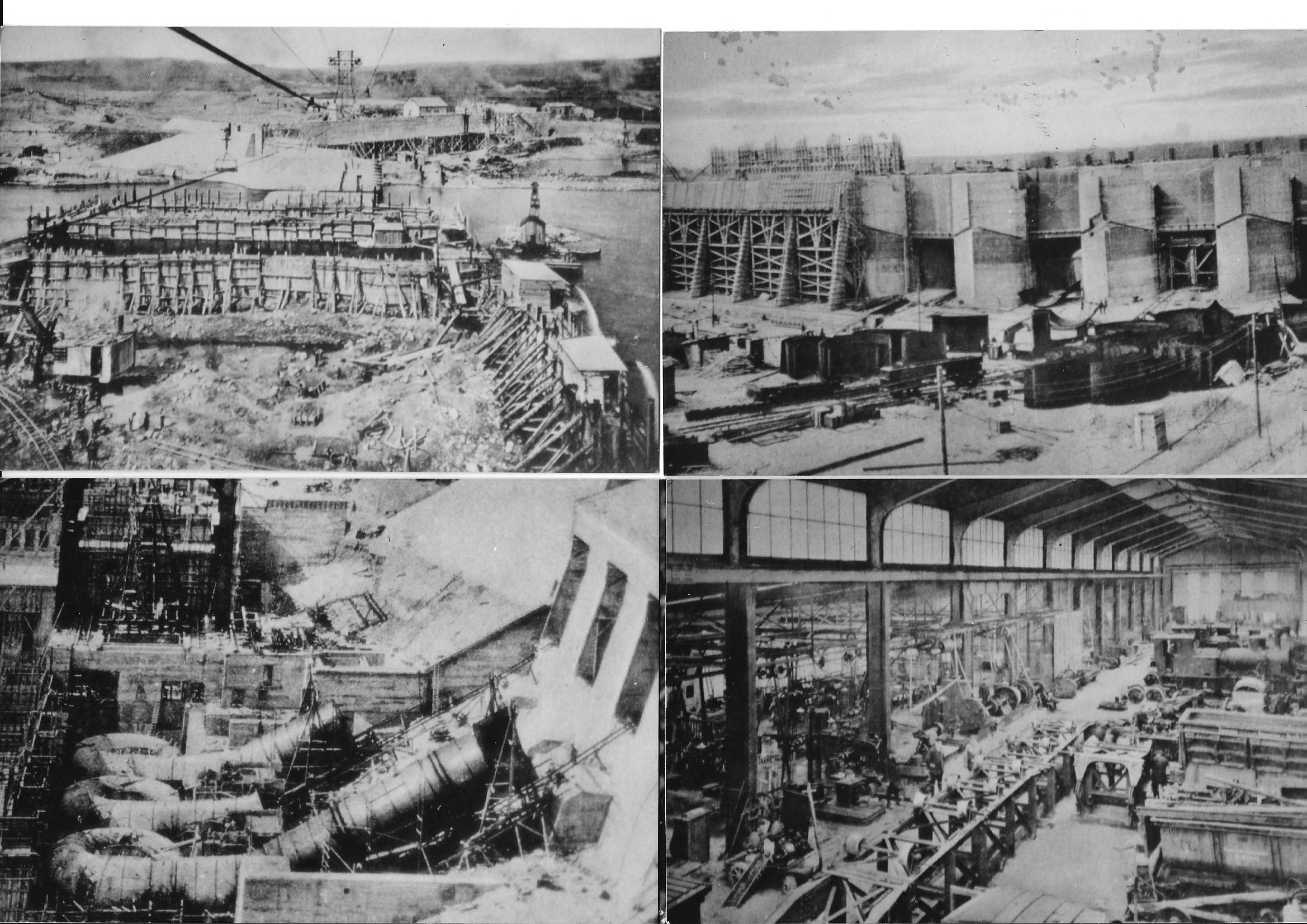
How Ireland’s 1929 Shannon Scheme Was Built by a German Company
In the summer of 1925, the Irish Free State was barely three years old. Its civil war had ended just two years before, its government was still working out what kind of country it intended to be, and its total annual revenue stood at roughly £25 million. That August, it signed a contract for £5.2 million — approximately one pound in every five of its entire budget — to build what was then the largest hydroelectric station in the world.
The man who made it happen was Thomas Anthony McLaughlin. Born in Drogheda in 1896, he had done the most counterintuitive thing an ambitious Irish engineer of his generation could do: in 1922, with the country still at war with itself, he moved to Berlin and got a job at Siemens-Schuckert, Germany’s premier electrical engineering firm. He was working in their water power design department when the idea arrived.
The River as Engine
The Shannon is Ireland’s longest river — a slow, enormous body of water that drains almost a fifth of the island’s land area. Decades earlier, an engineer named John Chaloner Smith had spent years cataloguing its flow patterns. McLaughlin came across Smith’s data and saw something in the numbers: a natural fall of around 30 metres between Lough Derg at Killaloe and the tidal reach at Limerick. That drop, he calculated, could generate more electricity than Ireland had ever imagined producing for itself.
By the end of 1923, McLaughlin was back in Dublin with a proposal. The plan called for a dam and a headrace canal that would channel the Shannon’s flow into a purpose-built power station at Ardnacrusha in County Clare, harnessing the river to supply electricity to the entire country through a national grid — something Ireland had never had. The estimated cost: £5.2 million. The payback: a modern industrial nation that didn’t have to depend on imported coal for almost every watt of power it used.
A crucial accident of friendship shaped what happened next. McLaughlin’s contact at the Irish government was Patrick McGilligan, who had been a classmate of his at University College Dublin and who, by 1924, had become Minister for Industry and Commerce. McGilligan understood what McLaughlin was proposing and became its loudest champion in Cabinet. W.T. Cosgrave, President of the Executive Council, was harder to convince. He rejected the idea outright at the first meeting. McLaughlin requested a second. This time, he brought a senior director of Siemens with him.
Why a German Company?
The question of why an independent Irish government chose a German firm for its defining national infrastructure project is one of the more interesting political footnotes of the era. Part of the answer is McLaughlin himself: he was Siemens’ man in this conversation, and the proposal he was selling was intrinsically tied to Siemens’ engineering capacity. But Siemens did something that made the whole deal more politically defensible — they agreed to bear the full cost of the project themselves if the government ultimately rejected it. That kind of financial confidence was persuasive when everything else about the plan was enormous and untested.
International experts from Norway and Switzerland were brought in to validate the scheme, and they backed the centralised approach over the alternative — a smaller, cheaper scheme on the River Liffey near Dublin, which Éamon de Valera, then in opposition, preferred. The Norwegian and Swiss endorsements helped neutralise objections from the technical establishment, most of whom were “antagonistic,” as the contemporary record has it, and from a press that was “mostly hostile.” One London newspaper went so far as to warn that the Irish “may all be electrocuted in their beds.”
Siemens, for its part, knew it would likely lose money. The company did indeed turn in losses on its balance sheet for two years running. It was a calculated loss leader — a bet that a project of this scale and visibility would open the door to far larger opportunities in a world that was rapidly electrifying. The Irish government’s cheque was, in part, purchased with Siemens’ willingness to eat the risk.
The Scale of What They Built
The numbers are still staggering a century later. The scheme required the removal of 7.6 million cubic metres of earth and 1.2 million cubic metres of rock. A quarter of a million cubic metres of concrete were poured. To move materials across a largely roadless landscape, Siemens laid more than 60 miles (roughly 100 kilometres) of narrow-gauge railway and ran steam locomotives over it. Four major bridges were constructed. The chief civil engineer was Professor Frank Sharman Rishworth — a man who had previously worked on the construction of the Aswan Dam in Egypt, and whose experience of infrastructure on that scale was, in 1925 Ireland, essentially without equivalent.
At peak construction, more than 5,200 people were working on the scheme simultaneously. Around 4,000 of them were Irish — small farmers, agricultural labourers, ex-servicemen, fishermen, and railway workers drawn from across the country by the promise of work in a desperately poor economy. A contingent of German engineers and skilled technicians, who held work permits, formed the engineering core of the operation.
For the German workers, Siemens built a purpose-built camp on site. Many brought their families. A German school was established, staffed by a German-speaking teacher. For a few years, a small, transplanted community operated in rural Clare with the routines of a German settlement — children learning arithmetic in German, families speaking a language no one in Ardnacrusha had heard before. The machine house that still stands at the station has what one architectural account describes as “a truly Germanic look,” with its high-pitched roof and industrial geometry, an incongruity on the Shannon that is entirely deliberate.
What They Were Paid
The Irish workers had a very different experience. When Siemens arrived on site and announced its wage rates, it became immediately clear the company intended to pay agricultural labourers’ rates — somewhere between 13 and 18 shillings a week, depending on the class of work, in line with what farm labourers earned in the Irish countryside. The workers had expected industrial rates, which were higher. A strike broke out almost immediately.
It failed. The dispute was serious enough that President Cosgrave cut short a trip to Rome to deal with it in November 1925 — and when he came back, he sided with Siemens. The government had too much invested in this project to allow a labour dispute to derail it, and there were too many men in the country who needed work badly enough to break it. The strike had the support of Limerick‘s dockers, but that solidarity was not enough. The agricultural rate held.
What followed was four years of some of the most physically demanding work in the country’s history. Shifts ran 54 hours a week, alternating between days and nights every second week. Workers were identified on site by numbered discs worn around their necks. Protective clothing was not provided. Accommodation in the surrounding area was scarce, and some workers rented space in stables and outbuildings while the permanent camp was under construction. By 1927, twelve workers had been killed.
A Murder on the Shannon
On the evening of December 21, 1928, a German foreman named Jacob Kunz was attacked near Long Pavement station at Parteen, not far from the construction site. He was 45 years old, and he was carrying wages in cash — the standard method of payment on the scheme. Kunz died at St John’s Hospital in Limerick from a skull fracture and brain laceration. Police arrested an Irish worker named John Cox, 31 years old.
Cox gave conflicting accounts of his movements that evening. A letter he attempted to smuggle out to his wife from custody led detectives to the ruins of a house at Park Bridge, where Kunz’s missing £80 and ten shillings were recovered. Soil found on Cox’s clothing matched what was found at a fence the killer had scaled to conceal the money. At the Dublin Central Criminal Court on March 11, 1929, Cox was found guilty of murder. His appeal was dismissed, a petition for clemency gathered signatures but did not prevail, and he was hanged at Mountjoy Prison on April 25, 1929.
The scheme was completed three months later.
The Switch Gets Flipped
On July 22, 1929, W.T. Cosgrave walked to the sluice gates at Parteen Weir and opened them. Water began its engineered journey down the new headrace canal and into the turbines at Ardnacrusha. On October 24 that year — the same day the Wall Street Crash began — the station entered commercial operation.
By 1935, Ardnacrusha was producing around 80 per cent of the Irish state’s electricity. One station, in one county, on one river, was powering essentially everything that ran on electricity in the whole country. The national grid had been built from scratch. Ireland, which had barely a handful of generating stations a decade earlier, was now widely regarded as having completed one of the most ambitious electrification programmes ever attempted.
The painter Seán Keating had spent time on the construction site from 1926, watching and sketching. The painting he produced — Night’s Candles Are Burnt Out, a title borrowed from Romeo and Juliet — was allegorical and unsettling: figures representing old Ireland and new arranged in the foreground against the looming dam in the distance. Critics called it “the problem painting of the year” when it was exhibited at the Royal Hibernian Academy. It hangs today at the Hunt Museum in Limerick, on loan from a gallery in Oldham, England — a reminder that the Shannon Scheme was controversial, admired, and strange all at once, even to those who witnessed it being built.
The Voltage Ireland Never Changed
One legacy of the scheme is still present in every Irish socket, though most people have never thought about it. When the national grid was designed, the Siemens engineers followed German electrical standards: 220 volts. Britain ran on 240 volts. Almost every piece of infrastructure the Irish Free State had inherited ran on British specifications, but the Shannon Scheme’s German engineering team installed Germany’s standard, and Ireland’s grid was built around it. For decades afterward, plugging a British appliance into an Irish socket carried a small but real incompatibility — a voltage gap that traced directly back to a decision made in the planning offices of a project in County Clare in the 1920s. Both countries have since converged on a harmonised European 230V standard, but the divergence lasted the better part of a century.
The Man Who Built It
Thomas McLaughlin, the engineer from Drogheda who had started all of this with a set of river flow measurements and a conversation with an old university friend, stayed with the project he had created. When the Electricity Supply Board was established in 1927 as the state body to manage the new national grid — Ireland’s first semi-state company — McLaughlin was appointed its first managing director. He spent the decades that followed overseeing the expansion of electricity consumption across the country, and directing the rural electrification programme that, through the 1940s and into the 1950s, finally brought power to the communities Ardnacrusha had always been intended to serve, including places that did not get electricity until the 1970s.
He is remembered as the founding father of the ESB. He died in Spain on May 28, 1971, at the age of 74.
Ardnacrusha itself is still generating. A century after construction began, its turbines still turn on the Shannon. As of 2017 they contributed roughly 2 per cent of Ireland’s total electricity supply — not because the station has diminished, but because the country grew far beyond anything the 1920s planners could have anticipated. For fifteen or twenty years in the middle of the twentieth century, though, the Shannon — channelled through a dam conceived by a young Irishman in a Berlin office, built with German engineering and Irish labour on agricultural wages, and opened on a July morning in 1929 — was the light switch for an entire nation. We still feel its current.
☘️ Join 64,000+ Ireland Lovers
Every Friday, get Ireland’s hidden gems, local secrets, and travel inspiration — the kind you won’t find in any guidebook.
Already subscribed? Download your free Ireland guide (PDF)
Free forever · One email per week · Unsubscribe anytime
Tours & experiences you might love


Powered by Viator. Some links are affiliate links — we may earn a small commission at no extra cost to you.
Secure Your Dream Irish Experience Before It’s Gone!
Planning a trip to Ireland? Don’t let sold-out tours or packed attractions spoil your journey. Iconic experiences like visiting the Cliffs of Moher, exploring the Rock of Cashel, or enjoying a guided walk through Ireland’s ancient past often sell out quickly—especially during peak travel seasons.

Booking in advance guarantees your place and ensures you can fully immerse yourself in the rich culture and breathtaking scenery without stress or disappointment. You’ll also free up time to explore Ireland’s hidden gems and savour those authentic moments that make your trip truly special.
Make the most of your journey—start planning today and secure those must-do experiences before they’re gone!