

Try the Guinness Timer ⏱️
A perfect pour takes 119.5 seconds — the rest, two minutes, gives the stout time to settle. Time your own pint and see if you wait long enough.
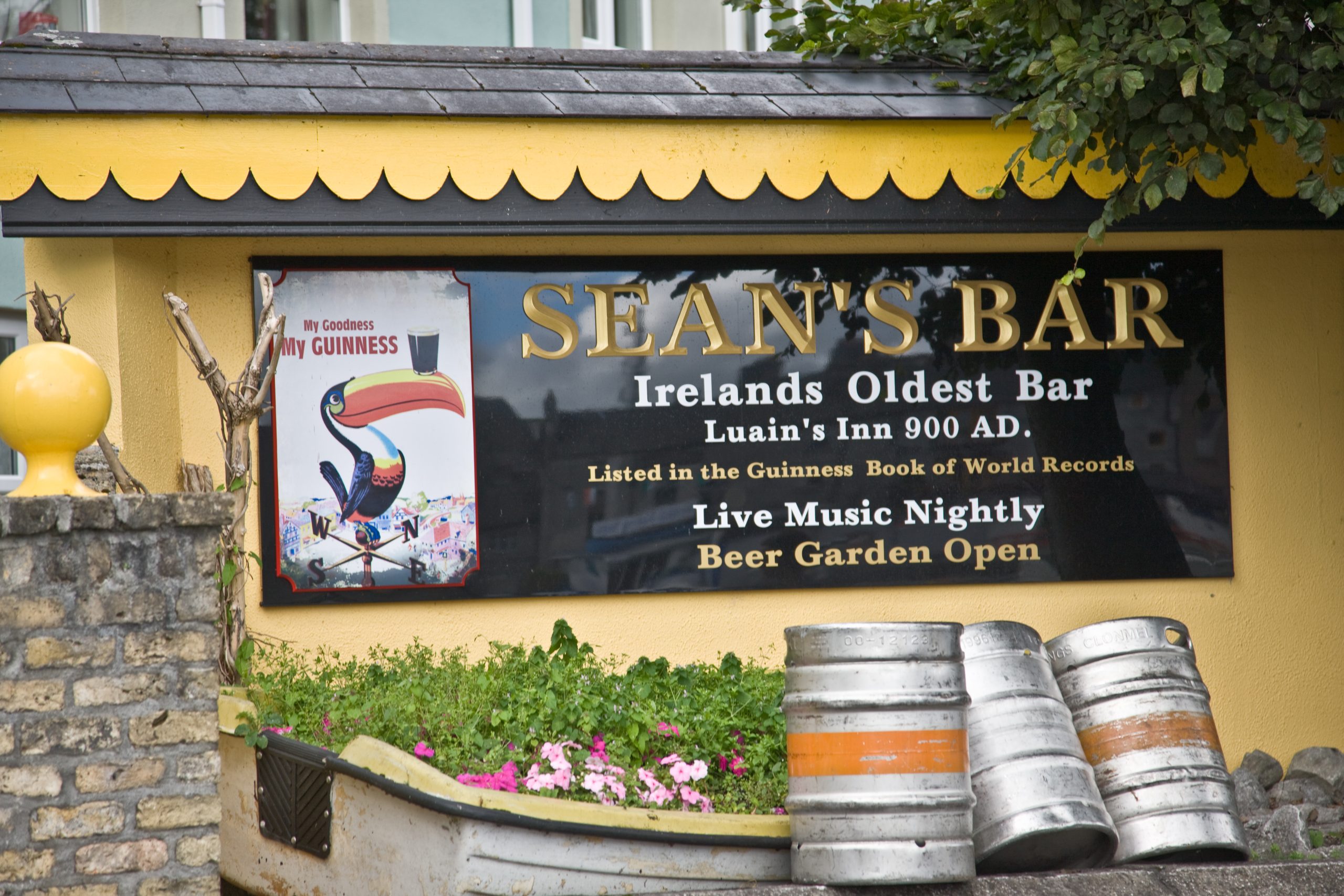
Behind the bar at Sean’s Bar in Athlone, County Westmeath, there is a framed certificate. It is issued by Guinness World Records, dated 2004, and it declares this premises to be the oldest pub in Ireland. Hundreds of thousands of visitors have filed past it. Lonely Planet included Sean’s Bar in its list of “50 Bars to Blow Your Mind.” Travel writers routinely reproduce the claim without footnotes. In 2018, the bar launched its own whiskey blend, trading on eleven centuries of brand equity.
There is one significant complication. Guinness World Records no longer maintains a category for oldest pub anywhere in the world. The certificate exists. The category does not.
Welcome to one of Ireland’s most commercially loaded, historically contested, and definitionally confused arguments. Pull up a stool.
The Claim and What It Actually Rests On
Sean’s Bar traces its origin to 900 AD, when a ferryman named Luain Mac Luighdeach is said to have established a hostelry at a crossing point on the River Shannon. The settlement that grew around that ford became known as Áth Luain — Ford of Luain — which we now call Athlone. It is a tidy story: the pub literally gave the town its name.
The claim took on new commercial life in 1970, when a man named Sean Fitzsimons bought the property and began renovating. Workers uncovered a section of back wall built from wattle-and-wicker materials — interwoven hazel sticks bound with horsehair and clay. They also found coins described as tavern tokens, which were deposited in the National Museum of Ireland. The wattle section was kept on display inside. Fitzsimons renamed the pub after himself, and the 900 AD founding date moved from local tradition to marketing cornerstone. Thirty-four years later, Guinness World Records made it official.
Here is what the independent record shows. The National Inventory of Architectural Heritage — the Irish government’s official architectural database — states the current building dates to approximately 1725, originally constructed as a coaching inn. A 1738 rental survey refers to it as “the Three Blackamoor Heads,” indicating the building had been trading under a different name for decades before anyone thought to record it. Records show a William Moorehead associated with the property as far back as 1654.
In October 2023, James Wright — an award-winning buildings archaeologist at Triskele Heritage with more than two decades of experience examining medieval structures — published a detailed assessment of the 900 AD claim. His finding was direct: the wattle partition discovered in 1970 “could be seventeenth-century but is not securely dated.” He cited the 2017 archaeological appendix submitted to An Bord Pleanála for the Athlone pedestrian and cycleway bridge project, an independent site review that reached the same conclusion. The walls did not support a ninth-century origin. They supported a seventeenth-century one.
Wright also identified a more fundamental problem. Athlone as a significant settlement almost certainly postdates 900 AD entirely. The Annals of the Four Masters record the following entry: “1129: The castle of Athlone and the bridge were erected by Toirrdelbach Ua Conchobair.” The town developed around Norman and later infrastructure, not a Dark Ages ferry crossing. As for the supposed founder, Luain — Wright found that “literally nothing beyond the personal name” is known about him from any external source. The entire origin story rests on the pub’s own promotional material, traced back no further than the twentieth century.
None of this has meaningfully dented Sean’s Bar’s visitor numbers. It remains one of Athlone’s most popular attractions, draws tourists from across the world, runs nightly traditional music sessions, and occupies a genuinely atmospheric stretch of the Shannon. The certificate on the wall keeps doing its job.
Dublin’s Contender and the Paper Trail That Stops at 1613
☘️ Join 64,000+ Ireland Lovers
Every weekday morning, get Ireland’s hidden gems, local secrets, and travel inspiration — the kind you won’t find in any guidebook.
Subscribe free — enter your email:
Already subscribed? Download your free Ireland guide (PDF)
📲 Know someone who’d love this? Share on WhatsApp →
Love more? Join 43,000 Scotland lovers → · Join 29,000 Italy lovers → · Join 7,000 France lovers →
Free forever · Unsubscribe anytime
About 125 kilometres east, at the end of Lower Bridge Street in Dublin, the Brazen Head makes a different but equally ambitious claim. The phrase “Ireland’s oldest pub since 1198” appears on its signs, its merchandise, and its website. The date is tied to the Norman consolidation of Dublin — Strongbow’s forces arrived in 1169, and by the late 1190s were established along Bridge Street, in the original Viking settlement at the mouth of the Liffey. A hostelry on that site in 1198 is historically plausible.
It is also completely undocumented.
The earliest verifiable record of the Brazen Head by name is a 1613 court document — a property claim against a man named Richard Fagan and his wife Eleanor concerning “one messuage and garden called the Brazen Head in Bridge Street in the City of Dublin.” The first known licence to sell ale was recorded in 1661. The first mention as an inn appears in 1668. The current building was constructed in 1754 — a Georgian coaching inn, and a fact the pub’s own website states plainly without apparent awareness of the tension it creates with the 1198 date printed outside.
No named archaeologist, no academic historian, and no published government record has been produced to establish any physical or documentary continuity between a twelfth-century hostelry and what stands on Bridge Street today. The gap between 1198 and 1613 — more than four centuries — is bridged entirely by tradition and a date that someone, at some point, decided to put on a sign.
This does not mean the Brazen Head lacks genuine history. Robert Emmet is said to have used the premises to plan the Rising of 1803. James Joyce wrote it into Ulysses. Brendan Behan drank there with some regularity. The building stands in one of Dublin’s most historically saturated neighbourhoods, a short walk from the site of the original Viking settlement. These are real, layered connections. They just do not reach back to 1198.
The Question Nobody Thinks to Ask: What Does “Oldest” Even Mean?
Before any verdict is possible, it is worth noting that “oldest pub in Ireland” is not a legally defined category, and the three most common interpretations of the phrase produce three completely different answers.
Oldest building used as a pub requires architectural or archaeological verification of the structure’s age. One of the few Irish pubs with genuine scientific evidence here is the Crosskeys Inn in Toomebridge, County Antrim. In 2010, Queen’s University Belfast completed dendrochronological analysis — tree-ring dating — of a wooden beam on the premises and confirmed the building predates 1654. The Crosskeys also appears in 1666 Hearth Money taxation documents, which list it among sixteen dwellings in Ardnaglass — an independent written corroboration within twelve years of its claimed founding. Two distinct lines of evidence for the same approximate date is an exceptional standard in Irish pub history. The Crosskeys calls itself Ireland’s oldest thatched pub — a more modest formulation than its rivals deploy, and considerably better supported.
Oldest licence runs into its own structural problem: the Irish government only made pub licensing a general legal requirement in 1635. Grace Neill’s in Donaghadee, County Down, holds documentation that predates the licensing system entirely — deeds from 1611, when it operated as the King’s Arms. Multiple independent sources describe Grace Neill’s as holding “the oldest known pub deeds in Ireland.” Grace Neill herself ran the place until her death in 1916, after which the pub was renamed in her honour. The building keeps its original stone floors and beams cut from ship timber. It is the kind of place you want to stay in for the afternoon — and the kind of place whose claim, backed by actual paperwork, gets far less international coverage than Sean’s Bar’s framed certificate.
Oldest continuous trading is essentially unverifiable for any pub in Ireland or anywhere else. Trading records are fragmentary, buildings burn, licences lapse. “Continuous trading since 900 AD” is an assertion, not a certification. No government body confirms it. Even the most careful pub historians cannot trace an unbroken operational record for any Irish pub beyond a few centuries with real confidence.
This definitional ambiguity is not accidental. It is extremely useful if you want to be the oldest.
Why the Fight Is Worth Millions
The Irish pub and nightclub sector generates around €2.1 billion annually, according to IBISWorld’s 2025 industry assessment, across roughly 6,600 businesses. Heritage tourism is a documented commercial driver within that number, and the “oldest” designation functions within heritage tourism the way a Michelin star functions in fine dining — it drives footfall, justifies premium pricing, and generates earned media that advertising budgets cannot replicate.
Sean’s Bar launched a whiskey blend in 2018, monetising the heritage claim directly. The Brazen Head runs history evenings and traditional music nights that draw a combination of international tourists and Dublin regulars. Both appear in the world’s major travel guides. Both are stops on organised tour routes. The claim that began as local legend has, over decades, become infrastructure.
The Guinness World Records certificate is, in this light, a masterpiece of brand architecture. Issued once, in 2004, it does not require the category to remain active in order to keep working. Visitors photograph it. It appears in travel articles without follow-up calls to the Guinness press office. The question of whether the claim holds up under archaeological scrutiny almost never makes it into print, because answering it properly requires reading government architectural databases and planning appendices submitted to An Bord Pleanála — and that is not what travel journalism is typically for.
James Wright’s October 2023 analysis — with its conclusion that the walls are seven centuries younger than advertised and the founder’s name unsupported by any external document — was published on a specialist heritage blog. It has not altered the framing of Sean’s Bar in any major travel publication we can find.
So What Does the Evidence Actually Support?
Let us be specific about what the real record holds.
The oldest pub in Ireland with verified documentary evidence predating the 1635 licensing requirement is most likely Grace Neill’s in Donaghadee, with deeds from 1611. The oldest pub in Ireland with scientific structural verification of its building’s age is probably the Crosskeys Inn in Toomebridge, whose timber was dated to pre-1654 by dendrochronology and cross-referenced against 1666 taxation records. Neither is a household name beyond its region.
Sean’s Bar has a Guinness certificate from 2004 in a discontinued category, an origin story with no documentary foundation older than the seventeenth century, and a building whose government-registered construction date is 1725. It also has one of the most enjoyable atmospheres in the Irish midlands, a nightly traditional music session, and a location on the Shannon at what has genuinely been an important river crossing since at least the twelfth century. None of those things are diminished by the wattle walls being considerably younger than advertised.
The Brazen Head has a building from 1754, a first documented appearance in 1613, real historical connections to the 1803 Rising and to some of the most significant writers Ireland produced in the twentieth century, and a date on its signage that precedes any known documentary evidence by more than four hundred years. It is also, genuinely, one of the most atmospheric rooms in a city that takes its atmospheric rooms seriously.
The uncomfortable conclusion — the one that nobody is paying a sign-painter to reproduce — is that the pubs with the most defensible claims are the ones you have probably not heard of. The pubs with the most famous claims have the most to gain from not looking too closely at the evidence. That is not a reason to avoid any of them. Irish pub history moves in layers: Viking settlement, Norman fortification, coaching roads, penal-era shebeens, Georgian ledgers, Rising safe houses. The arguments about which layer counts are genuinely interesting. Just do not take the framed certificate as the final word. Ask the person behind the bar — they will have a better story, and it will almost certainly be closer to the truth.
Tours & experiences you might love


Powered by Viator. Some links are affiliate links — we may earn a small commission at no extra cost to you.
Secure Your Dream Irish Experience Before It’s Gone!
Planning a trip to Ireland? Don’t let sold-out tours or packed attractions spoil your journey. Iconic experiences like visiting the Cliffs of Moher, exploring the Rock of Cashel, or enjoying a guided walk through Ireland’s ancient past often sell out quickly—especially during peak travel seasons.

Booking in advance guarantees your place and ensures you can fully immerse yourself in the rich culture and breathtaking scenery without stress or disappointment. You’ll also free up time to explore Ireland’s hidden gems and savour those authentic moments that make your trip truly special.
Make the most of your journey—start planning today and secure those must-do experiences before they’re gone!