

Most people visiting Ireland come for the landscape, the history, or the craic. But look a little closer and you will find something else — a country that built bold, practical, and sometimes breathtaking feats of engineering, often in places where doing so seemed almost impossible.
The question “what’s the most impressive piece of engineering you’ve seen while travelling?” gets asked a lot. In Ireland, the answers are more varied than you might expect. Here are some of the best Irish engineering landmarks. This guide widens the lens beyond bridges to take in dams, viaducts and canals; for a shorter bridge-by-bridge list, see our guide to Ireland’s most impressive bridges and engineering feats.
Want more Irish travel inspiration straight to your inbox? Subscribe to our free newsletter and we’ll keep you posted.
Mizen Head Bridge, County Cork
Mizen Head sits at the most south-westerly point of Ireland. To reach the signal station out on the headland, you cross a concrete arch footbridge that spans a deep, wave-hammered chasm in the cliffs. The drop to the water below is roughly 45 metres.
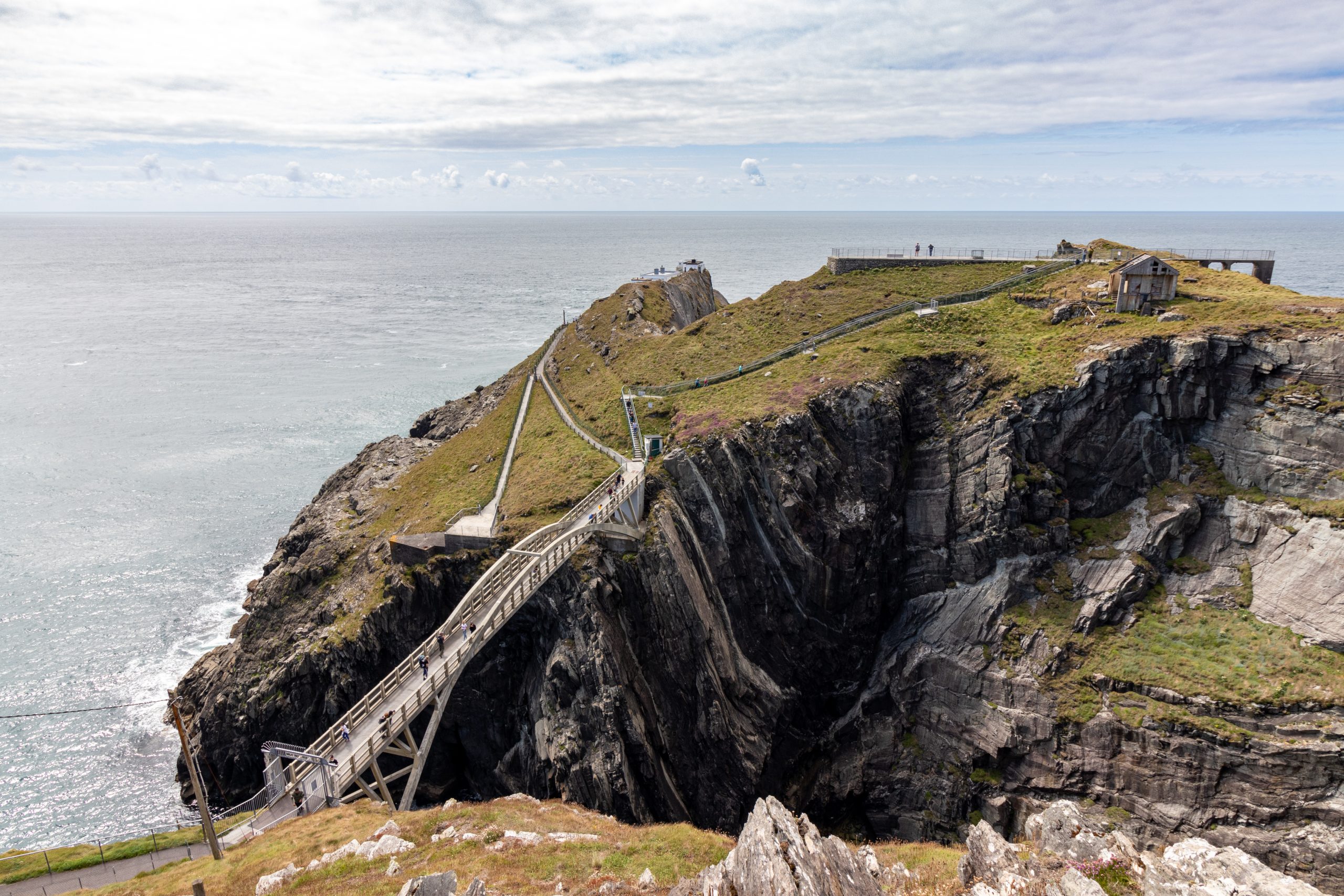
The first bridge here, a reinforced concrete arch built in 1909, gave the signal station’s keepers a safe way across the chasm. After a century of Atlantic weather it was declared unsafe, closed in 2009 and replaced by a new concrete arch that opened in 2011, spanning roughly 50 metres. It doesn’t look like much in photographs. In person, with Atlantic swells crashing through the gorge beneath you and the wind coming off the ocean, it feels considerably more significant.
The visitor centre is run by the community-based Mizen Tourism Co-operative and includes exhibits on the keepers’ life and the treacherous shipping lanes the station once served. Adult admission is currently listed at €7.50; check mizenhead.ie for current prices and opening hours, which are limited in winter. Allow time for the walk from the car park down to the bridge and out to the signal station, which involves steps and can be exposed in wind. Go early in the morning or off-season to avoid crowds.
Ardnacrusha: The Dam That Powered a Nation
In 1929, the Irish Free State — just seven years old and with very limited resources — completed one of the most ambitious civil engineering projects in Europe at the time. The Ardnacrusha hydroelectric scheme on the River Shannon, officially opened in July 1929, was designed to bring electricity to the whole country.
At the time of its completion, it was reportedly the largest hydroelectric station in the world, a title soon overtaken by the Hoover Dam. The scheme diverted most of the Shannon’s flow into a purpose-built headrace canal roughly 13 kilometres long, delivering water to a powerhouse just north of Limerick city, where a fall of around 34 metres drives the turbines. Within a few years it was supplying around 80% of Ireland’s electricity.
The scheme was built by the German firm Siemens-Schuckert and employed over 5,000 workers at its peak — roughly 4,000 of them Irish, many with no prior experience in heavy civil engineering. Conditions were gruelling. The scheme was estimated at about £5.2 million, roughly a fifth of the state’s annual budget, and finished within about 3 per cent of that figure, which for a state this young was remarkable.
Ardnacrusha is still operational today, managed by the ESB. Its contribution to the national grid is now only a few per cent of total output, but it has been generating electricity for nearly a century. You can see the area from public roads near Ardnacrusha village, a few kilometres north of Limerick city. Check the ESB’s Ardnacrusha page before you go, as access to the working station itself may be restricted.
Carrick-a-Rede Rope Bridge, County Antrim
Carrick-a-Rede is not a record-breaker. At roughly 30 metres above the rocks below and 20 metres in span, it is, by the standards of suspension engineering, a fairly modest structure. What makes it impressive is the reason it exists and the landscape it sits in.
The bridge was first strung by salmon fishermen in 1755 to give access to the small island of Carrick-a-Rede, where fish traps were laid in the channel between the island and the mainland. For two and a half centuries, fishermen crossed a rope bridge here each season, often with equipment and catch. The salmon fishing eventually ended, but the bridge stayed.
The National Trust now manages the site and maintains a permanent modern bridge in roughly the same location. Crossing it is not technically difficult, but the movement underfoot and the view down into the Antrim coastline channels have a way of convincing your legs otherwise. Admission is by timed ticket and pre-booking online is essential; the National Trust closes online sales an hour before each slot, and summer slots sell out. It is in Northern Ireland, so prices are in pounds sterling. The coastal walk from the car park to the bridge is about 1 km each way, and the Giant’s Causeway is a short drive along the coast.
Like reading about Ireland’s hidden history and lesser-known places? Join our newsletter — we send a new edition every weekday.
Dublin’s Bridges: Ha’penny to Samuel Beckett
Dublin has more than 20 bridges crossing the Liffey within the city, and together they form a rough timeline of two centuries of engineering and design.
The Ha’penny Bridge, opened in 1816, was the first dedicated pedestrian bridge over the Liffey and the first iron bridge in Ireland. Its formal name is the Liffey Bridge, but it picked up the popular name from the toll — a half-penny — that pedestrians once paid to cross. The bridge was cast by the Coalbrookdale Company in Shropshire, England and shipped to Dublin in sections. It spans 43 metres and carries thousands of people a day. The toll was finally dropped in 1919, and much of the ironwork is original, though the bridge was restored in the early 2000s. It is worth stopping on it and thinking about the fact that this structure was engineered before photography, before the railway age, and before modern steel.
At the other end of the historical spectrum is the Samuel Beckett Bridge, opened in 2009 and designed by Spanish architect Santiago Calatrava. The cable-stayed bridge is shaped to suggest a harp lying on its side — a deliberate nod to the instrument on the Irish coat of arms. It swings on a pivot to allow tall vessels through, rotating through 90 degrees to open the river to tall-masted vessels, though it is swung only occasionally. The engineering is elegant, and it is a serious piece of infrastructure, not just decoration.
Between these two you have the O’Connell Bridge (rebuilt in 1880, and unusually almost as wide as it is long), the Rosie Hackett Bridge (2014), and the Calatrava-designed James Joyce Bridge (2003). Walking the north-south Liffey bank routes and crossing each bridge in sequence is a free afternoon in Dublin worth taking. For more to fit around it, see our guide to the best things to do in Dublin.
The Boyne Viaduct, County Louth
The Boyne Viaduct near Drogheda is not well known to tourists, but it is one of the more striking pieces of Victorian ironwork in Ireland. Built between 1853 and 1855 for the Dublin-Belfast railway line, the viaduct carries the line across the River Boyne on three iron lattice-girder spans, approached by twelve stone arches on the south side and three on the north.
The whole structure is roughly 540 metres long and stands 30 metres above the river. It was designed by the Irish civil engineer Sir John Macneill, and building an iron viaduct of this scale over a tidal river demanded precision in both the metalwork and the foundations.
The three river spans were replaced in 1932 with new steel trusses, built inside the original structure before the old ironwork was removed, but the stone arches and overall proportions remain from 1855. Trains on the Dublin-Belfast Enterprise service still cross it daily. It is easy to spot from around Drogheda, and our guides to the best walking trails along the Boyne Valley and the best things to do in County Louth will help you plan a longer visit.
The Grand and Royal Canals
Ireland’s canal network does not get discussed as engineering heritage in the way it probably should. The Grand Canal, which reached the River Shannon at Shannon Harbour in 1804 after roughly 48 years of construction, runs about 130 km from Dublin to the Shannon. The Royal Canal, its northern counterpart, is about 145 km long and reached the Shannon in 1817, after 27 years of work.
Both were built by hand — pick, shovel, and wheelbarrow — across bog, farmland, and varying ground conditions. The system of locks that allows boats to ascend and descend changes in elevation is a straightforward mechanical solution to a real problem, but the scale of what was built with the tools of the time is striking when you stand at a flight of locks and watch the water transfer.
Both canals now function as greenways, with towpaths open to walkers and cyclists. The Grand Canal towpath from Dublin towards Tullamore is popular with walkers and cyclists and passes through very quiet, flat midlands countryside. For more along the way, see our guides to County Offaly and County Westmeath.
What to Do With This List
These are not the kinds of sites that fill the front pages of Ireland travel guides. They require a bit more effort than pulling into a car park at a viewpoint. But they tend to be less crowded, and the context they provide — about what Ireland was doing, who built it, and why — adds a dimension to a visit that scenic landscapes alone can’t give you.
If you are planning a trip and want to factor in engineering landmarks, a few practical notes:
- Mizen Head requires about a half-day from Cork city. Combine with the drive along the R591 through Schull and Goleen, and see our list of the best coastal drives in Ireland for more routes.
- Ardnacrusha is a short drive north of Limerick city, so it fits easily into a Limerick stop. The canal and the outside of the powerhouse can be seen from public roads and are free to look at.
- Carrick-a-Rede must be booked in advance, ideally days ahead in summer, through the National Trust website.
- Dublin bridges require no planning at all — just walk the quays.
- Boyne Viaduct is best seen from Drogheda town, which is easily accessed by train from Dublin Connolly in roughly 30 to 50 minutes, depending on the service.
Ireland’s engineers — Irish, German, English, and otherwise — left behind structures that are still in use, still standing, and still worth stopping for. That is a better record than most.
We cover places like these every day in our newsletter. Subscribe here to get it delivered free to your inbox.
☘️ Join 64,000+ Ireland Lovers
Every weekday morning, get Ireland’s hidden gems, local secrets, and travel inspiration — the kind you won’t find in any guidebook.
Subscribe free — enter your email:
Already subscribed? Download your free Ireland guide (PDF)
📲 Know someone who’d love this? Share on WhatsApp →
Love more? Join 43,000 Scotland lovers → · Join 29,000 Italy lovers → · Join 7,000 France lovers →
Free forever · Unsubscribe anytime
Tours & experiences you might love


Powered by Viator. Some links are affiliate links — we may earn a small commission at no extra cost to you.
Secure Your Dream Irish Experience Before It’s Gone!
Planning a trip to Ireland? Don’t let sold-out tours or packed attractions spoil your journey. Iconic experiences like visiting the Cliffs of Moher, exploring the Rock of Cashel, or enjoying a guided walk through Ireland’s ancient past often sell out quickly—especially during peak travel seasons.

Booking in advance guarantees your place and ensures you can fully immerse yourself in the rich culture and breathtaking scenery without stress or disappointment. You’ll also free up time to explore Ireland’s hidden gems and savour those authentic moments that make your trip truly special.
Make the most of your journey—start planning today and secure those must-do experiences before they’re gone!