

The Gold Rush Nobody Talks About: How 4,000 People Descended on a Wicklow Valley in 1795
On the morning of 15 September 1795, a group of timber workers were felling trees on Lord Carysfort’s estate in County Wicklow when an uprooted root ball turned up something that stopped everyone dead. Glinting in the mud was a half-ounce piece of gold.
Within days, word had spread across the county. Within a month, more than four thousand people had descended on a remote river valley seven miles west of Arklow. There were makeshift camps, whiskey booths, improvised gold pans hammered from bowls, teams of eight working the gravel in rotating shifts with a treasurer appointed to weigh and hold the daily haul. There was a military response, a letter from the Lord Lieutenant of Ireland to the British Prime Minister, and — eventually — a nugget the size of a child’s fist that ended up melted down into a snuffbox for King George III.
Ireland had a gold rush. It lasted exactly one month before the government shut it down. And almost nobody outside County Wicklow knows it happened.
What Was in the Ground
The Gold Mines River runs from the northern slopes of Croghan Kinsella mountain down to join the Aughrim River near Woodenbridge. “Gold Mines River” is not a poetic name — it is a completely literal one, and it was already old before 1795. A local schoolmaster, sometime around 1770, had reportedly spent years quietly searching the valley at night, convinced gold was there. His neighbours considered him somewhere between eccentric and mad. He died before anyone took him seriously.
What the timber workers found in that tree root was alluvial gold — placer gold, geologists call it — the kind that grinds off an upstream source over millennia and collects in river gravels. The Wicklow gold appeared in pieces ranging from a few grams to, eventually, much larger specimens. It was not pure: analysis would later show about 6% silver content. But it was unmistakably, undeniably real.
The announcement ran in Finn’s Leinster Journal between 16 and 19 September 1795. The Freeman’s Journal followed on 29 September. By that point, the valley was already filling up.
Four Thousand People in a Month
☘️ Join 64,000+ Ireland Lovers
Every weekday morning, get Ireland’s hidden gems, local secrets, and travel inspiration — the kind you won’t find in any guidebook.
Subscribe free — enter your email:
Already subscribed? Download your free Ireland guide (PDF)
📲 Know someone who’d love this? Share on WhatsApp →
Free forever · Unsubscribe anytime
By 8 October 1795, there were 250 to 300 people actively working the gravel. Three days later — 11 October — the count had passed four thousand. Men, women, and children arrived with whatever they could improvise as a gold pan. Women reworked the tailings that the teams had already passed through. Teams of up to eight people operated as loose companies, appointing a treasurer to manage whatever they pulled from the riverbed each day.
There were booths selling whiskey. There were arguments, and what one contemporary report called “a spirit of animosity” beginning to appear between rival groups. The atmosphere was, in other words, exactly what you would expect when thousands of people converge on a small patch of ground that might make them rich.
Those four weeks, between discovery and government takeover, produced an estimated 2,666 ounces of gold that was collected and sold — generating around £10,000 in Irish currency. That is the documented figure from the unregulated period alone. For a remote mountain valley in 1795, the scale of the operation was extraordinary.
The gold that came up was not in uniform flakes. Some pieces weighed two or three ounces. Some weighed five. And then, in 1796, someone pulled a single nugget from a Wicklow stream that weighed 682 grams — the largest piece of gold ever found in Ireland or Britain.
The Government Notices
On 11 October, as the crowd on the Gold Mines River passed four thousand, a colonel named John Francis Craddock arrived to assess the situation. He filed his report to Dublin Castle promptly: the scene on the ground, he wrote, was only a small step from open revolt.
The Lord Lieutenant of Ireland at the time was Lord Camden — John Pratt, who held the post from 1795 to 1798. His letter to Prime Minister the Duke of Portland on 8 October 1795 is a remarkable document, partly for how precise it is about the quantities being recovered (“many lumps weighing several ounces”), and partly for the anxiety running underneath the official language. The whiskey booths. The animosity between groups. The speed of it.
Camden moved. On 15 October 1795 — exactly one month after the initial discovery — the government deployed a force of approximately 68 soldiers to take control of the Gold Mines River site. The Collector of the King’s Revenues for the District of Wicklow assumed formal charge of the mine. The free-for-all was over.
The timing matters. This was not simply a property dispute or a revenue concern. Ireland in 1795 was three years away from rebellion, and the British administration was watching every large, uncontrolled gathering with the particular wariness of a government that knows the ground is unstable. A crowd of four thousand people in an armed, hungry, colonial context was not just a mining problem.
The Scientists Move In
The government did not simply post soldiers and walk away. It commissioned proper scientific investigation and appointed directors to run formal operations. The team included Abraham Mills and Thomas Weaver — both geologists, both serious, both eventually publishing in the Philosophical Transactions of the Royal Society.
Mills’s paper, “A Mineralogical Account of the Native Gold Lately Discovered in Ireland,” appeared in Volume 86 of the Philosophical Transactions in 1796. Weaver, who lived until 1855, would return to the question years later with a memoir on the geological relations of the east of Ireland, specifically examining the gold deposits.
What they were trying to find — and never did — was the source. The mother lode. The primary deposit from which the alluvial gold in the river had originally eroded. Every piece they recovered was secondary: fragments broken from something upstream by millennia of weather, carried down by water, deposited in the gravels. The original vein, if it still existed, was never located.
The formal government streaming operations began on 12 August 1796. The Act of Parliament legalising the works received Royal Assent on 24 April 1797. The operation employed miners, geologists, and a small standing military force that remained on site through at least 1805.
The Nugget and the Snuffbox
In early 1796, that 682-gram (22-ounce) nugget — the largest piece of gold ever found in Ireland or Britain — was purchased for £18 12s by two men, Abraham Coates and Turner Camac, who donated it to King George III.
He had it melted down to make a snuffbox.
Casts of the nugget survive today, held by the Natural History Museum in London, the National Museum of Ireland, and the Geological Survey of Ireland. The original is gone, dissolved into an object for storing tobacco.
This was not unusual for the period — presenting remarkable natural specimens to the monarch was a standard form of political theatre, and monarchs were not always sentimental about what happened to the gifts afterward. But it is a sharp illustration of how the economics of the Wicklow gold rush actually worked. The people who found the gold, who waded the river gravel in autumn in County Wicklow, did not keep much of what they found. The Crown took control of the operation. A significant portion of the most valuable specimens went to London.
1798
In May 1798, the government’s formal mining operations at the Gold Mines River came to an abrupt halt. The workers walked off the site to join the United Irish Rebellion.
The rising of 1798 swept through Wicklow with particular intensity. The county was central to the rebel campaign, with figures like Joseph Holt operating in exactly the terrain where the gold had been found three years earlier. The men working the government’s gold mine made their choice, and it was not to keep sieving gravel for the Crown.
The mining resumed briefly in 1801 and 1802 but was soon found unproductive and abandoned. The great surge of gold had already been taken. What remained was marginal.
The Long Reckoning
Across the full period from 1795 through to around 1830, historical estimates suggest somewhere between 7,000 and 9,000 troy ounces — roughly 200 to 280 kilograms — of gold was extracted from the Gold Mines River and its surrounding area. The total value recovered across all workings reached approximately £30,000, spread over decades.
For a single Irish mountain river, that is a remarkable number. For a gold rush measured against those that would follow in California (1848) or Victoria (1851), it is also, clearly, a small one.
What makes it interesting is not its scale but its timing and its compression. This was 1795 — two and a half years before the Act of Union, three years before a rebellion that would kill tens of thousands, sixty-three years before the first Australian gold rush and fifty-three before California. The infrastructure for a proper mining operation barely existed. Communication was by newspaper and word of mouth. And yet within three weeks of a tree being felled, more than four thousand people had organised themselves into a functioning, if chaotic, gold-mining community in a County Wicklow valley.
Academic attention has been limited but serious. Timothy Alborn’s 2011 paper in the Journal of British Studies — “An Irish El Dorado: Recovering Gold in County Wicklow” — traces how the Wicklow gold left a lasting cultural and political imprint, and how successive generations tried to make the discovery mean different things: economic promise, national identity, Crown revenue, geological curiosity.
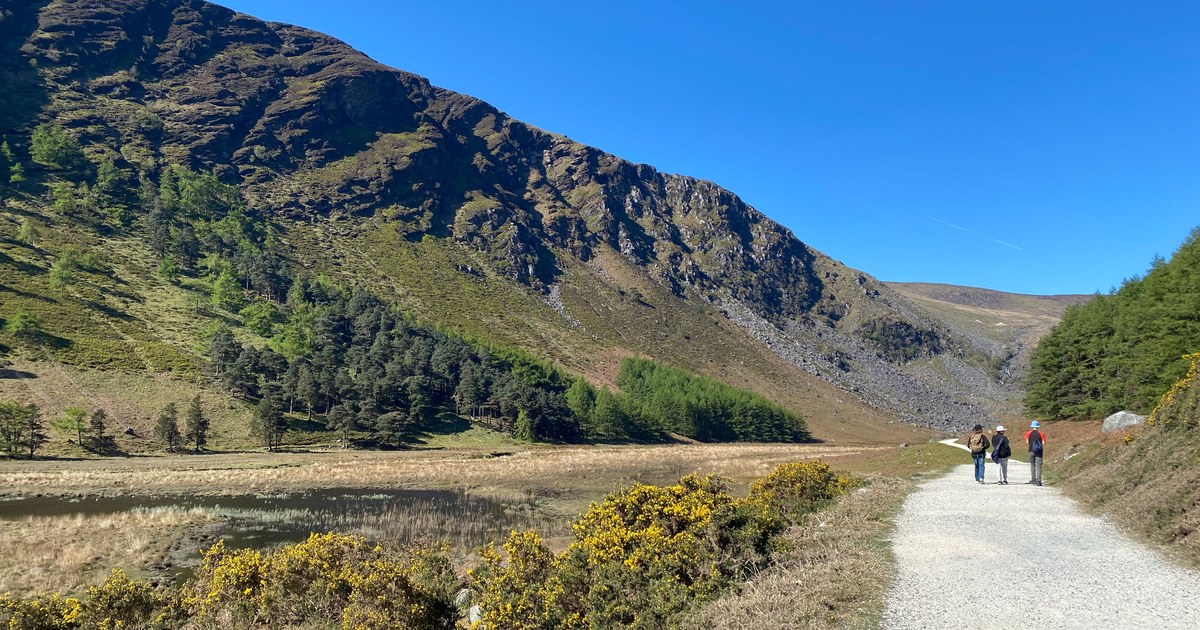
The valley today is quiet. The Gold Mines River still runs down from Croghan Kinsella toward Woodenbridge, through terrain that looks much as it would have in October 1795 when four thousand people were working its banks and Lord Camden was writing anxious letters to London. You can walk the area. Occasional hobbyist prospectors still pan for colour in the gravel — and still, occasionally, find it.
The mother lode has never been found. The snuffbox is gone. The cast of the great nugget sits in London. And somewhere upstream of Arklow, according to every geologist who has ever studied the question, there is still a primary gold deposit waiting to be located — the source of everything, eroding imperceptibly into the river, year by year, the way it has been doing since long before anyone thought to look.
We think about Irish gold and the Bronze Age hoards in Dublin’s National Museum come to mind — those extraordinary torcs and lunulae made by hands four thousand years ago. The Wicklow rush of 1795 sits in a stranger category: too recent to feel mythological, too obscure to feel like history, too real to dismiss. It happened fast, ended faster, and left behind a cast of a nugget in London and a valley that still has gold in it. Some stories don’t resolve. They just keep running downhill.
Love Ireland? Get weekly stories in your inbox.
Join 169,000+ readers who get the best of Ireland every week — travel tips, hidden gems, and local stories.
Tours & experiences you might love


Powered by Viator. Some links are affiliate links — we may earn a small commission at no extra cost to you.
Secure Your Dream Irish Experience Before It’s Gone!
Planning a trip to Ireland? Don’t let sold-out tours or packed attractions spoil your journey. Iconic experiences like visiting the Cliffs of Moher, exploring the Rock of Cashel, or enjoying a guided walk through Ireland’s ancient past often sell out quickly—especially during peak travel seasons.

Booking in advance guarantees your place and ensures you can fully immerse yourself in the rich culture and breathtaking scenery without stress or disappointment. You’ll also free up time to explore Ireland’s hidden gems and savour those authentic moments that make your trip truly special.
Make the most of your journey—start planning today and secure those must-do experiences before they’re gone!