THE LOVE IRELAND GUIDE № 001

There is a loaf that sits at the centre of nearly every Irish kitchen, and most people who eat it have no idea why it exists at all. No yeast, no proving, no kneading for an hour by the window — just flour, buttermilk, a pinch of bicarbonate of soda, and a cross cut into the top before it goes in. This is Guide № 001 in a new series: one subject at a time, covered properly — history, chemistry, regional variation, real recipes, common mistakes and how to fix them, and everything else worth knowing, gathered into a single reference worth keeping.
In this guide
- Where soda bread actually came from
- The chemistry that makes it rise
- Why every loaf has a cross cut into it
- How it was traditionally baked
- Regional variations, explained properly
- The recipes: classic white and brown wheaten soda bread
- What went wrong — troubleshooting the six most common problems
- How to store and serve it
- A short glossary
- What people get wrong about it
- Where it fits in Irish life today
- Frequently asked questions
Get the collectible PDF edition
The Love Ireland Guide № 001 — history, recipes, troubleshooting and more, laid out as a keepable booklet.
Where soda bread actually came from
Soda bread is younger than most people assume. Bicarbonate of soda only became available in Ireland in the 1830s, and the earliest known published recipe appeared in 1836, in a Newry newspaper — a simple mix of wheaten meal, salt, bread soda and soured buttermilk. Before that, rural households baked flatter, denser breads without any raising agent at all, because yeast was expensive, unreliable to keep, and needed a warm, steady kitchen most cottages simply didn’t have. For a closer look at exactly what changed and why, see our deep dive on why Ireland started baking soda bread in the 1840s.
Bread soda changed that overnight. It was cheap, it kept, and it worked with the soft, low-gluten wheat that Irish soil actually produced — flour that made poor yeast bread but excellent soda bread. Combined with buttermilk, a by-product of butter-making that every farmhouse already had in surplus, it meant a family could have fresh bread on the table within the hour, with no starter, no proving, and no waiting. The timing mattered enormously: soda bread became a kitchen staple in the years immediately before the Great Famine, and its cheapness and simplicity helped it become a genuine survival food through the years that followed.
The chemistry that makes it rise
There’s no mystery ingredient at work here, just a straightforward chemical reaction. Buttermilk is naturally acidic; bicarbonate of soda is alkaline. When the two meet in the bowl, they react instantly, releasing tiny bubbles of carbon dioxide through the dough. That gas is the entire rise — there’s no yeast fermenting slowly overnight, which is exactly why soda bread goes from mixing bowl to table in under an hour, and exactly why it doesn’t keep as long as a yeasted loaf. It’s built to be eaten the day it’s baked, which is also why so many Irish households still bake it two or three times a week rather than buying a loaf that will last.
This is also why the reaction can’t be rushed or reused: once the soda and buttermilk meet, the clock starts. A batter left sitting too long before baking loses its rise before it ever sees the oven — one of the reasons soda bread is normally shaped and baked within minutes of mixing.
Why every loaf has a cross cut into it
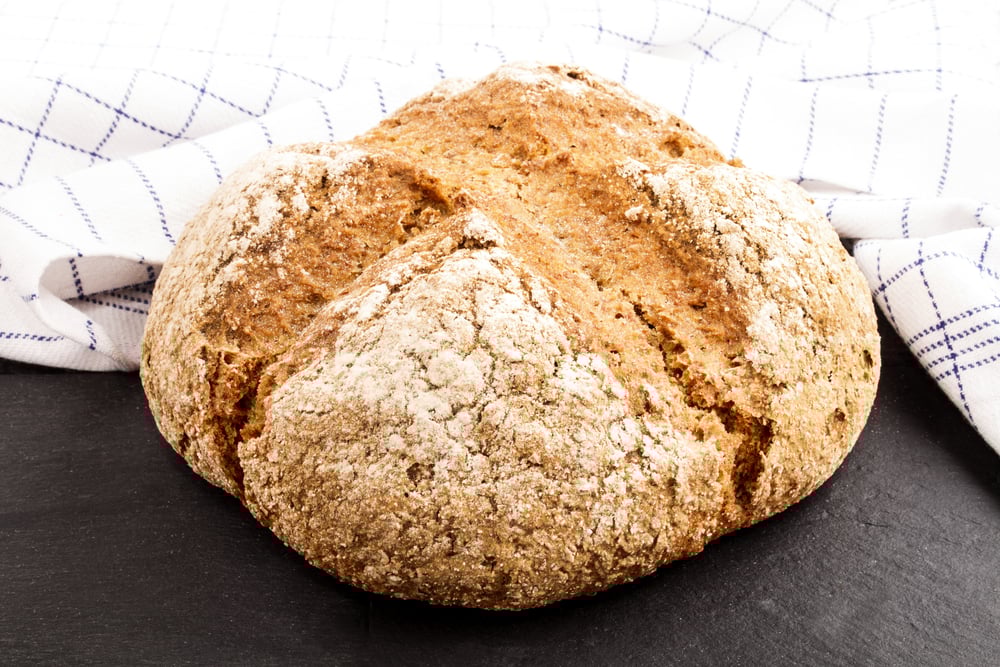
Cut a cross deep into the top of a round loaf before it bakes, and you’re following a tradition with two answers, not one. The practical answer is that soda bread, unbaked, is a dense, compact dome — cutting it open lets the heat reach the centre so it cooks through evenly instead of staying raw in the middle. The older, more human answer is that the cross was cut to “let the fairies out” of the bread, or to bless the loaf and the house it fed. Both explanations are true at once, and neither one cancels the other out — that’s fairly typical of Irish kitchen tradition generally.
How it was traditionally baked
Most rural Irish homes had an open hearth long before they had an oven, so soda bread was baked in a bastible — a heavy, flat-bottomed cast-iron pot with a tight, slightly domed lid. The bastible sat directly on the coals, and more hot coals were piled onto the lid itself, so the loaf baked from above and below at once, much like a small oven built entirely from embers. Some of that method survives today in the cast-iron pot ovens still used at open hearths in a handful of heritage cottages and living-history sites around the country.
Regional variations, explained properly
White soda bread
The loaf most people picture: plain white flour, a light crumb, a floury crust, most associated with the south and west of the country. This is the version usually meant when someone simply says “soda bread” with no qualifier.
Brown or wheaten bread
Made with wholemeal flour instead of white, denser, nuttier, and slightly sweeter. Wheaten bread is especially associated with the north of Ireland, and is the loaf most often served alongside seafood or a hearty soup.
Treacle bread
A brown loaf darkened and sweetened with black treacle, popular in Ulster in particular. It’s noticeably sweeter and denser than plain wheaten bread, closer to a dessert bread.
Spotted dog
Soda bread studded with raisins or sultanas, sometimes with a little caraway seed, traditionally baked for a Sunday or a special occasion rather than an everyday loaf.
Soda farls
Flattened, quartered dough cooked on a hot griddle rather than baked in a pot or oven — a fixture of the Ulster fry, and the version most associated with Northern Ireland specifically. The griddle-versus-oven split broadly follows the line you’d expect: the north favours the griddle, the rest of the island bakes it as a round loaf. Neither is more “authentic” than the other — they’re simply two different kitchen traditions solving the same problem.
The recipes
Two versions, made the traditional way. Both use the same basic method — mix, shape, cross, bake — and both come together in under ten minutes of hands-on work.
Classic white soda bread
You will need:
- 450g plain flour, plus extra for dusting
- 1 level teaspoon bicarbonate of soda
- 1 level teaspoon fine salt
- Approximately 350ml buttermilk (you may not need all of it)
Method:
- Heat the oven to 200°C (fan 180°C) and dust a baking tray with flour.
- Sift the flour, bicarbonate of soda and salt into a large bowl, and make a well in the centre.
- Pour in most of the buttermilk and mix quickly with one hand, fingers spread like a claw, drawing the flour in from the sides. Add the remaining buttermilk only if the dough still looks dry — you’re aiming for a soft, slightly sticky dough, not a firm one.
- Turn the dough onto a floured surface. Do not knead it — a few light turns is all it needs. Overworking it toughens the loaf.
- Shape into a round about 4cm deep, place it on the tray, and cut a deep cross most of the way through the loaf with a sharp knife.
- Bake for 30–35 minutes, until the crust is golden brown and the loaf sounds hollow when tapped on the base.
- Cool on a wire rack under a clean tea towel for at least 10 minutes before slicing — cutting it too soon makes it seem gummy even when it’s fully baked.
Brown wheaten soda bread
You will need:
- 350g wholemeal flour
- 100g plain flour
- 1 level teaspoon bicarbonate of soda
- 1 level teaspoon fine salt
- 1 teaspoon sugar (optional, softens the flavour slightly)
- Approximately 400ml buttermilk — wholemeal flour is thirstier than white, so expect to use more
Method: Follow exactly the same steps as the white loaf above. Because wholemeal dough is heavier, the finished loaf will be denser and won’t rise quite as high — that’s expected, not a fault. Bake for the same 30–35 minutes and check doneness the same way, by the hollow sound on the base.
What went wrong — troubleshooting
- The loaf didn’t rise and turned out flat and dense. Almost always old bicarbonate of soda — it loses potency over time — or buttermilk that wasn’t acidic enough to react with it properly. Use fresh soda and proper buttermilk, not milk with a squeeze of lemon as a substitute if you can help it.
- The crust is rock-hard. Usually means the oven ran too hot or the loaf baked too long. Covering the loaf loosely with foil for the last ten minutes softens the crust if this keeps happening.
- The centre is gummy or seems undercooked. Two likely causes: the loaf was sliced before it finished cooling (soda bread keeps cooking slightly as it rests), or the dough was overworked, which develops gluten and makes it dense and wet-feeling in the middle.
- It has a strange, slightly soapy or metallic aftertaste. Too much bicarbonate of soda relative to buttermilk, or the soda wasn’t mixed evenly through the flour. Measure levelly, not heaped, and sift thoroughly.
- The loaf spread out flat instead of holding its shape. The dough was too wet, or was left to sit too long before going into the oven — remember, the rise starts the moment the buttermilk meets the soda.
- The bottom is soggy. The loaf usually needs longer in the oven, or a hotter tray — preheating the baking tray itself before the dough goes on can help the base crisp properly.
How to store and serve it
Soda bread is at its absolute best within a few hours of coming out of the oven, split while still warm and spread with real butter. It doesn’t keep the way a yeasted loaf does — without any preservatives or long fermentation, it starts to dry out within a day or two. Wrapped in a clean tea towel and kept in a bread bin, it’s good for about two days; after that, it’s better toasted than eaten fresh. It also freezes well, whole or sliced, for up to three months — thaw at room temperature or toast slices directly from frozen.
A short glossary
- Bastible — a cast-iron pot with a tight, domed lid, traditionally set directly on hearth coals with more coals piled on the lid, used to bake bread before ovens were common.
- Buttermilk — the tangy, slightly acidic liquid left over from churning butter, or its cultured supermarket equivalent; the acid it provides is essential to the bread’s rise.
- Farl — a flattened, usually quartered piece of dough cooked on a griddle rather than baked, as in “soda farl.”
- Wheaten bread — the standard Irish term for brown soda bread made with wholemeal flour.
- Bread soda — the everyday Irish term for bicarbonate of soda, the raising agent at the heart of the whole tradition.
What people get wrong about it
The most common misconception is that soda bread is an ancient recipe stretching back centuries — it isn’t. It’s a product of the 1830s and 40s, arriving just before the Great Famine and becoming a survival staple partly because it required so little in the way of equipment or expensive ingredients. Another common mix-up: soda bread and brown bread aren’t strictly interchangeable terms — brown bread specifically means the wholemeal version, while “soda bread” on its own most often refers to the white loaf.
Where it fits in Irish life today
Soda bread is still baked fresh in Irish homes every week, not preserved as a museum piece — that’s really what separates it from a lot of “heritage” food. It sits alongside butter and jam at breakfast, next to a bowl of stew at dinner, and torn straight from the loaf beside a pot of tea. In our own 2026 Best Irish Food poll, readers voted soda bread and butter the outright winner — not a runner-up in a “traditional foods” category, but the single most-loved thing on the list.
It shows up constantly alongside the rest of the Irish table too — mopping up a bowl of Irish stew, buttered thick for a full Irish breakfast, spread with Irish butter that gets its own reputation for a reason, and eaten alongside a cup of tea made the way Irish tea always seems to taste different everywhere else.
*Was this forwarded to you? Subscribe free and never miss the next Love Ireland Guide → loveireland.substack.com*
Frequently asked questions
Why does Irish soda bread not use yeast?
Because it doesn’t need it. The reaction between buttermilk’s natural acidity and bicarbonate of soda produces enough carbon dioxide to raise the loaf on its own, which is what let 19th-century Irish households bake fresh bread without yeast, a warm proving spot, or hours of waiting.
What is the cross on top of Irish soda bread for?
Both a practical and a folk answer are true at once: the cut lets the dense loaf cook through evenly, while tradition also holds it “lets the fairies out” or blesses the bread and the house.
How old is Irish soda bread, really?
It dates to the 1830s at the earliest — the first known published recipe appeared in 1836 — making it a 19th-century development rather than an ancient one.
Can I substitute regular milk for buttermilk?
Not really successfully — the acidity is what makes the whole reaction work. If buttermilk genuinely isn’t available, milk soured with a spoon of lemon juice or vinegar is the standard workaround, but it won’t quite match real buttermilk’s flavour or reliability.
Why is my soda bread dense and heavy?
The two most likely causes are overworking the dough, which develops gluten it isn’t meant to have, or using bicarbonate of soda that’s lost its potency. Handle the dough as little as possible and use fresh soda.
More Love Ireland Guides
The Love Ireland Guide is a new numbered series — one tightly focused subject at a time, each with its own downloadable collectible PDF. Guide № 001 is Irish Soda Bread. Guide № 002 is next.
Sources: The Newry Telegraph (1836, earliest known published recipe); regional variation, hearth-baking method and troubleshooting guidance per established Irish culinary tradition and standard baking practice.
Secure Your Dream Irish Experience Before It’s Gone!
Planning a trip to Ireland? Don’t let sold-out tours or packed attractions spoil your journey. Iconic experiences like visiting the Cliffs of Moher, exploring the Rock of Cashel, or enjoying a guided walk through Ireland’s ancient past often sell out quickly—especially during peak travel seasons.

Booking in advance guarantees your place and ensures you can fully immerse yourself in the rich culture and breathtaking scenery without stress or disappointment. You’ll also free up time to explore Ireland’s hidden gems and savour those authentic moments that make your trip truly special.
Make the most of your journey—start planning today and secure those must-do experiences before they’re gone!