

Most beaches in Ireland come with a car park, a café, and a queue. Murder Hole Beach has none of those things. What it does have is golden sand, ice-cold Atlantic water, towering cliffs, and one of the most dramatic settings you will find on this island.
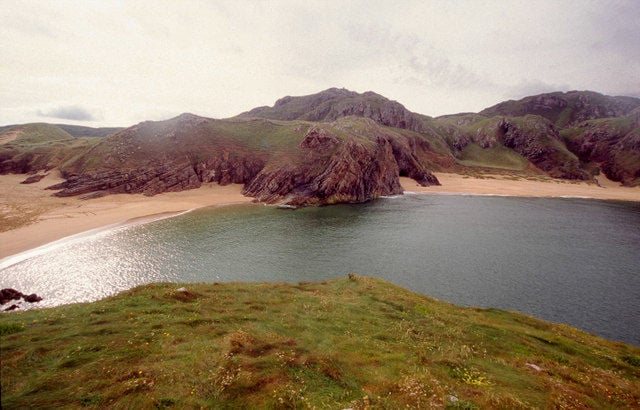
Officially known as Boyeeghter Bay, Murder Hole Beach sits on the Rosguill Peninsula in north County Donegal. It is remote, it is raw, and it takes effort to reach. That effort is absolutely worth it.
What Is Murder Hole Beach?
Boyeeghter Bay earned its more memorable nickname over the centuries. Local legend links the name to smugglers who used these isolated coves to hide contraband — and allegedly dealt with informants in more permanent ways. Another version ties the name to powerful tidal pools near the base of the cliffs, where the suck and churn of the water could pull objects (and occasionally people) under. No single account has been confirmed, but the name has stuck, and it draws curious visitors from across Ireland and beyond. A third theory points to a specific 19th-century tragedy: a young woman said to have fallen to her death from the cliffs here, giving the spot its grim name.
What greets you when you arrive bears no relation to anything sinister. The beach is a sweep of pale golden sand bordered by dark sea cliffs. The water shifts between deep blue and vivid green depending on the light and time of day. On clear days, the views north stretch across towards Malin Head, Ireland’s most northerly point. On overcast days, the mist and low cloud make the whole place feel like the edge of the world.
The beach is not large. It curves in a shallow arc, protected on both sides by rocky headlands. This natural shelter means the water can be calmer than you might expect for the Atlantic coast — but rip tides and strong undercurrents make swimming at Murder Hole Beach hazardous. Most visitors do not swim here; the beach is best experienced on foot.
How to Get There
Getting to Murder Hole Beach requires planning. There is no signpost on the main road directing you there. You will need GPS or a good map, and a willingness to follow narrow lanes that do not look like they lead anywhere useful.
From Carrigart or Downings, follow the road out onto the Rosguill Peninsula. The Atlantic Drive is signposted from here — follow it around the headland towards Melmore Head. There is an official car park at Melmore Head near the Melmore Head Caravan Park — a €5 parking fee applies. Do not park on grass verges, as this damages the land and causes problems for local farmers.
From the car park, a signed trail of approximately 15 to 20 minutes leads down to the beach. The path is uneven in places and can be slippery when wet, so proper footwear is essential. Sandals or flip-flops are not appropriate here.
There is no public transport to Murder Hole Beach. You need a car. Allow roughly 45 minutes from Letterkenny, or around four hours from Dublin via the N2 and N14.
What to Expect When You Arrive
The beach rewards visitors who arrive early or travel in the shoulder season. In summer, word has spread about this spot and you may find others already there. In spring or autumn, you may have it entirely to yourself.
The cliffs that frame the bay are dramatic and can be explored on foot along the headland. Walking above gives elevated views down onto the sand and out across the open Atlantic. Take care near the edges — there are no barriers, the ground can be wet, and the drop is serious.
The sand is clean and firm. Rockpools at the edges of the bay are worth exploring at low tide. Seabirds nest in the cliffs above, and gannets can often be spotted diving offshore. On a calm day, the water clarity here is exceptional.
There are no facilities at Murder Hole Beach. No toilets, no café, no bins. Pack out everything you bring in. Carry water and food if you plan to stay for any length of time.
The Best Time to Visit
Donegal’s weather is unpredictable in every season, but that is part of the appeal. Some of the most atmospheric days at Murder Hole Beach happen when the sky is grey and the wind is strong — the cliffs look darker, the water more intense, and the whole setting feels properly wild.
For those who do choose to enter the water — conditions must be assessed carefully given the rip tides present — July and August bring the warmest sea temperatures, typically around 14 to 15°C. Summer evenings in Donegal are long — light in the sky until after 10pm — and the golden-hour light on the cliffs is worth staying for.
Spring (April to May) and autumn (September to October) are excellent for walking and photography. The crowds are smaller, the light is often stunning, and the drive around the Rosguill Peninsula is at its most dramatic. Wildflowers appear along the cliff edges in May, and autumn brings rich copper colours to the surrounding hillsides.
Winter visits are for the committed only. The access path can be treacherous in wet conditions, and Atlantic storms move in quickly. But if you time it well, you will see waves breaking against those dark cliffs in a way that is genuinely unforgettable.
What to See Nearby
The Rosguill Peninsula has more to offer than one beach. The Atlantic Drive — the circular route around the headland — is one of the best short drives in Ireland. The loop takes around 30 minutes without stops, but budget at least two hours if you want to get out and explore along the way.
Downings is a small village at the base of the peninsula with a few pubs and places to eat. It is a working fishing village with limited tourist infrastructure, which gives it an honest feel. Fresh seafood is available locally in season.
Glenveagh National Park is about 45 minutes south and is well worth a full day. The park covers over 16,000 hectares of bogland, mountains, and lakes. Glenveagh Castle sits on the shores of Lough Veagh and offers guided tours throughout summer. For more on what to see across the county, see our guide to the best things to do in Donegal.
This part of Donegal also sits within the Gaeltacht — the Irish-speaking regions where the language is used daily. Road signs are in Irish first, and you will hear the language spoken in local shops and pubs. It is a living part of Irish culture, not a museum exhibit.
Horn Head, another dramatic headland about 20 minutes from the Rosguill Peninsula, is also worth the detour. The cliffs there reach around 180 metres and on clear days the views are extraordinary.
Practical Tips Before You Go
- Drive carefully. The lanes around Rosguill are single-track in places. Use passing places and give way to oncoming traffic without hesitation.
- Check the tide. Low tide reveals more of the beach and the rockpools. High tide is still beautiful, but the accessible sand is reduced.
- Bring layers. The temperature on an exposed Donegal headland can be noticeably lower than it feels in the car. Wind chill is significant.
- Leave no trace. This beach is in excellent condition because people treat it with respect. Keep it that way and carry out all rubbish.
- Download offline maps. Mobile coverage in parts of Donegal is patchy. Do not rely on live navigation once you are off the main roads.
- Respect the surrounding land. The fields and headland are privately owned or managed. Stick to the established path and close any gates behind you.
- Wear proper footwear. The path down to the beach is uneven. Walking shoes or boots are strongly recommended, especially in wet weather.
Why It Is Worth the Effort
There are easier beaches to reach in Ireland. Beaches with car parks right beside them, ice cream vans, and lifeguards on duty through the summer. There is nothing wrong with any of that.
But Murder Hole Beach offers something different. It is the experience of arriving somewhere that feels genuinely untouched — where the journey is part of the point, and where you can stand on golden sand with dark Atlantic cliffs rising on either side and feel the full force of the Irish coast without distraction.
Donegal has long been known among those who travel seriously in Ireland as the county where the landscape is at its most uncompromising. Murder Hole Beach is proof of that reputation. It asks a little more of you than most places. What it gives back is worth every bit of it.
Thinking about it for retirement?
If you’ve started thinking seriously about retiring there, our complete our full Retire in Ireland guide covers the visa, healthcare, cost-of-living, and the regions worth shortlisting.
Tours & experiences you might love


Powered by Viator. Some links are affiliate links — we may earn a small commission at no extra cost to you.
Secure Your Dream Irish Experience Before It’s Gone!
Planning a trip to Ireland? Don’t let sold-out tours or packed attractions spoil your journey. Iconic experiences like visiting the Cliffs of Moher, exploring the Rock of Cashel, or enjoying a guided walk through Ireland’s ancient past often sell out quickly—especially during peak travel seasons.

Booking in advance guarantees your place and ensures you can fully immerse yourself in the rich culture and breathtaking scenery without stress or disappointment. You’ll also free up time to explore Ireland’s hidden gems and savour those authentic moments that make your trip truly special.
Make the most of your journey—start planning today and secure those must-do experiences before they’re gone!
Subscribe Free