

At the Ould Lammas Fair in Ballycastle every August, one of the most popular items doesn’t come in a box or a bottle. It comes in a brown paper bag, and it smells faintly of the sea. Dulse — dried red seaweed from the Antrim coast — has been filling those bags, and Irish mouths, for over a thousand years.
What Dulse Actually Is
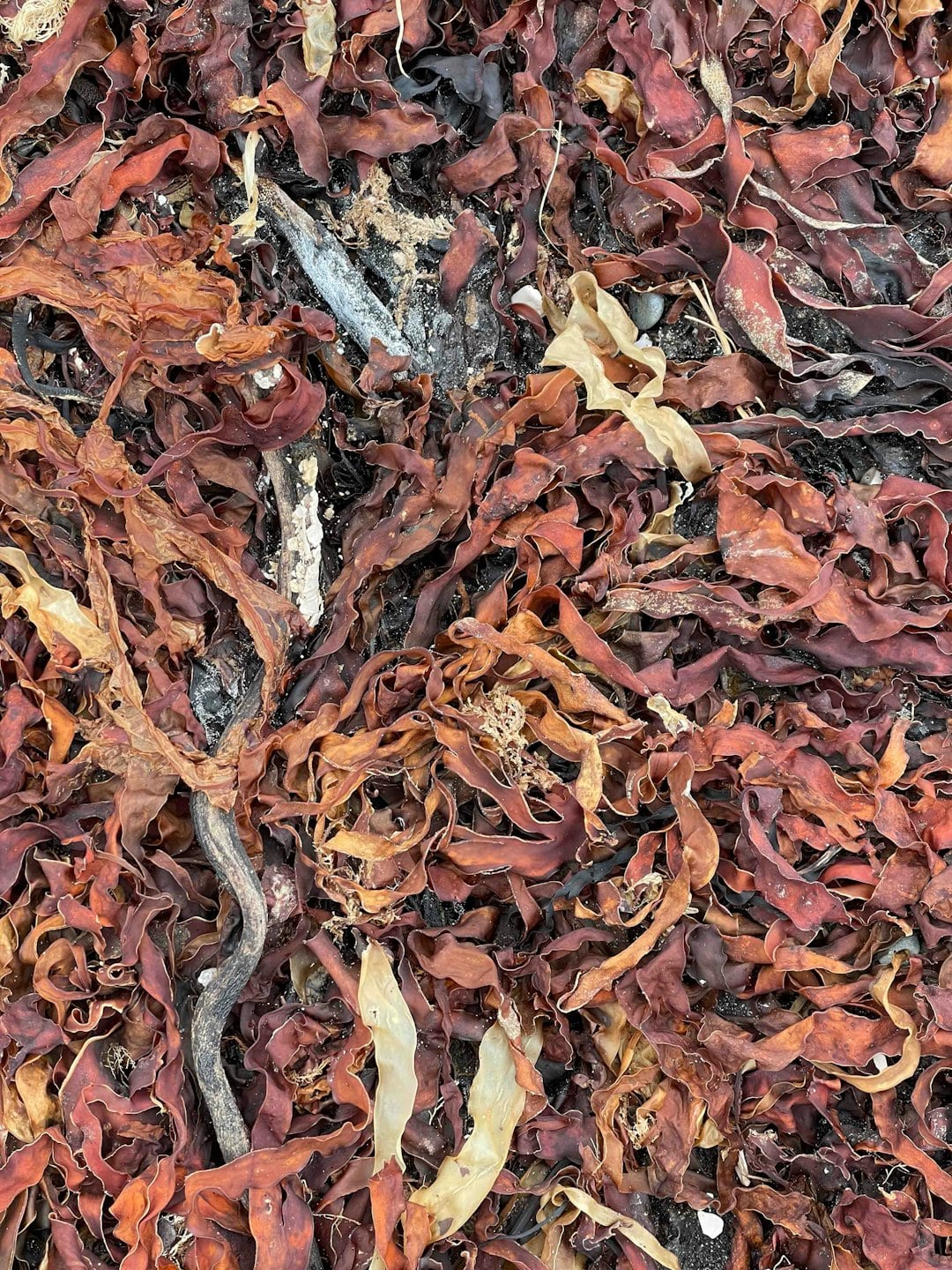
Dulse is a flat, purple-red seaweed that clings to rocks along the Atlantic shore. It grows from Donegal and Antrim in the north to Clare and Connemara in the west, and it has done so for as long as people have lived on these coasts.
When dried, it turns a deep wine-red and becomes leathery and chewy. The taste is salty and briny with a rich umami depth. For those who grew up near the sea, it’s as familiar as bread.
In Irish, it’s called duileasc, often anglicised as dillisk in Connacht and Galway. Both names refer to the same thing: food from the rocks.
A Thousand Years on Irish Shores
Dulse appears in Irish texts as far back as the 7th century, listed alongside other foods in ancient Brehon Law records. Monks in coastal monasteries gathered it at low tide as a source of nourishment when meat was scarce.
Medieval Irish writers treated dulse as a staple, not a delicacy. It was common food for fishermen, farmers, and anyone who lived within reach of the tide. During hard years, coastal communities turned to the shore for what they could not grow on land.
Dulse even features in old Irish traditions as a symbol of something freely given by the shore. For coastal families in Donegal, Antrim, and Connemara, gathering it was not considered work the way farming was. It was simply what you did when the tide went out.
From the Rocks to the Table
☘️ Love Irish Food & Culture?
Every Wednesday, we send our best Irish recipes, food stories, and kitchen traditions straight to your inbox. Join 64,000+ readers who love Ireland.
Harvesting dulse was simple, low-tide work. Gatherers would wade among the rocks, pulling handfuls of wet weed from the stone. It was then laid out to dry in the sun — on flat rocks, on stone walls, on stretches of clean gravel near the shore.
Once dried, it was eaten as it was, added to soups and stews, or fried in a dry pan until it crisped up like a salty snack. Some families folded it into bread dough. Others chewed it raw, as something to keep a person going through a long working day.
Women sold it at coastal markets and at the edges of country fairs — a handful wrapped in paper, exchanged for a small coin. The transaction was brief. It happened the same way, in the same places, for generations.
☘️ Enjoying this? 64,000+ Ireland lovers get stories like this every week. Subscribe free →
The Fair That Kept Dulse Famous
If one place is synonymous with dulse, it’s Ballycastle in County Antrim. The Ould Lammas Fair, held every August Bank Holiday, is one of Ireland’s oldest fairs — and for centuries its two most iconic products have been dulse and yellowman, a hard honeycomb toffee.
There’s a traditional song about them. “Did you treat your Mary Ann to dulse and yellowman at the Ould Lammas Fair at Ballycastle-o?” Locals still sing it. The two foods go together as well now as they ever did — one impossibly sweet, one deeply savoury.
The yellowman half of that famous pairing has its own rich story. The tale of Ireland’s ancient amber sweet is worth a read if you’re heading to the north Antrim coast.
A Sea Vegetable Having Its Moment
For much of the 20th century, dulse was associated with older generations and coastal communities. It wasn’t something you’d find in city supermarkets or on restaurant menus.
That has changed. Irish artisan food producers now dry and package dulse for a national audience. Chefs at some of Ireland’s best restaurants use it in stocks, seasoned butter, and bread. Food writers have rediscovered it as a plant-based ingredient packed with protein, iron, and minerals.
If you’ve never tried it, the taste is hard to describe in advance. It’s not fishy. It’s not slimy. Something between dried mushroom and sea salt — but that doesn’t quite capture it. The best way to try dulse is the way it’s been tried for a thousand years: straight from the bag.
If you’re planning a visit to the north coast, the planning hub has everything you need to map out the route. Ballycastle, in particular, is the best place to buy dulse straight from producers who still harvest and dry it locally.
Still Growing on the Same Rocks
There’s something quietly powerful about a food eaten by monks in the 7th century, gathered by fishermen in the 19th, and still sold in paper bags at an August fair today.
Dulse doesn’t ask to be fashionable. It doesn’t need a rebrand. It just keeps showing up — salt-crusted and chewy, from the same rocky shores it always grew on.
☘️ You Might Also Love
☘️ Join 64,000+ Ireland Lovers
Every Friday, get Ireland’s hidden gems, local secrets, and travel inspiration — the kind you won’t find in any guidebook.
Free forever · · Unsubscribe anytime
☘️ Get More Irish Recipes & Stories
Join 64,000+ readers for weekly Irish recipes, food traditions, travel guides, and hidden gems. Free every morning.
Tours & experiences you might love


Powered by Viator. Some links are affiliate links — we may earn a small commission at no extra cost to you.
Secure Your Dream Irish Experience Before It’s Gone!
Planning a trip to Ireland? Don’t let sold-out tours or packed attractions spoil your journey. Iconic experiences like visiting the Cliffs of Moher, exploring the Rock of Cashel, or enjoying a guided walk through Ireland’s ancient past often sell out quickly—especially during peak travel seasons.

Booking in advance guarantees your place and ensures you can fully immerse yourself in the rich culture and breathtaking scenery without stress or disappointment. You’ll also free up time to explore Ireland’s hidden gems and savour those authentic moments that make your trip truly special.
Make the most of your journey—start planning today and secure those must-do experiences before they’re gone!