

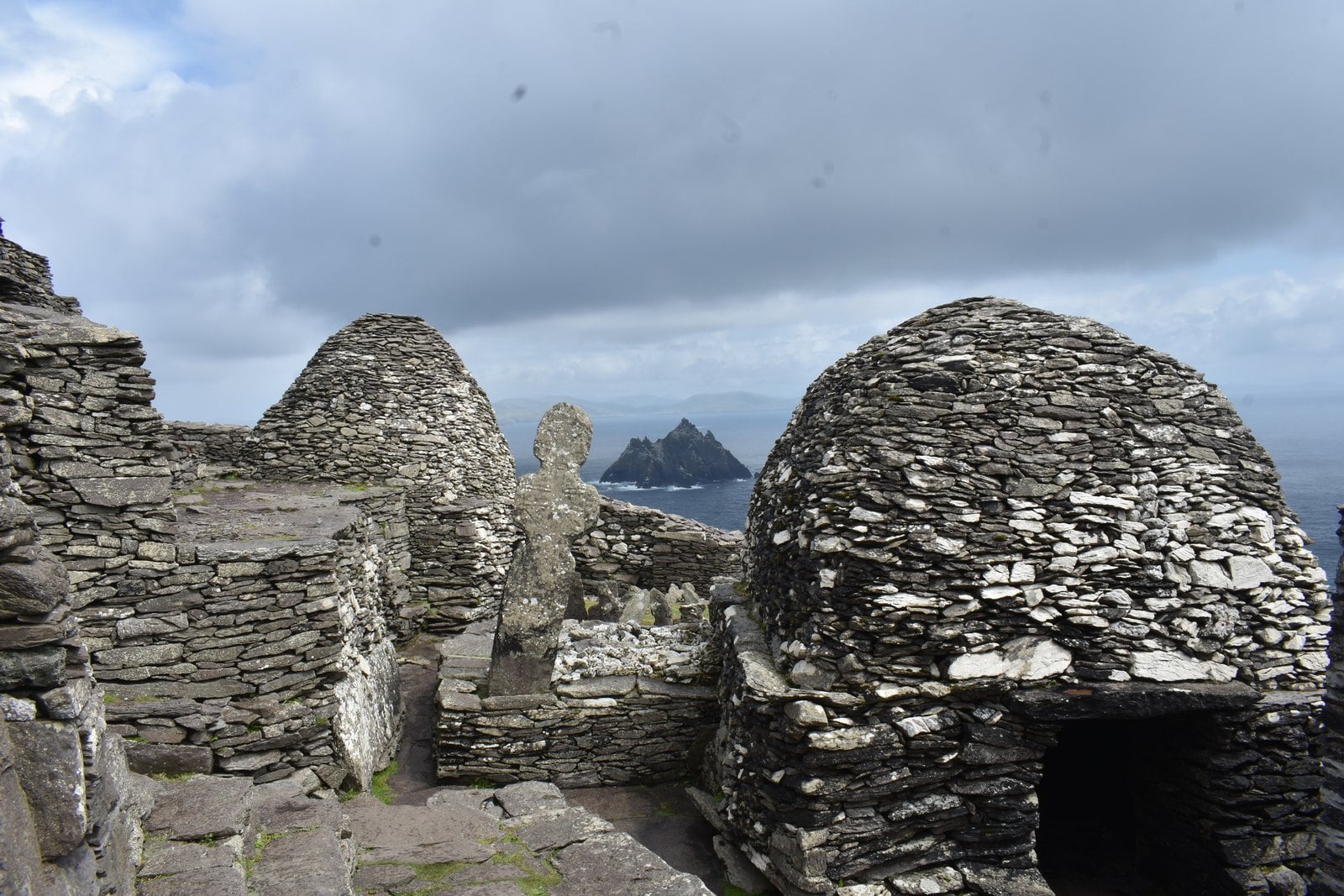
There is a jagged pyramidal rock rising 218 metres out of the North Atlantic, about 11 kilometres off the Kerry coast, and on it — near the summit, on a series of artificially levelled terraces — sit six stone huts built somewhere between 1,200 and 1,400 years ago. They have no mortar. They have no foundations in the conventional sense. They have endured everything the Atlantic has thrown at them: centuries of salt spray, gale-force winds, and the attentions of the occasional passing archaeologist.
They are still standing.
This is Skellig Michael — Sceilg Mhichíl in Irish — and the story of who built those huts, why they chose to do it on one of the most inhospitable pieces of rock in Europe, and why the buildings have outlasted the builders by well over a millennium, turns out to be considerably stranger than the tourist brochure version.
A Place That Should Not Have People On It
Start with the geography. The rock sits 11 to 11.5 kilometres off the Iveragh Peninsula in County Kerry. It can only be reached by boat, in calm enough weather for a boat to dock — which, on the Atlantic’s western fringe, is not guaranteed. Once you land, getting to the monastery involves climbing 618 stone steps cut directly into the living rock, ascending roughly 180 vertical metres. The steps are old. Some are very narrow. There is no handrail on significant stretches. And at the top, on a ledge carved into the near-vertical face, you find the enclosure.
The island’s highest point reaches 218 metres. The monastery sits somewhat below that — the steps stop at the monastic terraces, not at the true summit — but the height and exposure are sufficient. Stand on those terraces on a clear day and the mainland looks very far away. On most days, it is obscured by weather.
The question that everyone who visits eventually asks is some version of: why would anyone choose to live here?
The answer, as best historians can reconstruct it, is that this was precisely the point.
Sometime Between the 6th and 8th Centuries
The monastery’s founding date is one of those historical facts that sounds more certain than it actually is. The traditional attribution credits Saint Fionán, a figure associated with the early Irish Church — but this attribution is doubted by historians, and there is no documentary or archaeological evidence to support it. What we actually have is blunter than that: official Irish government records of the site state plainly that “the date of the foundation of the monastery on this island is not known,” and place the founding “sometime between the sixth and eighth centuries.”
The earliest person we can name at Skellig Michael is Suibhini of Skelig, whose death is recorded in an 8th-century entry in the Irish annals. We know he existed. We know he died. We do not know much more.
What we do know is why monasteries like this one were built where they were. Early Christian monasticism in Ireland — particularly in its more ascetic strains — was deeply influenced by the Desert Fathers of Egypt and Syria, who had withdrawn from the world into the literal desert to pursue spiritual discipline. Irish monks translated that impulse to their own landscape. The desert became the ocean. The further from the world, the closer to God. Islands off the Kerry coast — remote, hard to reach, hostile to comfort — were spiritually desirable precisely because they were physically terrible places to live.
The monastery at Skellig Michael was not an accident or a compromise. It was a statement.
The Year the Vikings Came
For several centuries, the community on the rock apparently sustained itself — praying, fasting, and tending whatever small gardens the terraces could support. Then, in 823 AD, the Vikings arrived.
The Annals of Inisfallen, a medieval manuscript digitised by University College Cork, records what happened in language that has lost none of its force across twelve centuries: Scelec do orgain do gentib, & Etgal do brith i m-brait co n-erbailt gorta léo. “Skellig was plundered by the heathens, and Etgal was carried off into captivity, and he died of hunger at their hands.”
Etgal — or Eitgal — was the abbot. He was taken from his monastery on a rock in the Atlantic and starved to death by his captors. It is one of the most specific and verifiable moments in the site’s entire history, and it lands with considerable weight across twelve centuries of distance.
The Vikings came back in 838 AD, according to the Annals of the Four Masters. The community endured that raid too.
And here is the part that doesn’t fit the story most people tell about Skellig Michael: after those raids, the monks stayed. They continued occupying the island for another three and a half to four centuries. The Vikings did not end the monastery. They were a catastrophe, not a conclusion.
The Engineering Trick That Explains Everything
The monastery enclosure, as surveyed and recorded in peer-reviewed archaeological literature, contains six corbelled cells — five of which remain intact — two oratories, two cisterns, and dry-stone enclosing walls arranged across a series of carefully levelled terraces. All of it was built without mortar.
The corbelled cells — clocháns in Irish — are the structures that attract the most attention, and rightly so. They are roughly dome-shaped, beehive-like, constructed by laying flat stones in successive courses with each course projecting slightly inward over the one below, until the ring closes at the top. This is corbelling: an ancient technique that predates the true arch and requires no binding agent, provided the geometry is correct. Gravity does the work.
But corbelling alone does not explain why these particular structures have survived for over a millennium in one of the wettest, windiest marine environments in Europe. The answer to that is in the joint angle.
Each course of stone is laid with a slight outward slope — angled so that the face of the wall tilts away from the interior. This means that rainwater, rather than running down into the joints between stones and eventually penetrating inward, is directed outward and shed off the face of the wall. The effect is the same as a tiled roof: water runs away from the building, not into it. Architectural analysts of early Irish dry-stone construction have documented the outward inclination of the joint faces as being of the order of 15 degrees — a small angle, but sufficient to change everything about how the structure handles water over centuries.
Walls in the Skellig cells run up to 1.5 to 1.8 metres thick. The combination of mass, geometry, and that outward joint angle has meant that structures built without any binding material have survived conditions that would destroy most modern construction within a generation or two. No mortar required. No mortar to crack. No crack for water to exploit.
The builders of these cells did not have engineering manuals. They had centuries of accumulated craft knowledge, and they applied it to the most demanding site they could have chosen. It worked better than almost anything built in Europe in the same era.
Why the Monks Actually Left
The popular version of Skellig Michael’s end goes something like this: the Vikings became too much of a problem, and eventually the monks gave up and retreated to the mainland. This is not quite right.
What the historical record shows is more layered. The community appears to have withdrawn to the mainland by the 13th century — probably around 1210, when the Augustinian priory at Ballinskelligs, on the mainland across the water, was founded. The scholars who have studied the sequence most carefully point to a cluster of causes, none of which is Viking raids.
The first is climate. The 12th century in Europe brought deteriorating weather conditions — temperatures dropped, seas became stormier, and conditions that had been merely harsh became genuinely unsustainable for a permanent community on an exposed Atlantic rock. Maintaining a monastery at close to 180 metres of elevation on a sea cliff requires regular supply by boat; a sustained worsening of weather patterns would have made this increasingly untenable.
The second is institutional. Irish monasticism was changing. The ascetic tradition that had made remote island perches spiritually attractive was giving way to a more structured, Continentally influenced religious culture. The extreme isolation that had been the whole point of Skellig was beginning to look eccentric within 12th-century Irish Christianity rather than exemplary.
The third is political. The arrival of the Anglo-Normans from the 1120s onwards disrupted the patronage networks that Irish monasteries depended on. The kings of the Corcu Duibne — the local dynasty whose territory included the Skellig islands — had been the monastery’s traditional patrons. After the Anglo-Norman settlement, that structure was undermined. A monastery that loses its royal backing does not close overnight, but it does run down.
The Viking raids of 823 and 838 predate the eventual abandonment by somewhere between 350 and 400 years. They are part of the island’s history — the death of Eitgal is its most documented tragedy — but they are not why the monks left. The monks left because the world changed around them, slowly, over the course of a century, until the case for staying on the rock could no longer be made.
UNESCO, 180 Visitors a Day, and a Legal Battle in 2025
In 1996, Skellig Michael was inscribed as a UNESCO World Heritage Site — Ireland’s second, after Brú na Bóinne in 1993. UNESCO’s formal language describes it as “a unique example of an early religious settlement that illustrates the extremes of early Christian monasticism.” The inscription recognised the site both as an outstanding example of a specific type of human settlement and as a monument of enduring cultural significance.
Inscription brought international attention, which brought visitors, which created a problem the medieval monks would have found incomprehensible: too many people wanting to go to their rock.
Access is now capped at 180 visitors per day. This reflects the maximum capacity of the 15 licensed landing boats permitted to make the crossing, each carrying a maximum of 12 passengers. The permit system is managed by Ireland’s Office of Public Works, and getting one of those 15 permits is, in a given year, a competitive and occasionally litigious process.
In 2025, the permit system became the subject of legal proceedings when unsuccessful applicants challenged the allocation in court. The dispute prevented the island from opening for a significant portion of the season from mid-May, with boat operators reporting economic losses estimated at around €1 million. One of the oldest and most physically inaccessible heritage sites in Europe had become the subject of a High Court motion over permit rights — a peculiar kind of problem for a place that spent six centuries successfully discouraging visitors.
Even with the cap in place, getting to Skellig Michael requires calm enough seas for the boats to land — a condition the Atlantic does not reliably provide — and the physical capacity to climb 618 uneven steps in open air, with no alternative route. The island has always enforced its own additional layer of access restriction, the same way it always has.
What 1,400 Years of Survival Looks Like
Five of the six original corbelled cells still stand. The sixth has partially collapsed. The oratories remain. The cisterns that collected rainwater for the community are still identifiable. The enclosing walls the monks built to create flat, usable ground on a near-vertical Atlantic rock face have not moved.
These buildings were standing — on their wind-scraped terraces, without mortar, tilting their joint faces slightly outward against the rain — before the Normans arrived in England. They predate Magna Carta by at least four centuries. They were already ancient when Columbus crossed the Atlantic.
The monks who built them understood something about permanence that we find difficult to reproduce with modern materials and professional engineers: that if you get the geometry right and work with the physics of water rather than against it, stone placed on stone — carefully, patiently, without a single drop of binding agent — will outlast almost everything.
Whatever drove the community off the rock in the end — the worsening weather, the shifting politics, the changing shape of Irish Christianity — what they built remains exactly where they left it, 11 kilometres out in the Atlantic, still standing in the wind.
Tours & experiences you might love


Powered by Viator. Some links are affiliate links — we may earn a small commission at no extra cost to you.
Secure Your Dream Irish Experience Before It’s Gone!
Planning a trip to Ireland? Don’t let sold-out tours or packed attractions spoil your journey. Iconic experiences like visiting the Cliffs of Moher, exploring the Rock of Cashel, or enjoying a guided walk through Ireland’s ancient past often sell out quickly—especially during peak travel seasons.

Booking in advance guarantees your place and ensures you can fully immerse yourself in the rich culture and breathtaking scenery without stress or disappointment. You’ll also free up time to explore Ireland’s hidden gems and savour those authentic moments that make your trip truly special.
Make the most of your journey—start planning today and secure those must-do experiences before they’re gone!