

Dingle sits at the western tip of the Dingle Peninsula in County Kerry, roughly 50 kilometres west of Tralee. It is one of Ireland’s most westerly towns, a working port with a population of around 2,000 people, and a place where the Atlantic weather comes in fast and without warning. It is also one of the most visually striking towns in the country — not because of grand architecture or formal design, but because of paint.
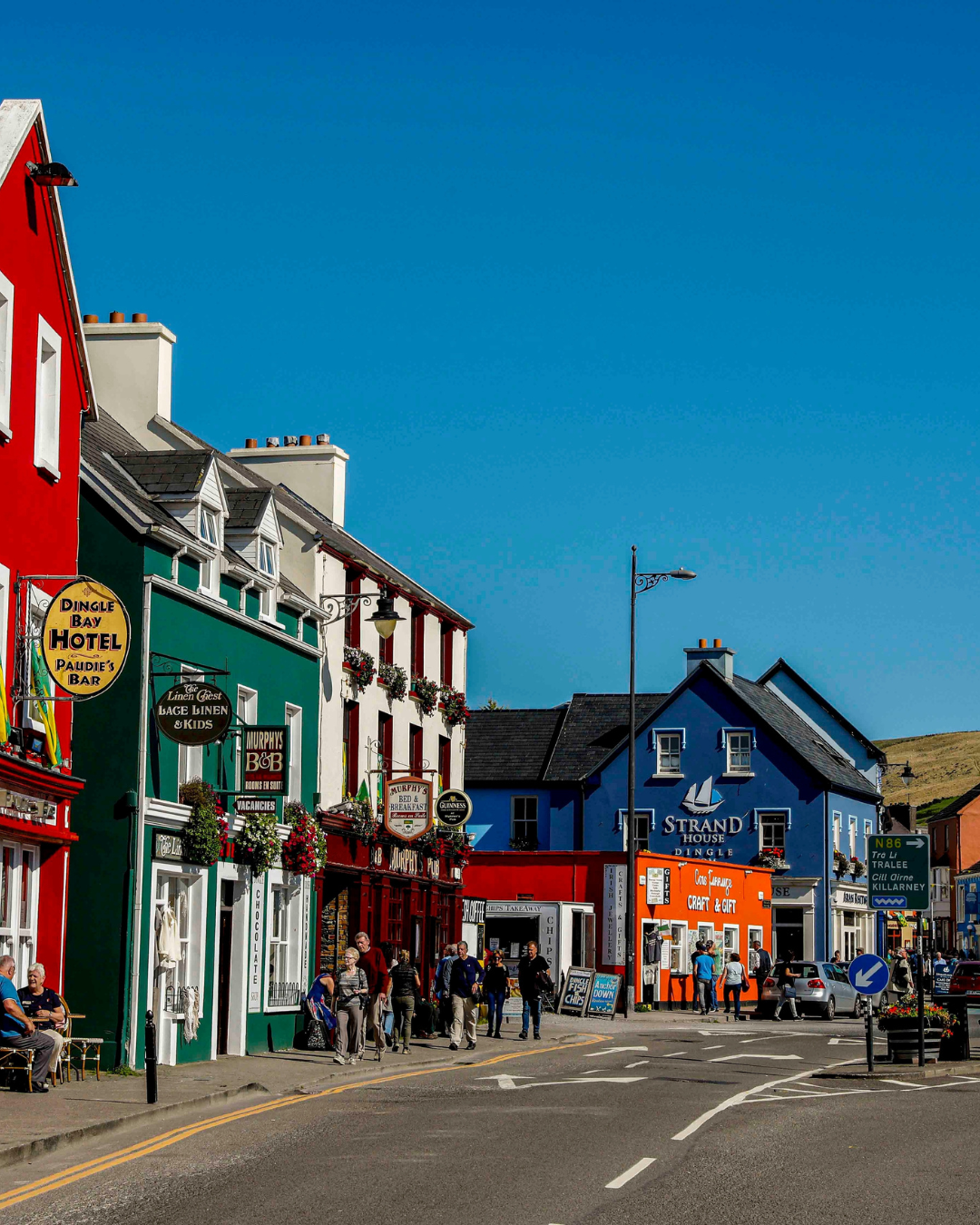
Walk along Strand Street or Main Street and you will see what visitors notice almost immediately: every building is a different colour. Deep red. Sunflower yellow. Cobalt blue. Forest green. Terracotta. No two facades match, and none of them are trying to. That patchwork of colour is not an accident or a marketing scheme. It has roots in Irish commercial and social history, and it tells you a great deal about how towns like Dingle actually worked.
Why Irish Towns Paint Their Buildings
The tradition of painting shopfronts and commercial buildings in bold, individual colours goes back several centuries in Irish towns. Before street numbering became standard, colour was one of the main ways people identified a specific shop or pub. “Meet me at the yellow pub” or “the butcher with the blue door” were practical directions, not poetic ones.
Landlords and business owners maintained their facades to attract customers, and bright colour was a simple, cheap way to stand out. Unlike Britain, where Georgian uniformity was fashionable and white or cream render was common, Ireland’s commercial streets developed in a more ad hoc fashion. Each owner made their own choice, and the cumulative result was the kind of colourful streetscape you see in Dingle today.
The colours you see now are not heritage-protected or enforced by any official body. Each building owner still chooses their own paint. Some have kept the same colour for decades; others have changed it several times. The variety is organic, not curated.
What Makes Dingle’s Streets Worth Slowing Down For
Most visitors to Dingle arrive with a list: Slea Head Drive, Connor Pass, the Blasket Island ferry, Inch Beach. These are all worth doing. But the town itself often gets treated as a quick stop rather than a destination — somewhere to park the car, grab a coffee, and move on.
That is a mistake. Dingle’s streets repay a slower pace.
Take the shopfronts as a starting point. Many of the buildings along Main Street and Strand Street date from the 18th and 19th centuries. The timber-framed windows, the wide pilasters between display windows, and the hand-lettered signage that still survives on some older facades are features that have largely disappeared from Irish town centres elsewhere. In Dingle, they are still functioning commercial premises — butchers, hardware shops, pharmacies — not heritage museum pieces.
The pubs are their own category. Dingle has around 50 pubs for a population of roughly 2,000, which works out at approximately one pub per 40 residents. For more on where to drink in the county, see The Best Pubs in County Kerry. That ratio has historical roots. The town was a significant fishing port and market town for the surrounding peninsula, and pubs served as meeting places, informal banks, and social infrastructure for a largely rural hinterland. Many of the pub interiors have changed little in 50 or 60 years: dark timber, small rooms, open fires in winter.
The Language Behind the Colour
Dingle sits within the Kerry Gaeltacht — one of the Irish-speaking regions where Irish remains in everyday use. The town’s Irish name is An Daingean, meaning “the fortress” or “the stronghold,” a reference to its sheltered harbour position. You will see bilingual signage throughout the town, and in some shops and pubs, Irish is the language of the staff.
This linguistic identity is part of what gives Dingle a distinct character that sets it apart from more tourist-oriented coastal towns. The cultural layer is not performed for visitors. It is simply how the town operates.
Local events — music sessions in the pubs, the Dingle Food Festival in October, the Dingle Film Festival in November — draw heavily on that local identity. The music sessions in particular are not tourist entertainment. They are regular community events that happen to be open to anyone who walks through the door.
What to Look For When You Walk the Streets
A few things worth noticing as you walk through Dingle:
The door details. Many buildings still have their original timber doors with decorative fanlights above. The ironwork — door knockers, letter plates, boot scrapers — varies from building to building and is often original.
The signs. Some of the older shops still carry lettering in gold leaf or painted directly onto the render. These hand-painted signs are becoming rare across Ireland; Dingle still has several.
The variation in scale. Not all the buildings are the same height. Walk along Strand Street and you will see two-storey Victorian buildings next to single-storey cottages next to taller commercial premises. That variation creates the slight irregularity of the roofline that makes Dingle’s streetscape look different from purpose-built tourist towns.
The laneways. Several narrow lanes run off the main streets. These connect to residential areas and back yards. They are worth exploring — quieter than the main streets, and sometimes with interesting detail: a painted wall, a workshop, an unusual door.
Practical Information for Visiting Dingle
Dingle is roughly 4 hours from Dublin by car, taking the N7/N21 route via Limerick or the N7/M7 via Portlaoise. Bus Éireann runs services from Tralee, which is the nearest rail hub. Journey time from Tralee to Dingle by bus is approximately 50 minutes.
The town is compact. The main commercial area — Strand Street, Main Street, and the streets running between them — can be walked comfortably in under 30 minutes. Most of what you would want to see and do is within easy walking distance of the harbour.
Accommodation ranges from B&Bs and guesthouses to a small number of hotels. Booking ahead is essential from June to August; outside those months the town is considerably quieter and rooms are more easily available.
The Dingle Peninsula itself is worth at least two full days. Slea Head Drive is an approximately 47-kilometre loop taking in dramatic coastal scenery, the Fahan beehive huts (clocháns), sea stacks, and views of the Blasket Islands. Coumeenoole Beach — one of the most dramatic stops on the drive — is well worth a longer pause. Connor Pass, at 456 metres the highest mountain pass in Ireland accessible by road, cuts across the spine of the peninsula and gives panoramic views on both sides in clear weather.
Seafood is the thing to eat in Dingle. The town is a working fishing port, and the catch is landed locally. Dingle Pies — a local pastry filled with mutton, traditionally sold at the town’s markets — are worth trying if you find them. Several restaurants source directly from local boats, so the menu changes with what has come in.
Why Dingle Stays With You
Most places that are described as charming turn out to be either ordinary or over-restored. Dingle is neither. It is a working town that happens to look extraordinary, partly by design and partly by accident. The colours on the buildings have accumulated over generations of individual choices. The pubs and shops are there because people need them, not because tourists like them. The Irish language is spoken because it has always been spoken here.
That combination — function plus colour plus language plus setting — is harder to manufacture than it looks. Plenty of Irish towns have tried to replicate the formula by painting their buildings brighter. It rarely works the same way, because the paint alone is not the point. In Dingle, the colour is an expression of something that already exists. That is what you are looking at when you slow down and notice it.
Thinking about it seriously?
If you’ve started actually planning a move, our complete the full Move to Ireland guide walks through every step, every cost, and the paperwork that catches most people out.
Tours & experiences you might love


Powered by Viator. Some links are affiliate links — we may earn a small commission at no extra cost to you.
Secure Your Dream Irish Experience Before It’s Gone!
Planning a trip to Ireland? Don’t let sold-out tours or packed attractions spoil your journey. Iconic experiences like visiting the Cliffs of Moher, exploring the Rock of Cashel, or enjoying a guided walk through Ireland’s ancient past often sell out quickly—especially during peak travel seasons.

Booking in advance guarantees your place and ensures you can fully immerse yourself in the rich culture and breathtaking scenery without stress or disappointment. You’ll also free up time to explore Ireland’s hidden gems and savour those authentic moments that make your trip truly special.
Make the most of your journey—start planning today and secure those must-do experiences before they’re gone!