

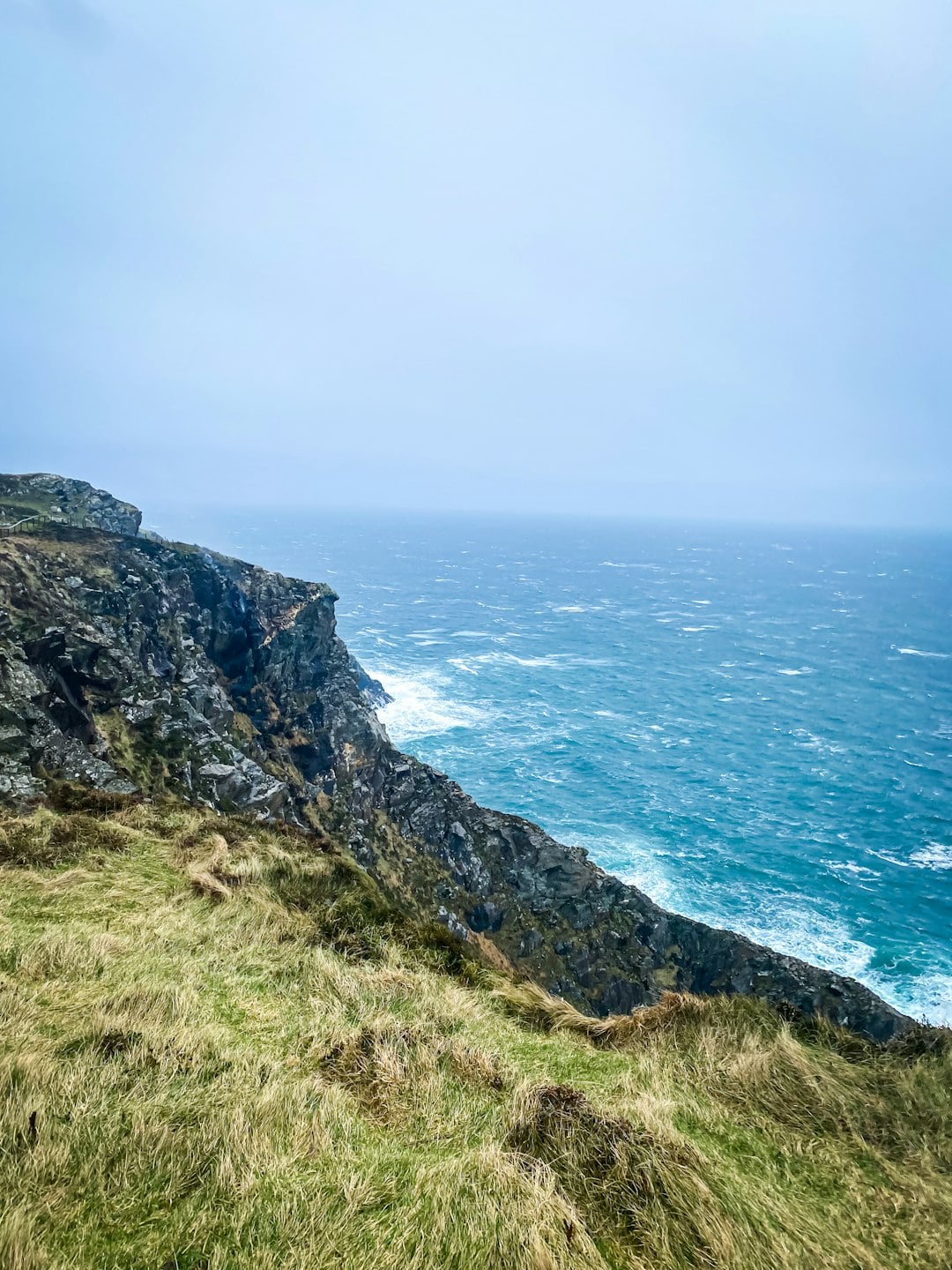
At 601 metres, the cliffs of Slieve League in County Donegal are nearly three times the height of the Cliffs of Moher. They plunge almost sheer into the churning Atlantic, ancient and indifferent. For over a thousand years, people came here on purpose — barefoot, in penance, and in search of something only this edge of the world could give them.
Slieve League: The Cliffs That Dwarf a Kingdom
Most visitors to Ireland never make it to Slieve League. The Cliffs of Moher in Clare take the tourists, the Instagram posts, the postcards. But those who do come to this remote headland in south-west Donegal tend to go quiet when they arrive.
The drop is almost incomprehensible. The water far below looks still from this height, but it is the Atlantic — restless, cold, and ancient. On a clear day, you can see Scotland to the north and the peaks of Connemara to the south. On a bad day, the mist sits so thick that nothing exists beyond the next footstep.
The cliffs were formed over 300 million years ago from quartzite, sandstone, and shale. Their colours shift in the light — purple, green, russet — streaked through with quartz veins that catch the sun like ice. There is nowhere in Ireland quite like them.
Why Pilgrims Climbed Here for a Thousand Years
Slieve League was not just a natural wonder to medieval Irish people. It was sacred ground.
The name comes from the Irish Sliabh Liag, meaning Mountain of the Pillar Stones — a reference to the ancient standing stones and early Christian monuments at its summit. By the sixth century, monks had built a small hermitage near the top. By the medieval period, Slieve League had become one of Ireland’s great pilgrimage destinations, rivalling Croagh Patrick and Lough Derg.
Pilgrims came from across Ireland and beyond. They climbed the steep path known as the Pilgrim’s Road, often in bare feet as a sign of humility and penance. At the summit, they prayed at an ancient oratory called An Eaglais Bheag — the Little Church — a rough stone structure barely big enough for a handful of people at once.
The climb took hours. The path was dangerous. And that, in some sense, was the point. If you are curious about other sacred sites that drew generations of Irish devotees, the holy well tradition tells a similarly moving story of faith woven into the Irish landscape.
One Man’s Pass: The Knife-Edge at the Top
Near the summit, the terrain narrows to something almost impossible.
One Man’s Pass — Bealach Aon Fhir in Irish — is a ridge no wider than a single set of shoulders. On one side, a sheer drop falls to the sea far below. On the other, the land tumbles into a steep valley. In calm weather, it is terrifying. In the Atlantic gales that batter this coast for much of the year, it becomes something else entirely.
Medieval pilgrims crossed this pass as part of their devotion. There was no handrail, no rope, and no easy way back once committed. They moved slowly, one step at a time, their eyes fixed on the narrow path ahead and their prayers fixed on whatever waited at the top.
The ridge is unchanged. Many modern walkers stop short of it. Those who cross tend to remember it for the rest of their lives.
The Ancient Chapel at the Edge of the World
Beyond One Man’s Pass, the ruins of An Eaglais Bheag still stand at around 595 metres above sea level — higher than any inhabited structure in Ireland.
The walls are rough, dry-stone, and have survived centuries of Atlantic storms without mortar to hold them. Inside, there is little shelter. The wind finds every gap. Pilgrims would have rested here, offered prayers, and looked out over the ocean toward a horizon that seemed impossibly far away.
The isolation was the message. This was not a comfortable pilgrimage. It was a reckoning.
What the Cliffs Still Give
The religious pilgrimage to Slieve League has almost entirely disappeared. The path exists now as a walking route rather than a spiritual road. The little church at the top is a ruin open to the wind.
But something of what those barefoot pilgrims felt remains in the climb itself. The effort, the exposure, the moment when the path narrows and the world falls away on both sides — none of that has changed in a thousand years.
People still go quiet at the top. They stand at the edge and look out at the Atlantic and feel something that doesn’t have a simple name.
Slieve League will never be as famous as the Cliffs of Moher. It never will be, and perhaps that is exactly as it should be. For the pilgrims who climbed it in bare feet over the centuries, it was never about fame. It was about arriving at the edge of everything — and not looking away.
For the full practical guide to visiting — including how to get there and what to expect on the walk — see our complete Slieve League visitor guide.
Visiting Slieve League: What to Know
- Park at the Pilgrim’s Path car park above Teelin village, Co. Donegal
- The Pilgrim’s Path is roughly 3km one-way (2–3 hours return), graded strenuous
- One Man’s Pass is not an official trail — inexperienced walkers, anyone unsteady on their feet, or hikers in poor weather should take the longer, safer route that bypasses the ridge
- Check the forecast before setting out; the summit is frequently shrouded in mist
If you are planning a visit to County Donegal, the complete Ireland planning guide has everything you need to make the most of this extraordinary corner of the island. And for another glimpse of the wild, dramatic west, the story of Achill Island’s abandoned village is equally unforgettable.
Love Ireland? So do 65,000 of us.
Join the Love Ireland newsletter — free stories of Irish heritage, hidden gems, and the magic of the Emerald Isle delivered to your inbox.
☘️ Want More Hidden Ireland?
Join 64,000+ subscribers who discover Ireland’s best-kept secrets every week.
Subscribe Free — Join the Community →
Free forever · Unsubscribe anytime · No spam
📥 Free Download: Ireland Travel Planning Guide
Our most popular resource — itineraries, insider tips, and the 50 places you must not miss.
Tours & experiences you might love


Powered by Viator. Some links are affiliate links — we may earn a small commission at no extra cost to you.
Secure Your Dream Irish Experience Before It’s Gone!
Planning a trip to Ireland? Don’t let sold-out tours or packed attractions spoil your journey. Iconic experiences like visiting the Cliffs of Moher, exploring the Rock of Cashel, or enjoying a guided walk through Ireland’s ancient past often sell out quickly—especially during peak travel seasons.

Booking in advance guarantees your place and ensures you can fully immerse yourself in the rich culture and breathtaking scenery without stress or disappointment. You’ll also free up time to explore Ireland’s hidden gems and savour those authentic moments that make your trip truly special.
Make the most of your journey—start planning today and secure those must-do experiences before they’re gone!