

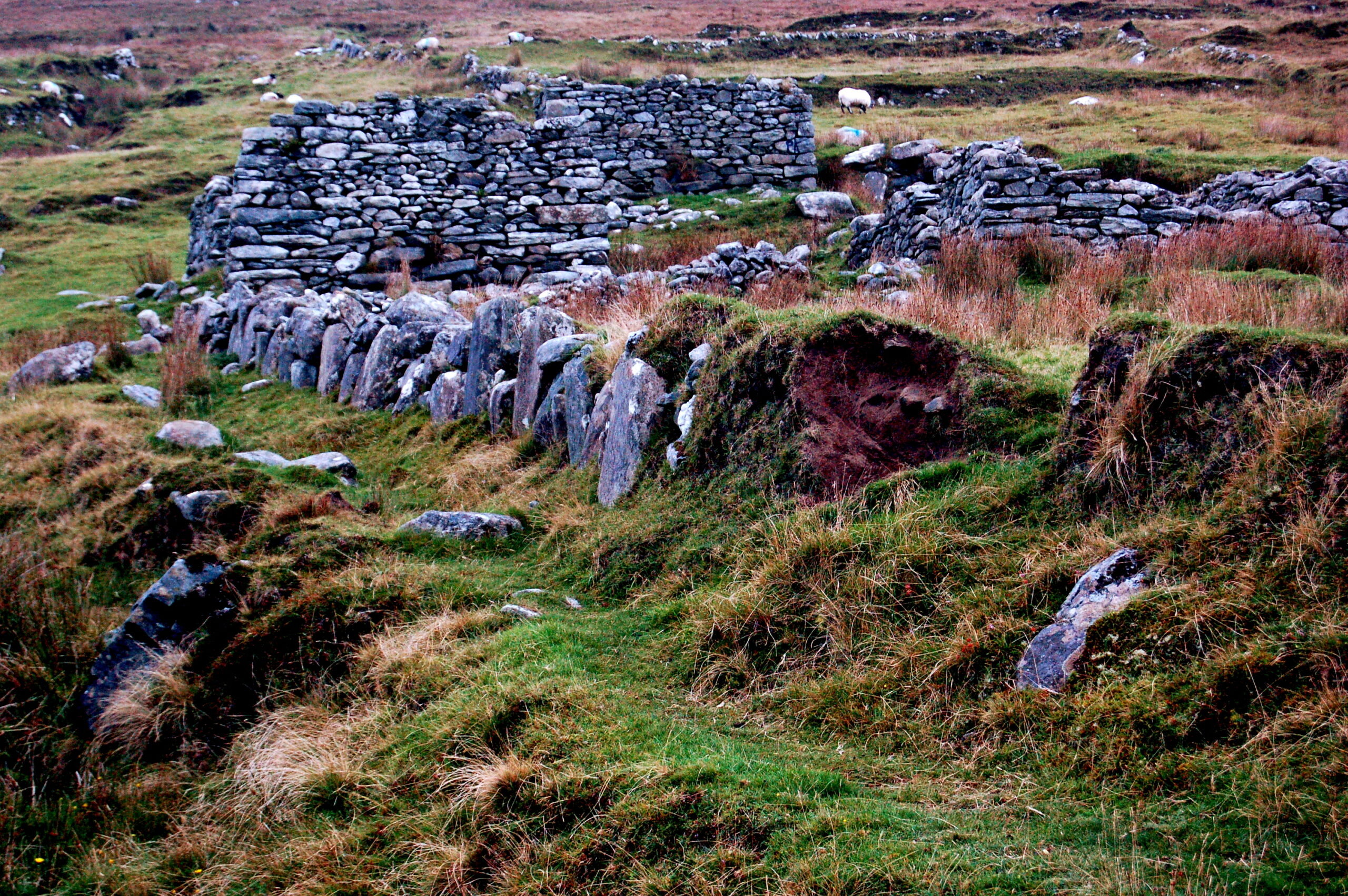
You hear it before you see it. Or rather, you don’t hear anything at all. On a hillside above the Atlantic, row after row of roofless stone cottages stretch across the slope — over a hundred of them — their walls still standing, their hearths cold for nearly 200 years. Slievemore Deserted Village on Achill Island is one of the most quietly devastating places in Ireland, and it appears on almost no tourist trail.
A Village That Stood for a Thousand Years
The settlement below Slievemore Mountain is not a recent loss. Archaeological evidence suggests people lived on this hillside for over 5,000 years. The ruins you see today are mostly from the 18th and 19th centuries — dry-stone cottages built low against the mountain, their doors facing downhill toward the sea.
At its peak, around a hundred families called this place home. They fished, farmed, and practised “booley” farming — a seasonal tradition of moving cattle to highland pastures in summer and returning to valley farms in winter. The village was never entirely fixed in place; it breathed with the seasons.
What the Famine Did — and Didn’t Do
It is tempting to call Slievemore a Famine village, and in part it is. The Great Famine of 1845–1852 devastated Achill Island as it did every corner of the west of Ireland. Families who had survived for generations found themselves with nothing. Some emigrated. Some died. Some simply never returned to the mountain.
But the story is more complicated than a single catastrophe. Many scholars believe the village was already in slow decline before the Famine, as people moved toward the coast for easier access to fishing and trade. The Famine did not create the silence — it sealed it.
Walking Among the Walls
There are no signs at Slievemore. No visitor centre, no gift shop, no laminated information boards. You park at the end of a narrow road, walk a short distance, and then the village appears around you.
The cottages are small — perhaps five metres by three — with thick walls that have survived two centuries of Atlantic storms. Nettles grow where families once cooked. Ferns push through doorways. The mountain rises directly behind, and below, the blue-grey waters of Blacksod Bay stretch west toward America.
Most visitors go quiet within moments of arriving. It is not one cottage, not three, but over a hundred — and that scale makes the loss feel enormous in a way that no monument ever could.
The Tradition That Never Fully Left
What surprises many visitors is that Slievemore was never completely abandoned. Even after the permanent residents left, local farmers continued the ancient booley tradition — using some of the old cottages as summer shelters when moving their cattle to the highland pastures.
As recently as the 1940s, families were still spending summer months on the hillside, keeping a rhythm alive that their ancestors had followed for centuries. The fires had gone out. But the connection had not.
How to Find It
Slievemore Deserted Village sits at the north end of Achill Island, reached by following signs toward Dugort village. From the small car park at the base of the mountain, it is a short, easy walk on a gravel track to reach the first cottages.
Visit early morning or late evening, when the light is low and golden and the hillside is likely to be yours alone. On a clear day, the views across Blacksod Bay are extraordinary. If you are making a wider loop of the island, the Atlantic Drive on Achill Island takes you along one of Ireland’s most dramatic coastal roads — a worthy companion to a morning at Slievemore.
For everything you need to plan a broader trip to Ireland, our Ireland travel planning guide is the place to start.
There are places in Ireland that feel like they belong to another time entirely. Slievemore is one of them. The walls are still standing. The mountain is still there. And on a quiet morning when the mist is low and the sea is silver below, it does not feel like 170 years have passed at all.
☘️ You Might Also Love
64,000 Ireland lovers can’t be wrong.
Every week, our free newsletter delivers hidden gems, seasonal guides, local stories, and practical travel tips — straight to your inbox. Join the community that loves Ireland as much as you do.
☘️ Want More Hidden Ireland?
Join 64,000+ subscribers who discover Ireland’s best-kept secrets every week.
Subscribe Free — Join the Community →
Free forever · Unsubscribe anytime · No spam
📥 Free Download: Ireland Travel Planning Guide
Our most popular resource — itineraries, insider tips, and the 50 places you must not miss.
Tours & experiences you might love


Powered by Viator. Some links are affiliate links — we may earn a small commission at no extra cost to you.
Secure Your Dream Irish Experience Before It’s Gone!
Planning a trip to Ireland? Don’t let sold-out tours or packed attractions spoil your journey. Iconic experiences like visiting the Cliffs of Moher, exploring the Rock of Cashel, or enjoying a guided walk through Ireland’s ancient past often sell out quickly—especially during peak travel seasons.

Booking in advance guarantees your place and ensures you can fully immerse yourself in the rich culture and breathtaking scenery without stress or disappointment. You’ll also free up time to explore Ireland’s hidden gems and savour those authentic moments that make your trip truly special.
Make the most of your journey—start planning today and secure those must-do experiences before they’re gone!