

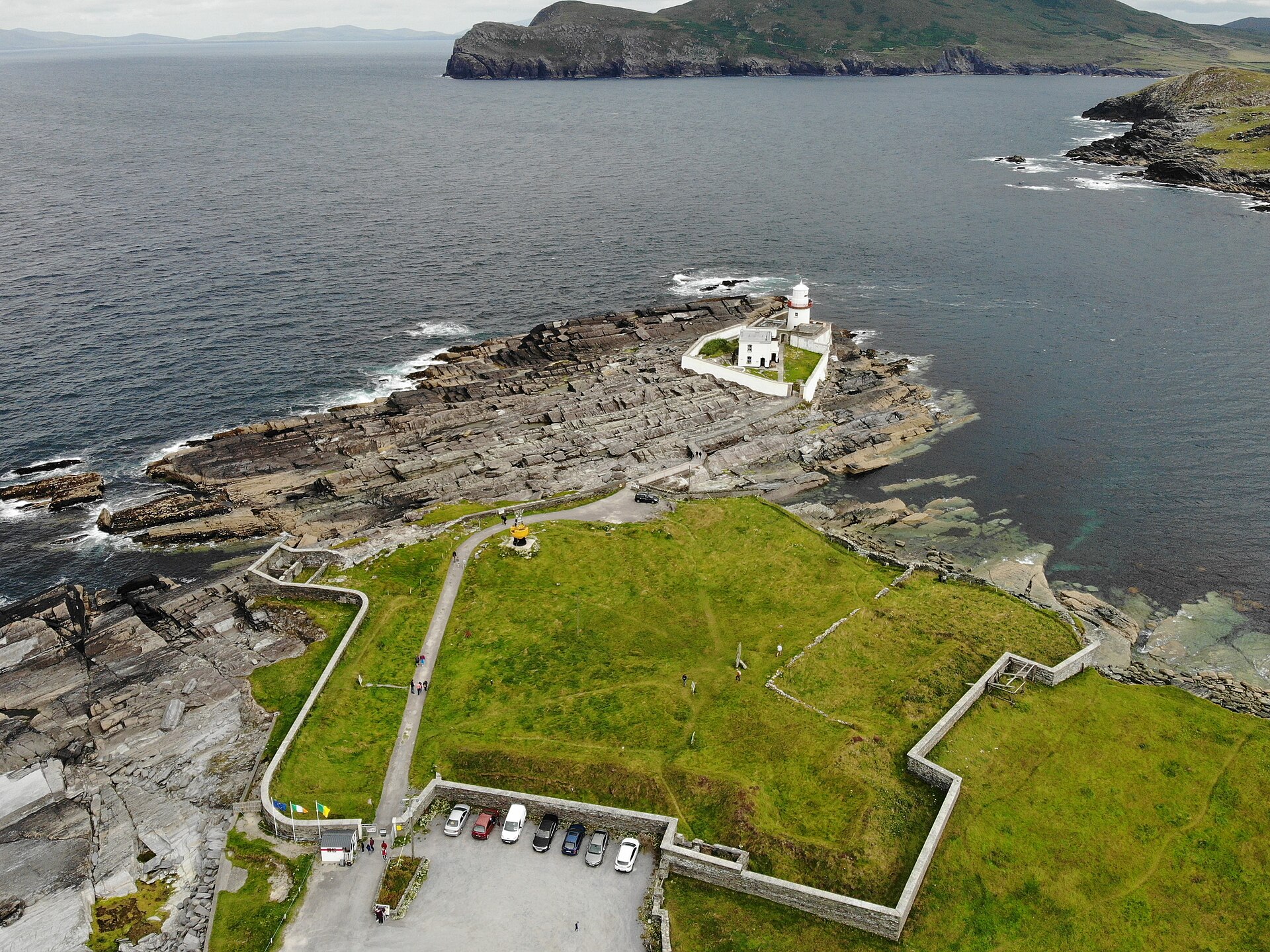
On the morning of 5 August 1858, a ship called HMS Agamemnon manoeuvred into the harbour at Knightstown on Valentia Island, County Kerry, and began feeding a cable ashore. The cable ran back across the Atlantic — nearly two thousand miles of copper wire wrapped in gutta-percha and iron — to a beach in Newfoundland, where another ship had been doing the same thing from the other end. When the two ends were connected, human beings would, for the first time in history, be able to send a message from Europe to North America in something faster than the weeks it took a ship.
This is the moment the modern world started. And it started in a sheep-farming village on an island off the coast of Kerry.
What happened next is either a story of heroic persistence or a cautionary tale about what happens when the wrong man is put in charge of a piece of equipment he doesn’t understand — depending on how generously you feel toward Wildman Whitehouse, the electrician who almost singlehandedly broke the nineteenth century’s most expensive engineering project.
The Man Who Wanted to Wire the Ocean
Cyrus Field was a New York paper manufacturer who had retired at the age of thirty-three with $250,000 in the bank and, apparently, no intention of staying retired. By 1854 he had decided, with the particular confidence of a self-made American businessman, that what the world needed was a telegraph cable running across the floor of the Atlantic Ocean. He was not an engineer. He was not a scientist. He was a promoter, an organiser, a man who could look at an impossible project and see not the obstacles but the cheques that needed signing.
Field had the sense to recruit people who did understand the technical side. Among them was William Thomson, a Scottish physicist who would later become Lord Kelvin and whose portrait graces every physics textbook. Thomson had worked out how electrical signals behaved in long undersea cables — they degraded, spread out, blurred — and he understood that the solution was not to shout louder (higher voltage) but to listen more carefully. He developed a mirror galvanometer, an instrument so sensitive it could detect the faint whisper of a signal that had crossed a thousand miles of saltwater, making it readable at the far end without amplification.
Valentia Island was chosen as the European terminus because it is, very nearly, the closest point in Europe to North America. The island sits at the mouth of Dingle Bay, accessible by ferry from Renard Point near Cahersiveen, on the Ring of Kerry, and in 1858 it was the kind of place where almost nothing ever happened. That was about to change.
Sixteen Hours for Ninety-Eight Words
☘️ Join 64,000+ Ireland Lovers
Every weekday morning, get Ireland’s hidden gems, local secrets, and travel inspiration — the kind you won’t find in any guidebook.
Subscribe free — enter your email:
Already subscribed? Download your free Ireland guide (PDF)
📲 Know someone who’d love this? Share on WhatsApp →
Free forever · Unsubscribe anytime
The 1858 expedition required two ships — HMS Agamemnon on the European side and USS Niagara on the American — because no single vessel in existence was large enough to carry the full length of cable. They sailed to the middle of the Atlantic, spliced their two sections of cable together, and headed in opposite directions: Niagara toward Newfoundland, Agamemnon toward Kerry.
The cable landed at Valentia on 5 August 1858. Test traffic began on 10 August. And on 16 August 1858, Queen Victoria sent a message to President James Buchanan. The message was ninety-eight words long.
It took sixteen hours and some minutes to arrive.
That works out to more than ten minutes per word. The transmission speed of the 1858 cable was roughly one-tenth of a word per minute — two minutes for a single character. The message Queen Victoria sent expressed “sincere wishes for the welfare of the United States” and her hopes that the cable would “prove an additional link between the nations whose friendship is founded upon their common interest and reciprocal esteem.” By the time Buchanan read the whole thing, a good part of a day had passed.
Still: it was a message that had crossed the Atlantic. People in London and New York went briefly mad with celebration. Newspapers ran special editions. City officials in New York accidentally set the City Hall cupola on fire with the fireworks.
Then the cable transmitted 731 more messages — 732 in total — and stopped working entirely.
The Man Who Killed It
The chief electrician of the Atlantic Telegraph Company was a man named Edward Orange Wildman Whitehouse, and his relationship to the cable is one of history’s more instructive lessons in the dangers of professional overconfidence.
Whitehouse had a theory. When signals came through the cable weak and garbled, he believed the answer was more power — specifically, much more power. Where Thomson’s approach used sensitive detection instruments to read faint low-voltage signals, Whitehouse preferred simply blasting higher voltage down the wire until the signal at the other end was impossible to miss. He applied up to 2,000 volts to the cable using large induction coils.
The problem with 2,000 volts passing through a copper wire surrounded by a thin layer of gutta-percha insulation is that gutta-percha, however excellent it may be for waterproofing, has limits. Whitehouse’s repeated high-voltage blasts degraded the insulation from the inside. By September 1858 — probably a few weeks after the Queen’s message, though the exact date remains disputed in the historical record — the signal through the cable had declined to nothing. The cable was dead.
An 1861 board of inquiry into the failure pointed its finger squarely at Whitehouse. His excessive voltage use was identified as the primary cause of the insulation breakdown.
There was, it turned out, a secondary cause that Whitehouse could not be blamed for. Physical examination of recovered specimens of the 1858 cable found that the copper core had not been properly centred within its gutta-percha insulation. In places, the core lay dangerously close to the outer metal covering — a manufacturing defect that left the cable vulnerable to failure even before Whitehouse had touched it. The cable that came ashore in Kerry in August 1858 was, essentially, already compromised before a single message had been sent.
The Ship That Changed Everything
There was no way back from the 1858 failure in the short term. The Atlantic Telegraph Company had spent a staggering sum, and the cable lay useless on the ocean floor. Field returned to New York, regrouped, raised more money, and began again.
The 1865 expedition attempted another crossing. The Great Eastern — the largest ship then afloat, and the only vessel in the world capable of carrying the full 2,600-mile cable in a single hold — got more than halfway across before the cable snapped and disappeared to the bottom of the ocean. The expedition retreated.
In July 1866, they tried again.
The Great Eastern left Valentia Island on 13 July 1866 and made for Heart’s Content, Newfoundland. She covered approximately 1,686 nautical miles at around 120 miles per day, paying out cable the entire way. On 27 July 1866 — fourteen days after leaving Kerry — the cable came ashore in Newfoundland. This time it worked. And then the crew did something extraordinary: they sailed back out into the Atlantic to the spot where the 1865 cable had snapped the year before, where a buoy had been left to mark the position. They grappled in the deep water until they hooked the broken end of the 1865 cable, hauled it aboard, and spliced fresh cable to it. Within weeks, they had not one but two working transatlantic telegraph cables.
The speed comparison tells you everything. The 1858 cable had transmitted at roughly 0.1 words per minute. The 1866 cable could handle 8 words per minute — eighty times faster. A message that would have taken sixteen hours to send in 1858 could now be transmitted in a fraction of the time.
What It Was Actually Worth
In practice, the cable was not an instrument for ordinary people. The initial rate in 1866 was ten dollars per word, with a ten-word minimum — meaning the cheapest possible message cost a hundred dollars, at a time when a skilled worker might earn that in ten weeks of labour. About ninety percent of early cable traffic came from governments and large businesses. Everyone else simply couldn’t afford it.
The commercial world adapted fast. Companies developed elaborate codebooks in which a single agreed word could stand for an entire sentence — “ALBATROSS” might mean “we accept your offer at the price quoted, deliver as soon as possible” — to compress expensive cable traffic into the minimum number of billable characters.
Shortly after the 1866 cable opened, it was handling around fifty messages a day. In a single three-month period in 1867, it transmitted 2,772 commercial messages and generated about $2,500 in daily revenue. That sounds substantial until you learn that it represented roughly five percent of the cable’s theoretical capacity. The infrastructure was there; the customers with the resources to use it were, initially, scarce.
But the world was changing around the cable, not just because of it. A French company laid a competing transatlantic cable in 1869, which drove prices down and volumes up. By 1900, fifteen cables crossed the Atlantic. The Valentia terminus that had been an implausible engineering outpost in 1858 had become, over the course of a few decades, part of the circulatory system of global commerce.
What Remains in Knightstown
Valentia Island today is still reached by the ferry from Renard Point, or by the bridge from Portmagee, the gateway to Skellig Michael. It is small, unhurried, and far enough from the main tourist routes that the scale of what happened here remains slightly astonishing.
In Knightstown, the island’s main village, the white-painted buildings of the original cable station still stand along the main street, marked by commemorative plaques. The Valentia Heritage Centre holds original telegraph equipment and cable materials from the station’s working era. At the southwestern end of the island, near Bray Head, the Telegraph Field — where the 1865 and 1866 cables came ashore at Foilhommerum Bay, superseding the original 1858 landing site at Knightstown — is accessible via a designated parking area, a field that looks like any other Kerry field except for what once ran through it.
A Valentia Transatlantic Cable Foundation, established in 2016, has been working toward UNESCO World Heritage status for the site — a designation that would formally recognise Valentia’s place in the history of global communication. The application frames it well: the island is, as they put it, the birthplace of global telecommunications.
That is not an overstatement. In 1866, when the Great Eastern sailed away from Valentia Island trailing two thousand miles of cable behind her, the world had not yet found a way to talk to itself in real time. Within a month, it could. The conversation has not stopped since.
There is something quietly satisfying about the fact that it started here — not in London, not in New York, not in any city that might reasonably expect to matter in such a story, but on a small island off the Kerry coast, where the land runs out and the Atlantic begins, and where a ship once arrived with a wire that connected two worlds.
Tours & experiences you might love


Powered by Viator. Some links are affiliate links — we may earn a small commission at no extra cost to you.
Secure Your Dream Irish Experience Before It’s Gone!
Planning a trip to Ireland? Don’t let sold-out tours or packed attractions spoil your journey. Iconic experiences like visiting the Cliffs of Moher, exploring the Rock of Cashel, or enjoying a guided walk through Ireland’s ancient past often sell out quickly—especially during peak travel seasons.

Booking in advance guarantees your place and ensures you can fully immerse yourself in the rich culture and breathtaking scenery without stress or disappointment. You’ll also free up time to explore Ireland’s hidden gems and savour those authentic moments that make your trip truly special.
Make the most of your journey—start planning today and secure those must-do experiences before they’re gone!