

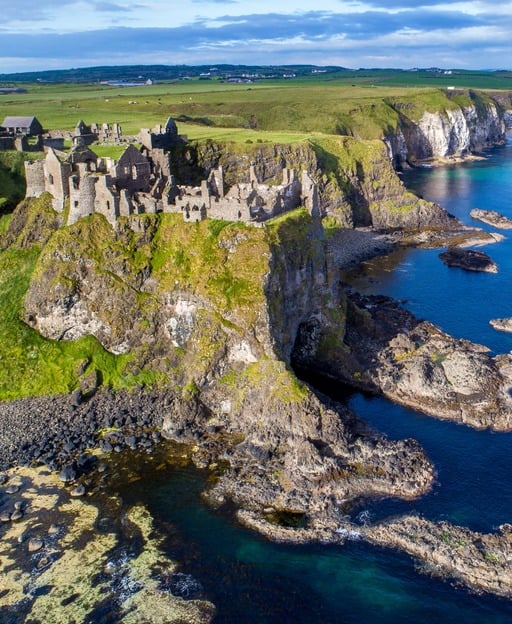
Dunluce Castle sits on a basalt cliff on the Antrim coast of Northern Ireland. Three sides of the promontory drop straight into the sea. The only way in or out is a narrow bridge cut across a gap in the rock. When you stand here in winter, with the Atlantic pushing waves against the cliff base sixty feet below, it is easy to understand how this place built its legends.
One of the most enduring is the story of Maeve Roe MacQuillan. According to local tradition, she was locked in the castle’s North Tower by her own father and never left. That was more than four hundred years ago. Some say she is still there.
Love stories like this? Subscribe free to the Love Ireland newsletter and we’ll send Ireland’s best history, heritage and travel stories straight to your inbox every week.
Who Were the MacQuillans?
The MacQuillan family controlled a large stretch of the north Antrim coast from the late medieval period. They were one of the most powerful Gaelic Irish families in Ulster, and Dunluce was their seat of power. The castle had been built on a site with strategic value for centuries. From the clifftop, defenders could see ships approaching across the North Channel. The rock it sits on is almost entirely surrounded by water, making it one of the most defensible positions in Ireland.
By the sixteenth century, the MacQuillans were losing their grip on the region. A Scottish clan, the MacDonnells, had been crossing from the Hebrides and settling along the Antrim coast. The two families clashed repeatedly. Eventually the MacDonnells took Dunluce for themselves. The MacQuillans never recovered their former power.
It was during this period of pressure and decline that Maeve Roe’s story is said to have taken place.
Why Her Father Locked Her Away
Accounts of the legend vary in the details, but the most consistently told version identifies Maeve Roe as the daughter of Rory Og MacQuillan, the last MacQuillan chief before the clan lost Dunluce to their rivals, the MacDonnells. Maeve fell in love with Reginald Og MacDonnell — in some tellings called Reginald O’Cahan — son of the very clan that had taken her family’s castle and power. To her father, the match was intolerable: a MacQuillan daughter bound to the son of the men who had ended his family’s rule.
Rory Og had other plans for his daughter. At a time when a high-born woman’s marriage was a political arrangement first and a personal matter second, Maeve’s choice was more than a romantic problem. It was a direct betrayal of her father’s authority and what remained of his family’s standing.
His response was to lock her in the North Tower.
This was not an unusual punishment for the time. Confining a disobedient daughter in a castle tower was a recognised, if brutal, form of control. In the version of the story told most often today, Maeve did not simply wait it out — on a stormy night, Reginald came for her, and the two tried to escape by rowing boat from the sea cave beneath the castle now known as Mermaid’s Cave. The boat was overwhelmed and both drowned. Other, quieter tellings end differently: she remained in the tower and never saw Reginald again.
The North Tower and What Remains
The North Tower at Dunluce still stands, or at least part of it does. The castle as a whole is a ruin today, managed by the Northern Ireland Environment Agency and open to the public. Significant portions of the structure survive, and the site gives a strong sense of what the castle must have looked like in its operational years.
The tower where Maeve Roe is said to have been imprisoned sits on the northern edge of the site, with direct views out over the sea. In winter, the wind off the water is sharp enough to cut through clothing. In that context, the cruelty of confinement here is not difficult to imagine.
Local guides and folklore collectors have documented accounts from visitors and locals who report a sense of unease in and around the tower. Some describe sounds — a rustling, a shift in the air — with no obvious source. These are the kinds of stories that attach themselves to places with violent histories, and Dunluce has had more than its share of those.
Love stories like this? Subscribe free to the Love Ireland newsletter and we’ll send Ireland’s best history, heritage and travel stories straight to your inbox every week.
A Castle With a Violent History
Maeve Roe’s story is one of several dark chapters in Dunluce’s long history. In 1639, part of the kitchen wing collapsed into the sea during a dinner. Several servants died. The MacDonnell countess who lived there at the time refused to spend another night in the castle after that, and the building began its long slide towards ruin.
Before that, in 1584, Lord Deputy Sir John Perrott captured Dunluce briefly on behalf of the English Crown. And in 1588, the Spanish Armada ship Girona wrecked on the rocks nearby, and its cannons were salvaged and used to fortify the castle. The site absorbed four centuries of conflict, grief, and upheaval.
Maeve Roe is remembered because her story is personal: a young woman, a locked door, a view of the sea she could not reach.
Is There Historical Evidence?
The honest answer is: it depends on how strictly you define evidence.
There is no document from the period that records Maeve Roe’s imprisonment in the way a court record or letter might. The MacQuillan family left relatively few written records, which was typical for Gaelic Irish families of the period, whose tradition was predominantly oral.
What we do have is a persistent oral tradition that has been recorded by folklore collectors from at least the nineteenth century. The story appears in accounts of Ulster legend and in local histories of County Antrim. The name Maeve Roe — meaning “Red Maeve” in Irish — suggests a specific individual with red hair, a level of detail that tends to indicate a real person was remembered, even if the story around them has been shaped over generations.
Historians treat the legend as probably containing a historical core. The MacQuillan family was real. The power dynamics that would have made such an imprisonment possible were real. Whether it happened exactly as described is impossible to confirm.
Visiting Dunluce Castle Today
Dunluce Castle is on the A2 coast road between Portrush and Bushmills in County Antrim, Northern Ireland. It is just under three hours by road from Dublin and around an hour from Belfast.
The castle is open to visitors most of the year, with seasonal hours. Admission costs around £5 to £6 for adults. The visitor centre on site has exhibits on the history of the castle and the surrounding area, including the MacDonnell period when the site was at its most powerful.
The approach from the car park involves crossing the narrow bridge over the gap in the rock — the same path that everyone who entered or left this castle used for centuries. The North Tower is accessible within the ruins. There is no interpretive sign specifically marking it as Maeve Roe’s prison; her story is part of the guided tour narrative and the wider oral history of the site.
The castle is also close to the Giant’s Causeway, about ten minutes by road. Most visitors combine the two in a single day. The coastal road between Portrush and the Causeway is worth taking slowly.
Why Dunluce Stays in the Memory
There are more picturesque castles in Ireland. There are castles with longer histories and better-preserved architecture. What Dunluce has is something harder to define — a sense of position and exposure that most ruins do not carry.
Standing on the clifftop on a clear day, you can see Scotland. On a stormy day, the noise of the sea below is constant and close. The castle did not grow elegant with age. It got stranger and more dramatic as it decayed, each fallen wall and open roofline making it look more like the edge of the world.
Maeve Roe MacQuillan’s story endures because the place invites it. A young woman locked in a tower with nothing but that view — it is a story that fits the landscape. Whether or not every detail is accurate, it captures something true about what this place was, and what it put people through.
Love stories like this? Subscribe free to the Love Ireland newsletter and we’ll send Ireland’s best history, heritage and travel stories straight to your inbox every week.
Thinking about it seriously?
If you’ve started actually planning a move, our complete the full Move to Ireland guide walks through every step, every cost, and the paperwork that catches most people out.
Tours & experiences you might love


Powered by Viator. Some links are affiliate links — we may earn a small commission at no extra cost to you.
Secure Your Dream Irish Experience Before It’s Gone!
Planning a trip to Ireland? Don’t let sold-out tours or packed attractions spoil your journey. Iconic experiences like visiting the Cliffs of Moher, exploring the Rock of Cashel, or enjoying a guided walk through Ireland’s ancient past often sell out quickly—especially during peak travel seasons.

Booking in advance guarantees your place and ensures you can fully immerse yourself in the rich culture and breathtaking scenery without stress or disappointment. You’ll also free up time to explore Ireland’s hidden gems and savour those authentic moments that make your trip truly special.
Make the most of your journey—start planning today and secure those must-do experiences before they’re gone!