

Stand anywhere in the Irish midlands or west, look across a crumbling estate wall, and you might spot it. The empty shell of a great house. No roof. Windows like dark eyes. Ivy eating the stonework year by year.
These are not ancient castles. They are much younger than that. And the story of how they ended up in ruin is one of the most dramatic in all of Irish history.
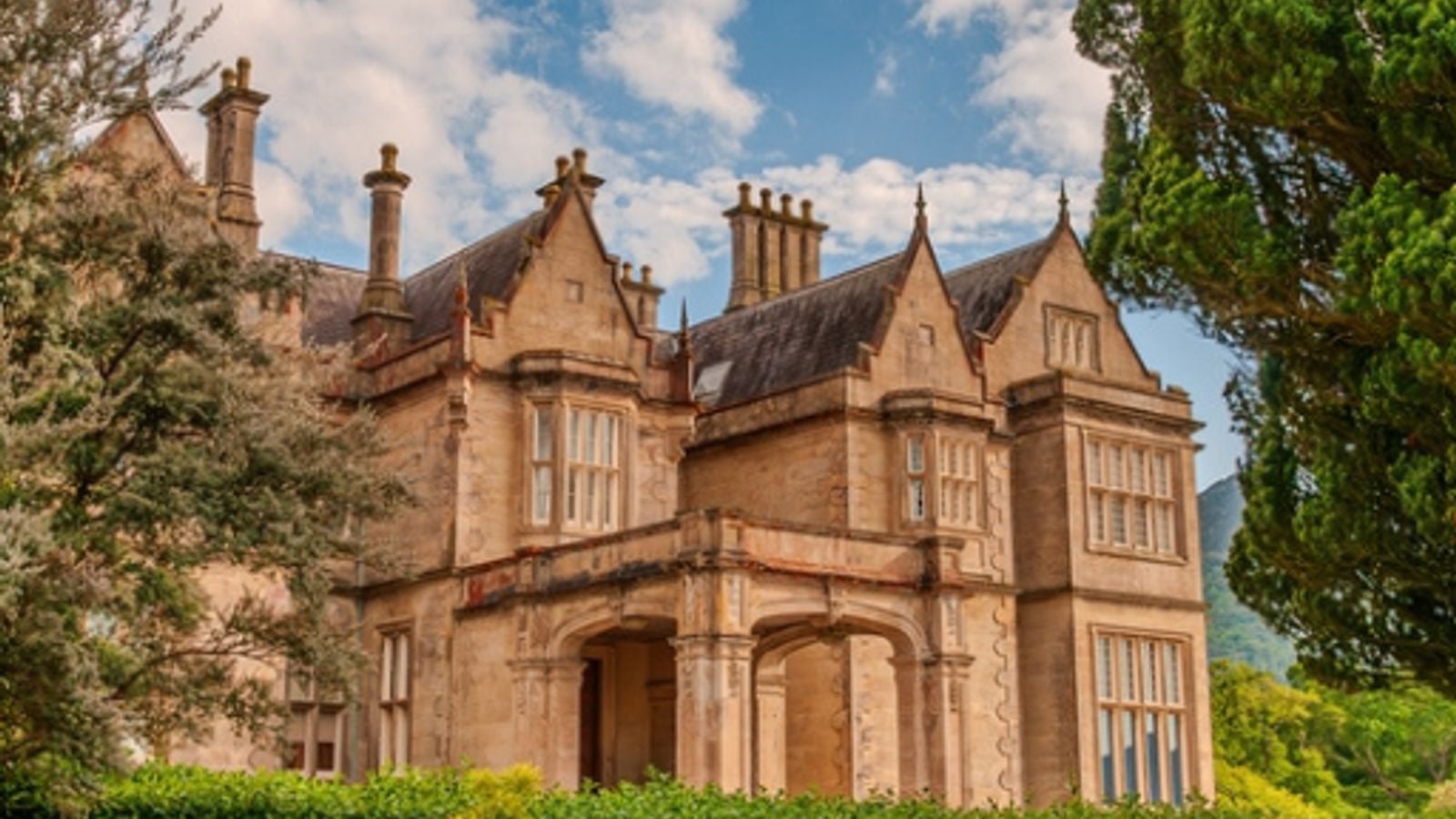
The World Behind the Walls
For more than two centuries, Ireland’s countryside was shaped by the Big House. These were the estates of the Anglo-Irish — Protestant families descended from English and Scottish settlers who arrived in the wake of the Cromwellian wars of the 1650s.
By the 1800s, there were perhaps 2,000 of them across the island. Grand Georgian and Victorian facades. Drawing rooms hung with oil portraits. Walled kitchen gardens feeding a household of thirty. Acres of parkland stretching away from every window, broken only by the distant shimmer of a lake or the grey line of a ha-ha wall.
For the tenant farmers who worked the land around them, the Big House was the centre of their world — and not always a benevolent one. Rent days, evictions, clearances. The distance between the drawing room and the cottage doorstep measured in far more than yards.
What the Land War Changed
The 1870s and 1880s brought the Land War — a mass movement of tenant farmers demanding fair rent and the right to own the land they worked. Over the following decades, a series of Land Acts allowed tenants to buy their holdings at government-assisted prices.
One by one, the great estates began to shrink. Demesnes sold off. Thousands of acres transferred from landlord to farmer. The gentry’s economic power was quietly hollowed out from beneath them.
But the houses remained. Many families stayed on, trying to adapt — farming the home land themselves, cutting the household staff from twenty to five, tentatively opening their gates. They were caught between two worlds: Irish by birth and upbringing, but seen by many as the visible face of colonial rule.
The Burning Years
When the War of Independence began in 1919, the Big Houses became targets. Between 1919 and 1923 — through the War of Independence and then the bitter Civil War that followed — more than 300 great houses were burned across Ireland.
Some were burned by the IRA as deliberate military operations, cutting off British forces who used them as barracks or billets. Others went up in the turbulent months of the Civil War, when old land grievances were settled under cover of politics. The line between military necessity and the settling of ancient scores was rarely clear.
The burnings often happened at night. A knock on the door. Time to leave. Then the torches and the petrol, and by morning, only walls and the sky where the roof had been.
☘️ Enjoying this? 64,000+ Ireland lovers get stories like this every week. Subscribe free →
Left to Crumble
The families who lost their houses rarely rebuilt. Some left Ireland for England, Australia, or South Africa, never to return. Others moved into the gate lodge or a nearby town and did not look back.
The shells were left where they stood — too expensive to demolish, too painful to restore, too complicated to sell. Over the following century, the trees grew up through the floors. The gardens went wild. The estate walls became home to foxes and jackdaws and the slow patient work of ivy.
Today, you find them all across the country. Sometimes announced by a crumbling entrance gate on a back road. Sometimes glimpsed through a curtain of trees — a roofless Georgian facade, three storeys high, rising from the briars with something almost noble about it. Counties Roscommon, Westmeath, Offaly, and Cork have particularly fine examples.
What You Can Still Visit
Not every Big House was lost. Some were spared through personal connections, or because local people stepped in to protect them. Others became convents, schools, or country hotels in the decades that followed independence.
A handful are now open as heritage sites and worth going well out of your way for. Strokestown Park’s famine museum in County Roscommon is one of the finest — its walled garden and servants’ quarters preserved almost intact, with a famine museum on site that puts the whole story into sharp and uncomfortable relief. Bantry House and Gardens in Cork still has the family living in part of it while the state rooms are open to visitors. Muckross House in Killarney National Park is another fine survivor — well worth the visit.
In County Mayo, Westport House remains one of the most complete examples of a working Irish estate open to the public. If you are planning to explore Ireland’s hidden history more broadly, the Ireland travel planning guide is a good starting point — many of the best surviving Big Houses lie well off the main tourist routes.
A Story Without Easy Verdicts
History does not offer simple judgements here. The Anglo-Irish were Irish too — born here, often deeply in love with the country, and sometimes contributing enormously to its literature and culture. Yeats, Swift, Burke, Maria Edgeworth, and Somerville and Ross all came from this world.
The tenant families who worked the land around those great houses had often suffered real hardship under the landlord system. The burnings were the violent end of a social order built on conquest. And yet the houses themselves, with their beautiful proportions and hand-cut stonework, were innocent of all of that.
Walk the overgrown terraces of a ruined Big House today and you feel both things at once. The beauty. And the grief. And the quiet sense that Ireland is still, in some rooms of its memory, working out what to do with all of it.
☘️ You Might Also Love
Tours & experiences you might love


Powered by Viator. Some links are affiliate links — we may earn a small commission at no extra cost to you.
Secure Your Dream Irish Experience Before It’s Gone!
Planning a trip to Ireland? Don’t let sold-out tours or packed attractions spoil your journey. Iconic experiences like visiting the Cliffs of Moher, exploring the Rock of Cashel, or enjoying a guided walk through Ireland’s ancient past often sell out quickly—especially during peak travel seasons.

Booking in advance guarantees your place and ensures you can fully immerse yourself in the rich culture and breathtaking scenery without stress or disappointment. You’ll also free up time to explore Ireland’s hidden gems and savour those authentic moments that make your trip truly special.
Make the most of your journey—start planning today and secure those must-do experiences before they’re gone!